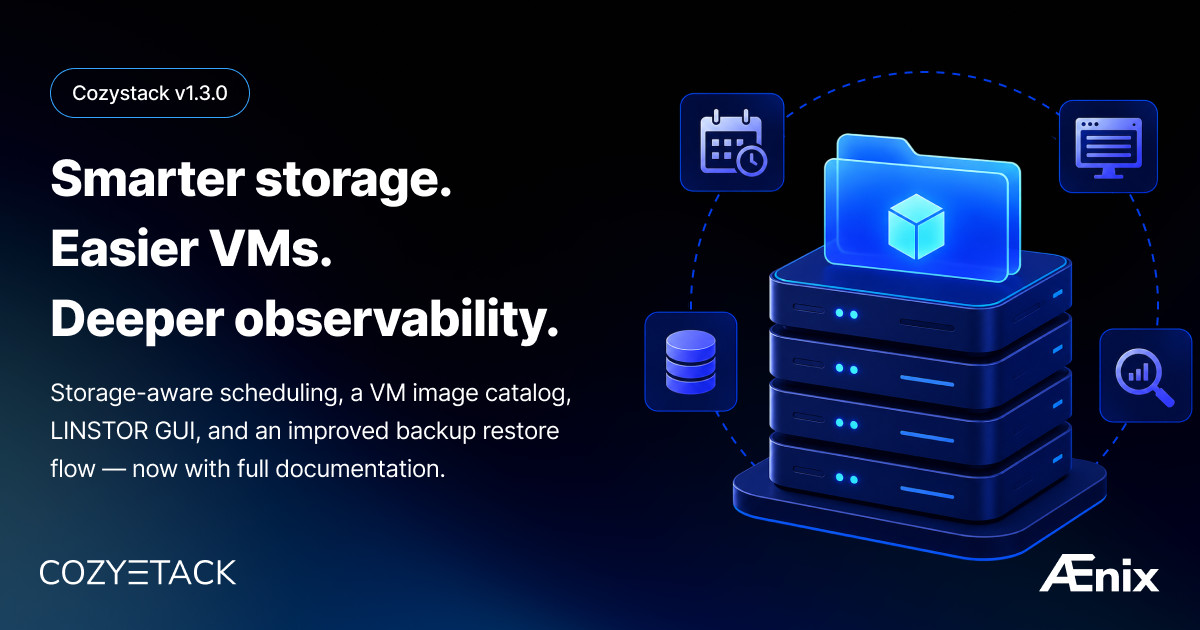
Cozystack v1.3.0 is now available. The release also rolls up every fix shipped in the v1.2.1 → v1.2.4 patch line.
This cycle pushes the platform forward in five clear directions: smarter storage placement, a managed UI for LINSTOR, a built-in catalog of VM base images, deeper application-level observability, and a complete cross-namespace VM backup-restore experience.
What is Cozystack
Cozystack is a comprehensive open-source platform for building bare-metal clouds to quickly deploy managed Kubernetes, database-as-a-service (DBaaS), application-as-a-service (AaaS), and virtual machines based on KubeVirt. With it, you can deploy Kafka, MongoDB, PostgreSQL, Cilium, Grafana, VictoriaMetrics, and other services with a single click. It also handles GPU workloads in both virtual machines and K8s clusters. Cozystack is a CNCF Sandbox project, distributed under the Apache 2.0 license.
Main highlights
Storage-aware scheduling via the LINSTOR extender
The cozystack-scheduler now consults a LINSTOR scheduler extender when placing pods that declare both a SchedulingClass and LINSTOR-backed PVCs. Pods are preferentially scheduled to nodes where their volume replicas already live, cutting cross-node replication traffic and lowering I/O latency for storage-heavy workloads — databases, object stores, VMs.
It builds on the SchedulingClass system introduced in v1.2 and requires no tenant-side configuration. Operators can continue to mix storage locality with the existing data-center / hardware-generation constraints on SchedulingClass.
LINSTOR GUI: managed web console for storage administration
A new opt-in linstor-gui package deploys LINBIT’s linstor-gui alongside the LINSTOR controller with mTLS client authentication and a non-root security context. When OIDC is configured, an optional Keycloak-protected ingress (via oauth2-proxy) exposes the UI; access is restricted to members of the cozystack-cluster-admin group, consistent with host-cluster admin RBAC. The CLI workflow is unchanged — the GUI is strictly additive.
VM Default Images: out-of-the-box VM provisioning
The new vm-default-images package ships a curated set of cluster-wide VM images (Ubuntu, Debian, CentOS Stream, and others) as pre-populated DataVolumes. Tenants can provision VMs against well-known base images without having to upload them first. The package is opt-in via the iaas bundle and defaults to replicated storage. The vm-disk chart also gains a new “disk” source type for cloning from existing vm-disks in the same namespace.
Application-level observability: WorkloadsReady, Events, and S3 metering
Applications now expose a WorkloadsReady condition on their status by aggregating their underlying WorkloadMonitor resources, giving operators a single readiness signal for Deployments, StatefulSets, DaemonSets, and PVCs. The dashboard gains a new Events tab showing namespace-scoped Kubernetes events per application.
The WorkloadMonitor reconciler is extended to track COSI BucketClaim objects as first-class Workloads, and the bucket controller queries SeaweedFS bucket-size metrics from VictoriaMetrics — enabling S3 billing pipelines on par with Pods and PVCs.
Cross-namespace VM backup restore and RestoreJob dashboard
The backup system now supports restoring VMInstance backups into a different namespace, with IP/MAC preservation and safe rename semantics. In-place backup and restore flows for VMDisk and VMInstance are improved across the board, and Velero failure messages now propagate to the Application status. The dashboard ships a complete RestoreJob experience: list view, details page, create form, and sidebar entry.
Also in v1.3.0
- Stricter tenant-name validation — alphanumeric-only at the API level, plus a check that the computed ancestor-chain namespace fits the 63-character Kubernetes limit.
- VMInstance subnets renamed to networks with a dashboard dropdown selector; the old field stays supported via migration 36.
- Custom Keycloak themes can be injected via initContainers; Keycloak-Configure adds email verification and SMTP settings for self-registration flows.
- Host runtime preflight check (make preflight) warns when a standalone containerd or docker is running alongside the embedded k3s runtime.
- System PostgreSQL pinned to 17.7-standard-trixie for Grafana, Alerta, Harbor, Keycloak, and SeaweedFS — preventing drift to PostgreSQL 18.
- kube-ovn upgraded to v1.15.10 with a port-group regression fix that preserves VM LSP membership across live migration.
- All bug fixes from v1.2.1 → v1.2.4 are rolled into v1.3.0.
Documentation worth knowing about
This release ships with a substantial documentation update. New and rewritten guides that pair directly with the v1.3 features:
- Custom Keycloak themes / white-labeling — image contract, configuration, imagePullSecrets, and theme activation.
- Network bonding (LACP) configuration — setting up LACP for Cozystack installations.
- Backup and restore for VMInstance and VMDisk — updated for the v1.3 cross-namespace restore flows.
- External applications via the ApplicationDefinition API — fully rewritten guide using Minecraft server examples.
- Go types for Cozystack managed applications— using the generated Go module from your own controllers.
- ApplicationDefinition naming convention — how cozystack-api resolves kinds to their backing definitions.
- Tenant namespace layout and parent / child derivation — how nested-tenant namespaces are computed.
- Talos / talosctl / Cozystack version pairing matrix — definitive compatibility reference.
- Air-gapped tenant Kubernetes registry mirrors — improved guidance for offline installations.
Governance
We also welcomed two new maintainers in this cycle: Mattia Eleuteri (@mattia-eleuteri) — CSI, storage, networking and security — and Matthieu Robin (@matthieu-robin) — managed applications, platform quality, and benchmarking.
Release link
- Cozystack v1.3.0 on GitHub: https://github.com/cozystack/cozystack/releases/tag/v1.3.0
Join the community
- Telegram group
- Slack group (Get invite at https://slack.kubernetes.io)
- Community Meeting Calendar
- Cozysummit Virtual 2026
By Timur Tukaev on April 27, 2026.
Exported from Medium on May 11, 2026.