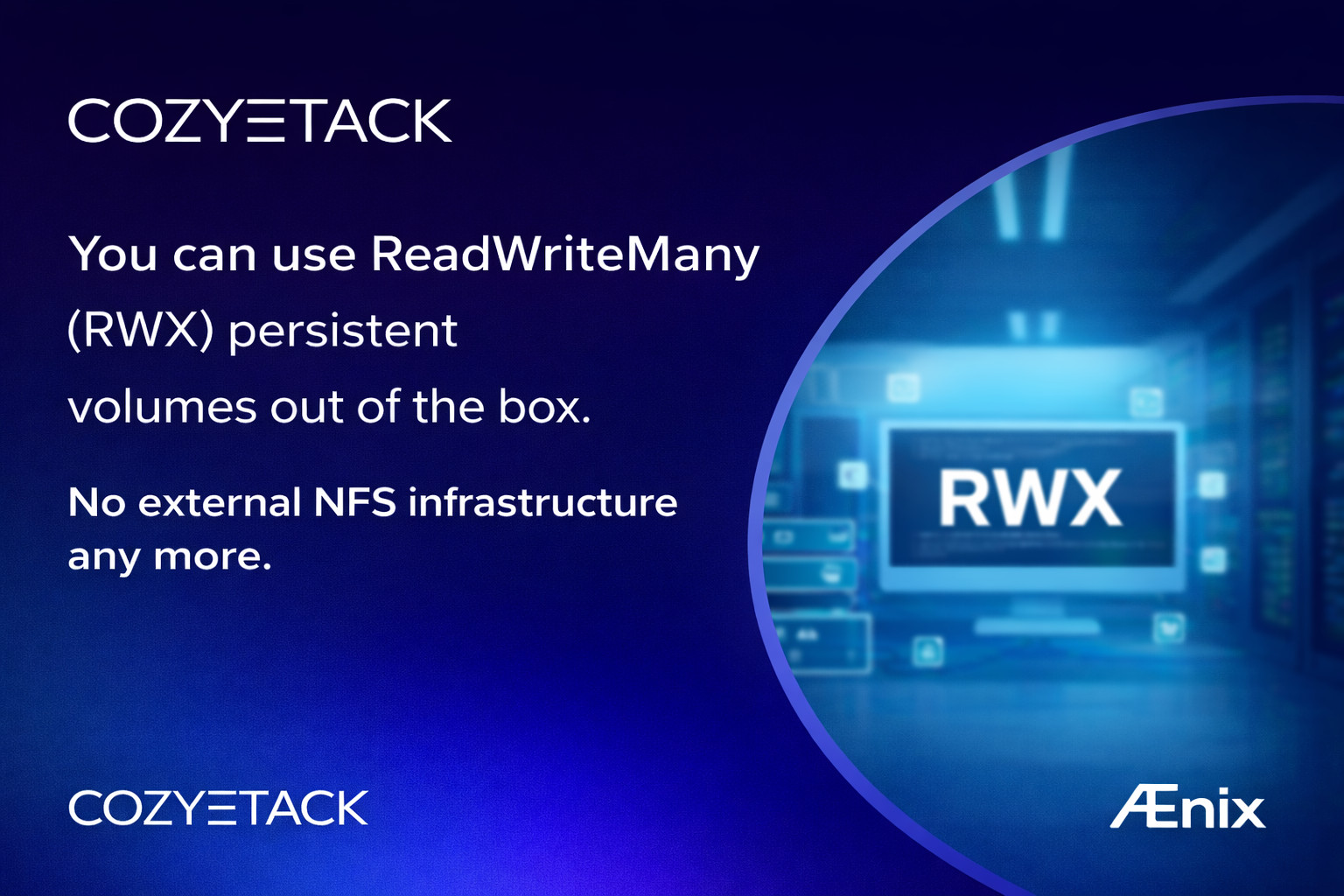
Starting with Cozystack v1.0, you can use ReadWriteMany (RWX) persistent volumes out of the box. This means multiple pods and VMs can mount the same volume simultaneously — a capability essential for shared filesystems, multi-replica applications, and cross-VM data sharing.
Under the hood, the kubevirt-csi-driver provisions a dedicated NFS server for each RWX PVC, backed by DRBD-replicated (LINSTOR) block storage, with CiliumNetworkPolicy handling traffic isolation. For tenants, it’s as simple as creating a standard PVC with accessModes: [ReadWriteMany] and storageClassName: nfs.
Update (September 2026, Cozystack v1.6): on the management cluster, RWX volumes must sit on a DRBD-backed LINSTOR StorageClass — linstor-csi rejects RWX on non-DRBD classes. Mounting an existing external NFS export instead is handled by the optional cozystack.nfs-driver package (csi-driver-nfs). See the current storage documentation.
What this unlocks:
→ Multi-replica deployments sharing persistent state
→ Shared data across multiple VMs in tenant Kubernetes clusters
→ Volume snapshots, expansion, and cloning — all supported per volume
→ No external NFS infrastructure needed — everything runs inside Cozystack
What is Cozystack? Cozystack is a free and open-source PaaS platform and framework for building clouds. It enables you to run a full-featured cloud platform on bare metal with managed Kubernetes, VMs, databases, and storage — all powered by proven CNCF technologies like Talos Linux, KubeVirt, Flux CD, and LINSTOR.
Starting from which Cozystack version are RWX (ReadWriteMany) volumes supported out of the box?
Why: Starting with Cozystack v1.0, you can use ReadWriteMany (RWX) persistent volumes out of the box. Multiple pods and VMs can mount the same volume simultaneously.
Question 2 / 5
What technology stack powers RWX under the hood?
Why: The kubevirt-csi-driver provisions a dedicated NFS server for each RWX PVC, backed by DRBD-replicated (LINSTOR) block storage. CiliumNetworkPolicy handles traffic isolation between tenants.
Question 3 / 5
How does a tenant request an RWX volume?
Why: Tenants create a standard PVC with accessModes: [ReadWriteMany] and storageClassName: nfs. No external NFS infrastructure needed — everything runs inside Cozystack.
Question 4 / 5
Which use case is NOT named as unlocked by RWX?
Why: RWX unlocks: multi-replica deployments sharing persistent state; shared data across multiple VMs in tenant K8s clusters; volume snapshots, expansion, and cloning per volume; no external NFS infrastructure needed. GPU live migration is an unrelated industry-wide limitation.
Question 5 / 5
How does the article describe what Cozystack is, in this announcement?
Why: The boilerplate: Cozystack is a free and open-source PaaS platform and framework for building clouds. Runs full-featured cloud on bare metal with managed Kubernetes, VMs, databases, and storage — powered by proven CNCF technologies (Talos, KubeVirt, Flux CD, LINSTOR).