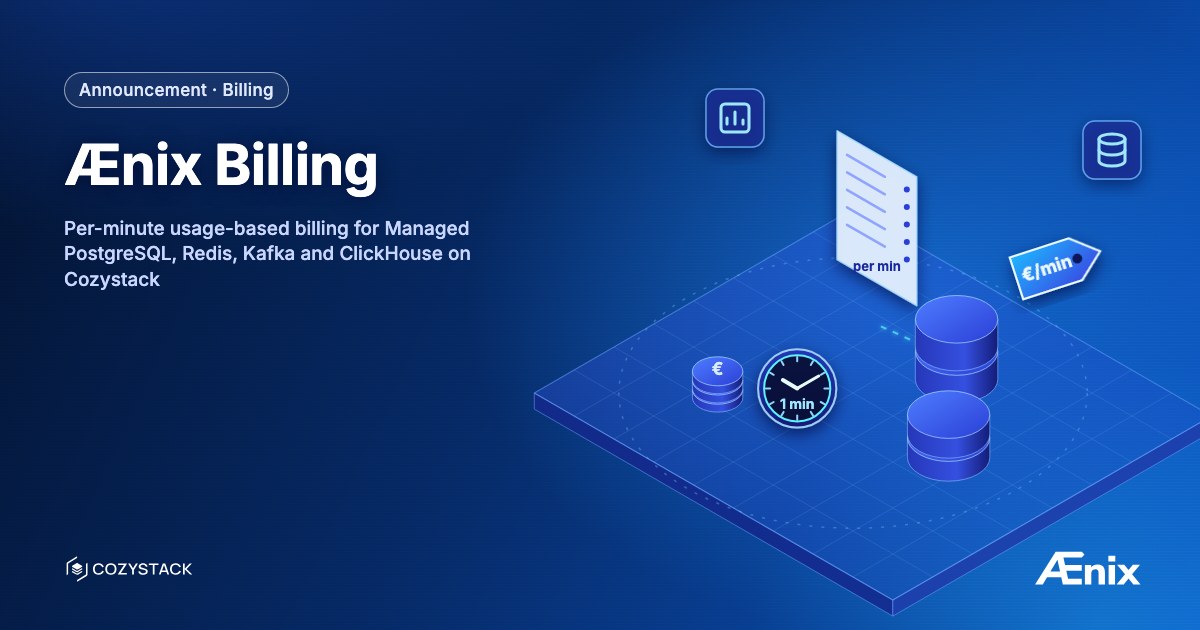
You ship a managed Postgres or ClickHouse cluster to a tenant in two minutes. Now you need to charge them — by the minute, broken down by CPU, memory and disk, reconcilable to the cent. AWS RDS does this. GCP does this. On your own metal? Until now: a custom Prometheus script, a monthly spreadsheet export, and a sales call to explain “why is the number this big”. Ænix Billing closes that gap.
What Ænix Billing is
A native Kubernetes extension API server that exposes the billing.aenix.io/v1alpha1 API. You query it the same way you query the regular Kubernetes API — with kubectl, kubeconfig RBAC, your existing tooling — and it returns a structured UsageReport for any tenant, any workload, any time window.
Under the hood:
- Cozystack Workload CRD — every managed service (Postgres primary, Redis sentinel, ClickHouse shard, KubeVirt VM, Kubernetes worker, S3 bucket) is one
Workloadobject. - Billing controller — turns
Workloadstate into Prometheus metrics: operational lifetime, owner tenant, kind/type, resource reservations. - VictoriaMetrics — stores metrics with stream aggregation. (Ænix and Cozystack standardise on VictoriaMetrics + VictoriaLogs, not Prometheus/Loki.)
- Billing API server — serves the API, computes the definite integral of reservations over the requested time window.
The shape: a thin extension-API server, a small controller, your existing metrics store. No new dependency to operate. Your platform team already runs all of these components.
What gets billed
Every consumer (a single Postgres pod, a Redis instance, a ClickHouse replica) is reported with:
vCPUHoursorCPUHours— switchable, depending on whether you bill physical or virtualised CPUMemoryGiBHours(or decimalMemoryGBHours)EphemeralStorageGiBHoursPersistentVolumeGBHours— partitioned by storage class (NVMe vs HDD vs replicated remote)IPAddressHours— derived from MetalLB IP pool labelsLifetimeHours— pure on-time, independent of reservationsS3StorageGBHoursandS3PhysicalStorageGBHours— for object storage tenants
Workload metadata travels with the report — kind: postgres, type: master vs replica, the owning tenant, custom Cozystack labels — so pricing rules can be as fine-grained as you want. Charge replicas at half the rate of primaries. Charge NVMe-backed volumes 3× HDD-backed. Apply a 20% discount to a strategic tenant. The data is there; the policy is yours.
How you query it
A UsageReport is a Kubernetes object. You build a request like any other CRD:
apiVersion: billing.aenix.io/v1alpha1
kind: UsageReport
query:
  tenant: tenant-acme
  includeSubTenants: true
  startTimestamp: 2026-04-01T00:00:00Z
  endTimestamp:   2026-05-01T00:00:00Z
kubectl create -f report.yaml -o yaml
You get back the same object with report.consumers[] populated — one entry per Postgres replica, Redis pod, ClickHouse shard, K8s worker — each with its own consumption breakdown.
includeSubTenants: truerecursively pulls every nested tenantexcludeTenants:filters internal namespaces outworkload: postgres-myapp-1scopes to a single cluster- Time-window the report to a billing month, a single day, or a tenant’s lifetime — the API accepts any RFC3339 interval
The same kubectl get mechanism that pulls a list of pods now pulls a tenant’s invoice line items. RBAC works the same way — the billing team gets a kubeconfig scoped to the billing API; nothing more.
Why this matters for hosting providers
You already host managed Postgres, Redis, Kafka, ClickHouse, S3 and Kubernetes via Cozystack. With Ænix Billing you get the missing piece — accurate per-tenant, per-workload, per-resource accounting that plugs into your invoicing. No spreadsheets. No quarterly reconciliation. No “why is my bill big” arguments with customers.
Three things change for the operations team:
- Billing is no longer a separate system. Same API as the rest of the platform. Same RBAC. Same kubectl. Nothing new to learn or run.
- Disputes drop. The line items in an invoice map one-to-one to the resources Cozystack actually scheduled. The customer can run the same query, see the same numbers, reconcile to the cent.
- Pricing experiments are cheap. Want to A/B test charging by
MemoryGiBHoursinstead ofvCPUHoursfor a specific service tier? Don’t change billing pipeline code — change the policy that consumes the same report.
How it differs from AWS RDS / GCP billing
AWS RDS and Cloud SQL bill per-minute against a managed-service price list — the provider owns the price list and the customer accepts the line items as authoritative. You are that provider on Cozystack. Ænix Billing gives you the same per-minute granularity, with the pricing model and the resource taxonomy under your control. The data is exposed, the policy is yours.
For hosting providers running on bare metal — Hetzner, OVH, regional data centres, sovereign cloud builders — this is the difference between competing with hyperscalers on capability vs. competing on price. The capability has been the gap.
Distribution
Ænix Billing is a proprietary Ænix module, delivered alongside Cozystack to customers with an Ænix subscription (for example Ænix Public Cloud Platform). The Cozystack platform stays Apache-2.0 and CNCF-governed; the billing layer is not part of it.
If you run a hosting business or a private cloud on Cozystack and want billing working out of the box, book a discovery call — we’ll talk scope, pricing, and rollout.
Join the community
- Cozystack — cozystack.io
- GitHub — github.com/cozystack
- Telegram — t.me/cozystack
- Kubernetes Slack — #cozystack (need an invite? slack.kubernetes.io)
- Community meetings — calendar