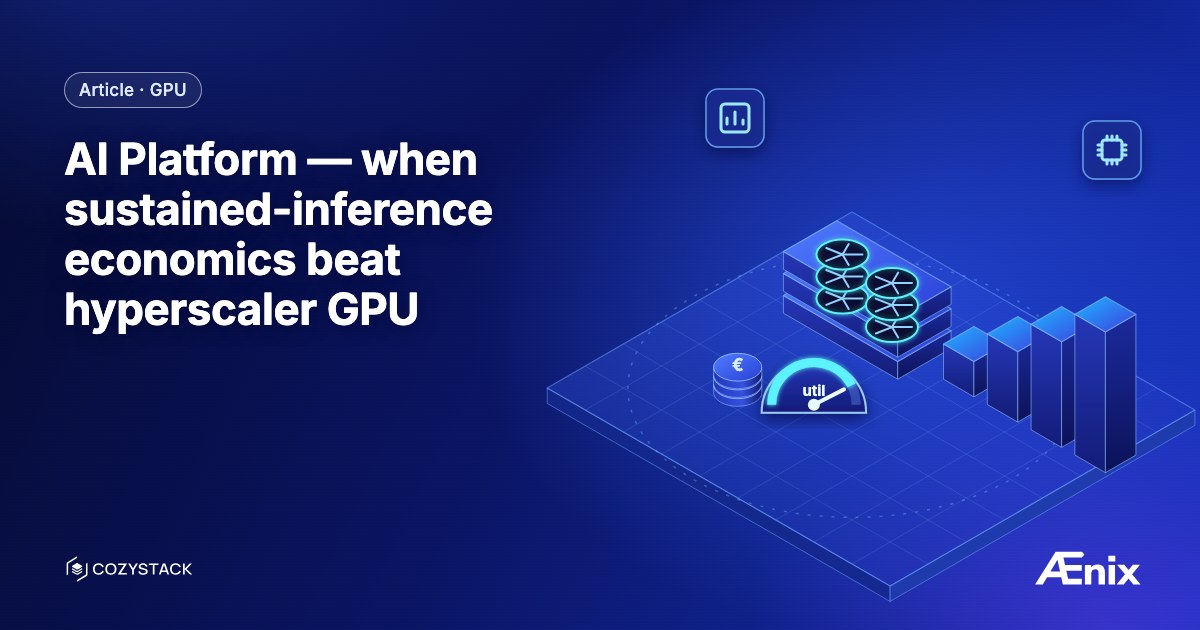
The “should we run our own AI infrastructure?” conversation has shifted in 2026. For sporadic experimentation, hyperscaler GPU on demand is still right. For sustained 24/7 inference, the math has moved substantially.
The crossover point — sustained inference
The economics question that drives most AI Platform engagements: at what utilisation does our own GPU infrastructure beat hyperscaler GPU?
For dedicated GPU instances, the crossover varies by class:
- H100 sustained: crossover around 30% utilisation. Hyperscaler H100 instance pricing in 2026 sits at ~€3-4/hr; amortised on-prem H100 (€25-30k acquisition + 4-year refresh + power + colocation) works out to ~€0.9-1.3/hr at 30% utilisation, ~€0.5-0.7/hr at 60%+.
- L40S: crossover around 40% utilisation. Lower hyperscaler pricing per hour (~€1.5/hr) but lower acquisition cost on-prem too (€12-15k). For multi-tenant inference fleets where workloads share a GPU via HAMi, L40S typically dominates.
- A100 (second-hand market): crossover around 25% utilisation. Lower upfront capital makes the break-even lower; A100 remains cost-effective for inference workloads through 2026.
- Blackwell B100/B200: depends on supply and pricing as the generation rolls out. Early adopters with sustained large-model inference benefit; for smaller-model inference, H100/L40S still fits.
- AMD MI300/MI325: credible alternative when ecosystem fits. ROCm tooling has matured; some workloads benefit. Hyperscaler options for AMD GPUs are thinner, so the on-prem case is often stronger.
For sustained 24/7 customer-facing inference (millions of tokens per day, steady load profile), owning the GPUs typically comes out cheaper from Year 2, accounting for hardware refresh and operational overhead. How much cheaper depends on utilisation and GPU class, as the crossover figures above show; model it on your own load profile before committing.
For sporadic experimentation, hyperscaler still wins — and we say so when fit assessment finds the workload profile.
What goes into a real AI platform
GPU is the visible cost line. The real platform has six layers, each of which AI Platform standardises:
Layer 1 — Hardware
A typical multi-tenant inference fleet runs a mix:
- 8-32 H100 / H200 for high-throughput large-model inference and fine-tuning workloads
- 16-64 L40S for tenant-facing inference of mid-sized models, with HAMi splitting each card across several smaller workloads
- CPU-only nodes for RAG retrieval, embedding generation, preprocessing pipelines that don’t need GPU
NVIDIA data-centre GPUs are supported through the NVIDIA GPU Operator (passthrough to VMs, sharing via HAMi). NVLink for multi-GPU training where applicable; 25-100 Gbps Ethernet sufficient for most inference patterns.
Layer 2 — Platform
This is where AI Platform adds substantial value over rolling your own. Cozystack provides:
- KubeVirt for VM-bound AI workloads (legacy notebook environments, data-science teams that need full VMs).
- Container-based GPU via the NVIDIA GPU Operator for whole-GPU allocation, plus HAMi for fractional allocation by GPU memory and compute cores in tenant Kubernetes clusters.
- Multi-tenant Tenant CRD with per-tenant GPU quotas, GPU-class- aware scheduling (e.g., L40S for inference tenants, H100 for fine-tuning tenants).
- Identity, storage, observability integrated.
Building this on raw Kubernetes is doable but expensive: 12-24 months of MLOps engineering before production-ready multi-tenant GPU scheduling works.
Layer 3 — Serving stack
vLLM is the 2026 default for transformer-model inference (PagedAttention delivers high throughput). NVIDIA Triton fits mixed workloads (LLM + vision + classical ML). TGI has niche features. AI Platform includes both vLLM and Triton, pre-integrated with the platform autoscaling and observability.
Layer 4 — Model layer
Open-weight model families in 2026 production:
- Llama 3 / 3.1 / 3.2 / 3.3 (Meta) — 1B to 405B+, licence permits commercial with caveats
- Mistral / Mixtral — commercial licence for newer, Apache 2.0 for older
- Qwen 2 / 3 (Alibaba) — strong multilingual including DACH and Eastern European languages, Apache 2.0
- DeepSeek V3 — strong reasoning, licence varies
- Phi (Microsoft) — small models with surprising capability, MIT
- Gemma (Google) — small/medium, commercial-use permitted
For most regulated-industry deployments: a primary model in the 7B-70B range for general use, smaller models (Phi, Gemma) for cost-sensitive paths, plus an embedding model for RAG. Fine-tuning happens for domain-specific accuracy needs.
AI Platform pre-deploys curated open-weight models in the cluster registry. Customer can add others; Ænix engagement covers compatibility testing.
Layer 5 — Application layer
- LLM gateway (LiteLLM, Portkey, custom) — request routing, rate limiting, audit logging, cost tracking
- RAG infrastructure — pgvector (PostgreSQL operator), Qdrant, Weaviate, Milvus
- Embedding pipelines — document indexing, retrieval orchestration
The application layer is where model-provider switching cost concentrates. A well-engineered LLM gateway makes the model swappable; a poorly-engineered one locks the application to a specific API contract.
Layer 6 — Operations
The post-deployment steady state is where most private AI projects underperform expectations. The operational surface includes:
- GPU utilisation per tenant — under-utilised GPUs are wasted budget; over-utilised GPUs cause queueing
- Model lifecycle management — when to upgrade Llama 3.x to 4.x? When to re-fine-tune? Who owns the regression-test suite?
- Cost tracking per tenant / team / workload — without per-tenant tracking, cost allocation becomes unmaintainable in multi-tenant AI platforms
- Audit trail — for regulator dialog, every inference request must trace to: model + version, weights, input, output, requesting user, timestamp
- On-call — GPU failures, OOM events, queue backups
- Capacity planning — when to buy more GPUs? When to retire older?
AI Platform ships VictoriaMetrics + VictoriaLogs. GPU usage is measured per tenant; charging happens in your billing system (WHMCS or your own). Inference metrics such as tokens per second and latency percentiles per model version come from the serving layer and land in the same stack, next to the GPU sizing inputs for capacity planning.
Common deployment patterns
Pattern 1 — single-tenant inference cluster. Smallest reasonable deployment. Single workload, single team, single model family. 4-16 H100/H200 or 8-32 L40S. Best for: regulated workloads with one application owner, PoCs that will grow.
Pattern 2 — multi-tenant inference fleet. Multi-team or multi- application deployment. 16-128 GPUs across mixed classes. Tenant CRD with per-tenant quotas. Best for: enterprise platform teams supporting multiple data-science teams.
Pattern 3 — inference + fine-tuning + RAG full stack. 32-512 GPUs across roles. Vector DB, embedding model, LLM gateway. Best for: financial services, healthcare, public sector with sustained AI programme. This is the typical AI Platform flagship deployment.
Pattern 4 — air-gapped sovereign deployment. No internet egress; updates through controlled channels. Customer-supplied hardware, opt-in volume encryption with a passphrase the customer holds (the key-management process, including any HSM, is designed with you), customer-side audit SIEM. Best for: classified workloads, healthcare with strict residency.
Common pitfalls
Pitfall 1 — skipping the platform layer
Teams deploy vLLM on bare-metal boxes, call it a private AI deployment. Works for a PoC. Falls over the first time GPU demand exceeds available capacity, multi-tenant isolation matters, or the regulator asks for an audit trail.
Pitfall 2 — model-API-as-private-LLM
Some vendors market a SaaS endpoint with privacy controls as “private LLM.” The data still leaves the customer perimeter even if the privacy clause is strong. For regulated-data workloads this fails the substantive requirement.
Pitfall 3 — under-sizing memory
Most common initial-sizing mistake: not accounting for KV cache memory that scales with context length and batch size. A model that “fits” by parameter count may not fit at the operational batch size. Right-sizing requires actual benchmark with realistic context lengths and batch profiles.
Pitfall 4 — under-staffing operations
GPU clusters need ongoing operational care. A team that nails the build-out but under-staffs operations ends up with a stack that “works” but isn’t audit-grade or business-continuity-grade. Plan operations team size for sustained workload, not PoC.
When AI Platform is the right answer
Strong fit:
- Sustained inference workloads (~millions of tokens per day or steady production load) where sustained-utilisation economics favour on-prem GPU.
- Regulated data class that can’t go to hyperscaler model APIs (banking, healthcare, classified, sectoral).
- Auditability requirement — every inference request traceable to model + version + input + output + user + timestamp.
- Existing platform-engineering capacity or willingness to invest in it (5-10 engineers).
Marginal fit:
- AI experimentation where sporadic GPU is sufficient. Hyperscaler on-demand wins for low-utilisation patterns.
- Single-workload deployments under 50 tokens/sec sustained. Often smaller deployments fit on hyperscaler-managed AI services more cost-effectively.
Poor fit:
- No regulated data, no sustained workload, no platform team. Use hyperscaler AI APIs or smaller open-source deployments.
Engagement structure
- Discovery call (30 min, free)
- Platform Readiness Assessment (fixed price, 14 days focused or 28 days full) — using the Sovereign AI Decision Guide framework plus Ænix experience
- Pilot engagement (3-6 months) — defined slice: one workload class, one tenant, one model family
- Full AI Platform build — production AI infrastructure with all targeted workload types; scope and duration are set in the assessment
- Support subscription (ongoing) — Plus or Enterprise tier for 24×7 (see /pricing/), or managed operations quoted separately
Engagement size: project plus support subscription, quoted per RFP.
Where to dig deeper
- AI Platform landing — feature list, GPU sizing tables, product-specific FAQ
- Sovereign AI services — buyer-trigger landing for sovereign AI
- AI platform build services — engagement details
- Private LLM deployment — practical guide — six-layer stack walkthrough with hardware tables
- Sovereign AI architecture decisions — the seven decisions that define a sovereign AI architecture
- Sovereign AI Decision Guide — downloadable decision-framework PDF
Test yourself: sustained GPU economics
5 questions · ~2 min