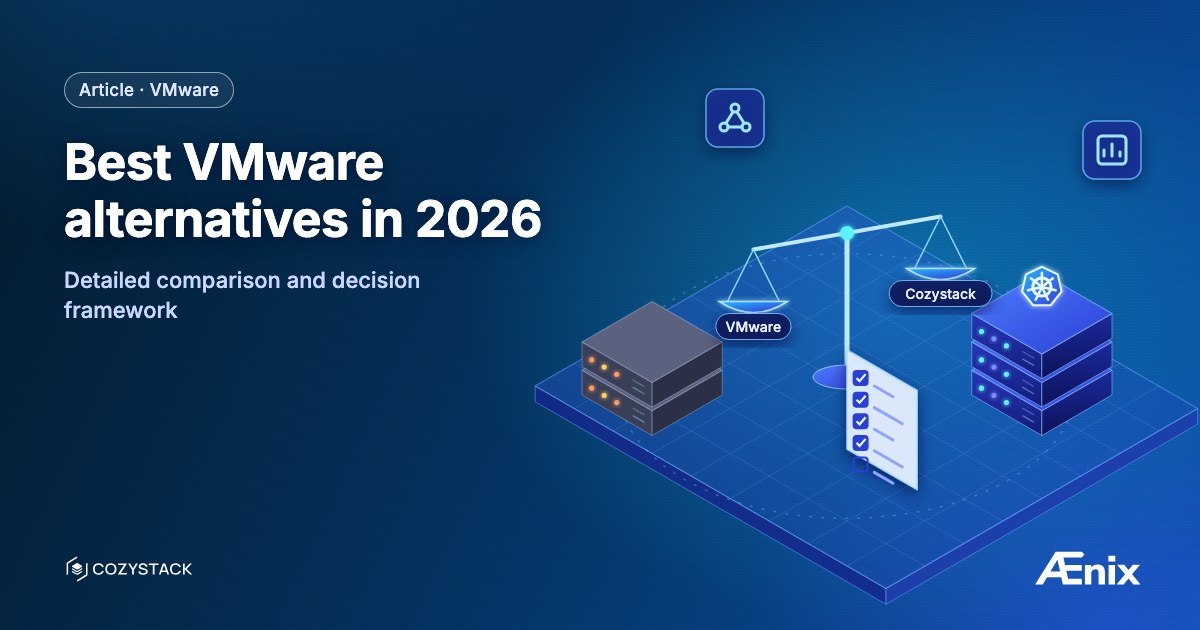
The VMware alternative market is in a different state in 2026 than it was in 2022. Broadcom’s pricing changes, sovereignty pressure, and the maturity of Kubernetes-native alternatives have all shifted the landscape. This is the working version of “best VMware alternatives” with the depth to actually decide.
Decision framework — five questions
Before evaluating products, answer these five questions:
- What’s your primary workload? VMs only / mostly / mixed VM-and-container / containers-only.
- Multi-tenancy? Single-tenant / multi-BU / customer-facing service-provider model.
- Scale? <50 hosts / 50-500 hosts / >500 hosts.
- Existing relationships? Red Hat / Microsoft / OpenStack-fluent / open-source comfortable / commercial-only.
- Trigger? Cost (Broadcom pricing), sovereignty (regulator), AI workload, scale, greenfield.
Your answers narrow the realistic options to 1-2 candidates.
Top alternatives ranked by use case
For service providers and multi-tenant cloud builders
Best: Cozystack (open-source, Kubernetes-native, Tenant CRD multi-tenancy native)
Runner-up: OpenStack (mature, multi-tenant via Keystone, telco-scale-proven; operational complexity)
Why Cozystack wins: Multi-tenant model is structural, not bolted on. Single platform for VMs + containers + databases + S3 + GPU. Open source — no vendor lock-in. Lighter operational footprint than OpenStack.
For regulated enterprises (banking, insurance, financial services)
Best: Cozystack (sovereignty-by-architecture, opt-in volume encryption with a passphrase you hold, audit-ready)
Runner-up: OpenShift Virtualization (Red Hat commercial support, established procurement relationships)
Why Cozystack wins for sovereignty: Open-source platform on customer hardware with customer-controlled cluster access. Sovereignty is structural; not “sovereign with caveats.”
For existing Red Hat / OpenShift customers
Best: OpenShift Virtualization (KubeVirt-based, integrated with existing OpenShift)
Runner-up: Cozystack (if procurement allows; better multi-tenancy)
Why OpenShift wins for this case: Existing Red Hat / IBM relationship, established procurement, team familiarity.
For SMB / single-tenant / labs
Best: Proxmox VE (mature, easy install, strong community)
Runner-up: Scale Computing HC3 (appliance simplicity)
Why Proxmox wins: Open source, large community, well-suited to single-tenant deployments under ~50 hosts.
For ROBO / edge
Best: Scale Computing HC3 (appliance designed for ROBO/edge)
Runner-up: Cozystack (if multi-site unified operations matter)
Why Scale wins for narrow ROBO: Operational simplicity at edge sites; designed for environments without dedicated infrastructure team.
For AI / GPU at scale
Best: Cozystack (KubeVirt + NVIDIA GPU Operator for NVIDIA data-centre GPUs, fractional sharing via HAMi)
Runner-up: OpenShift Virtualization (Red Hat ecosystem with GPU)
Why Cozystack wins for AI: Kubernetes-native means container + VM GPU workloads on one platform. Multi-tenant model accommodates multiple data-science teams. Sovereignty for data residency.
For Microsoft-aligned organizations
Best: Azure Stack HCI (Hyper-V + Azure Arc integration)
Runner-up: Cozystack (if open-source matters more than Microsoft ecosystem)
Why Azure Stack HCI wins for Microsoft shops: Hyper-V foundation familiar; Azure Arc bridges to Azure cloud; Microsoft licensing economics work.
For OpenStack-fluent telecom and government
Best: OpenStack (proven at telco scale)
Runner-up: Cozystack (lighter operational footprint; gradual migration option)
Why OpenStack wins for established teams: Existing expertise, vendor distros mature, telco-scale validated.
For pure-play container workloads (no VMs)
Best: Vanilla Kubernetes (smallest platform, lowest overhead)
Runner-up: Cozystack (multi-tenant Kubernetes if isolation matters)
Why pure Kubernetes wins: Without VMs, the KubeVirt layer is unnecessary; pure container platforms are simpler.
What’s genuinely different from VMware
For each alternative, the architectural mismatches with VMware that need redesign:
Cozystack
- Networking: Cilium (eBPF) ≠ NSX. Different model; redesigned during migration.
- Multi-tenancy: Tenant CRD ≠ vCloud Director. Conceptually different; mapping during migration.
- Operations: Kubernetes operational model; team learning curve.
OpenShift Virtualization
- Operations: OpenShift surface area larger than VMware; team learning curve.
- Pricing: Red Hat subscription model.
Nutanix AHV
- Vendor model: Closed source / appliance — different from open VMware ecosystem.
- Networking: Less flexible than NSX; vendor-managed.
OpenStack
- Operations: Significantly more complex than VMware. Realistic if team has expertise.
Proxmox
- Multi-tenancy: Limited. Appropriate only for single-tenant.
Scale Computing
- Scale ceiling: Lower than enterprise VMware deployments.
Azure Stack HCI
- Vendor relationship: Microsoft-tied; different from VMware-tied.
Migration considerations
For each alternative, the migration path complexity:
- VMware → Cozystack: Image conversion (qcow2 to KubeVirt CDI). Networking redesign (NSX → Cilium). Multi-tenant model redesign (vCD → Tenant CRD). Storage layer migration (vSAN → LINSTOR/DRBD). Typical: a 14- or 28-day Platform Readiness Assessment, then about 8-12 months for ~100 VMs and 18-24 months for ~1,000 VMs, including planning and migration waves.
- VMware → OpenShift: Similar to Cozystack but on Red Hat foundation.
- VMware → Nutanix: AHV migration via Nutanix Move (vendor tool). Less control during migration.
- VMware → OpenStack: Most operationally complex; requires deep team expertise.
- VMware → Proxmox: Image conversion straightforward; multi-tenant redesign required.
Test yourself: best VMware alternatives in 2026
5 questions · ~2 min