The phrase “build your own cloud” was niche in 2018. By 2026, it’s mainstream — Broadcom’s pricing changes plus sovereignty pressures plus AI workload economics have pushed thousands of organizations from “we’ll just rent cloud” to “we need a platform we control.”
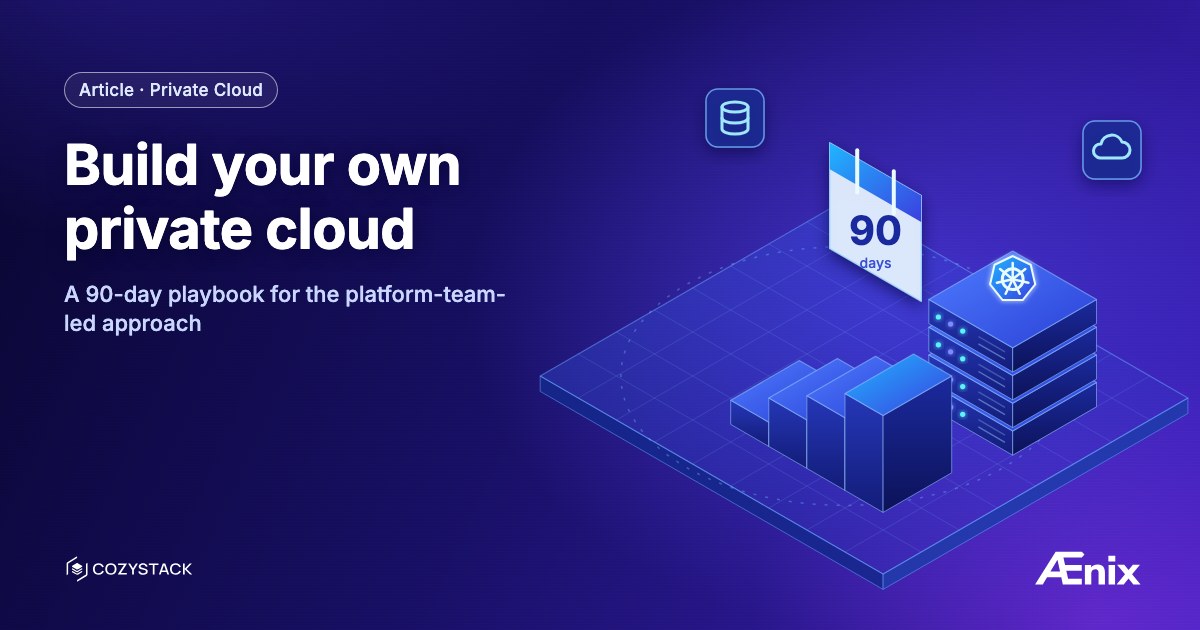
What used to take 18 months can now take ~90 days for the foundation, with subsequent quarters adding maturity. The reason: the open-source platform stack has matured.
Day-0: discovery (1 week)
Before you build, agree on:
- Trigger — what’s pushing you to build? (VMware exit, sovereignty, cost, AI.) The trigger shapes architecture.
- Workload portfolio — what’s running, what’s coming. Sizing follows.
- Capacity — internal team capacity to operate the platform after build.
- Hardware constraints — datacenter / colocation arrangements, refresh cycles, network connectivity.
- Compliance scope — DORA, NIS2, GDPR, sectoral.
Output: a one-page architecture brief. No code yet.
Days 1-30: foundation
Week 1: hardware setup
- Compute servers procured / repurposed
- Storage tier provisioned
- Network fabric configured (BGP, leaf-spine)
- Out-of-band management
Week 2: OS and platform
- Talos Linux installed (default for Cozystack) or chosen OS layer
- Cozystack platform deployed
- Initial cluster operational
- Operator and admin access verified
Week 3: storage and network
- LINSTOR (DRBD) deployed and validated
- Cilium configured with network policies
- MetalLB / ingress set up
- Cross-node replication tested
Week 4: identity and observability
- Keycloak (or chosen IdP) integrated
- VictoriaMetrics + VictoriaLogs deployed
- Initial dashboards and alerts
- Audit logging configured
End of day-30: a working platform. Single-tenant, single-cluster, basic observability. Not production-ready for customers yet.
Days 31-60: multi-tenancy and operations
Week 5-6: multi-tenancy
- Tenant CRD configured
- Per-tenant RBAC, quotas
- Tenant onboarding playbook
- First test tenants provisioned
Week 7-8: operations
- Runbooks for common scenarios (pod failure, node failure, control-plane recovery, certificate rotation)
- On-call rotation set up
- Backup and DR with Velero
- Incident response process documented
End of day-60: platform supports multiple tenants with documented operations. Ready for first real workload onboarding.
Days 61-90: workload onboarding and golden paths
Week 9-10: first workload migration
- Pilot workload (low-risk) migrated from existing infrastructure
- Performance and stability validated
- Backup and recovery tested
- Customer (internal) feedback collected
Week 11-12: golden paths
- Self-service paths for the 5-10 most common product-team needs
- Service templates documented
- Observability auto-onboarding
- Application-level CI/CD integrated
End of day-90: platform supports production workloads with self-service. Maturity continues compounding from here.
What you skip in 90 days
Honest acknowledgments:
- Polished customer-facing portal — Cozystack Dashboard works but UI polish is iterative.
- Multi-region / multi-DC operation — single-region first; multi-region in months 4-6.
- GPU/AI workload optimization — generic GPU support yes; AI-platform-specific optimizations later.
- Comprehensive compliance certification — architecture aligned with DORA/NIS2/GDPR; certification audit is a separate exercise.
- Decommissioning of legacy infrastructure — usually months 4-12 in cohorts.
Where teams routinely stumble
Stumble 1: under-staffed platform team
A 5-person platform team building a private cloud while operating existing infrastructure stalls in week 4. Realistic platform-team headcount: 5-10 dedicated engineers for the build phase; can shrink to 3-5 for steady-state operations.
Stumble 2: skipping observability investment
Observability gets squeezed because it doesn’t show up in Day 0 demos. Falls over in production. Build observability in Week 4 alongside core platform.
Stumble 3: vendor-led “private cloud appliance”
Buying a “complete private cloud in a box” rebuilds lock-in. Build velocity is also slower because the appliance is in the way.
Stumble 4: no platform-team product orientation
Engineering excellence without product orientation produces a platform that internal customers don’t adopt the way it was designed.
Stumble 5: skipping the compliance overlay
Architecture that ignores compliance until later requires retrofitting. Build sovereignty / audit / observability with compliance in mind from Day 0.
What 90 days does not include
The 90-day playbook delivers a foundation. Maturity continues:
- Months 4-6: workload migration cohorts, golden-path expansion, regional / DR site
- Months 7-12: GPU/AI subsystems, advanced multi-tenancy patterns, FinOps integration
- Year 2: maturity, optimization, scaling
A private cloud at year 2 is a different platform from a private cloud at day 90.
Test yourself: 90-day private cloud playbook
5 questions · ~2 min