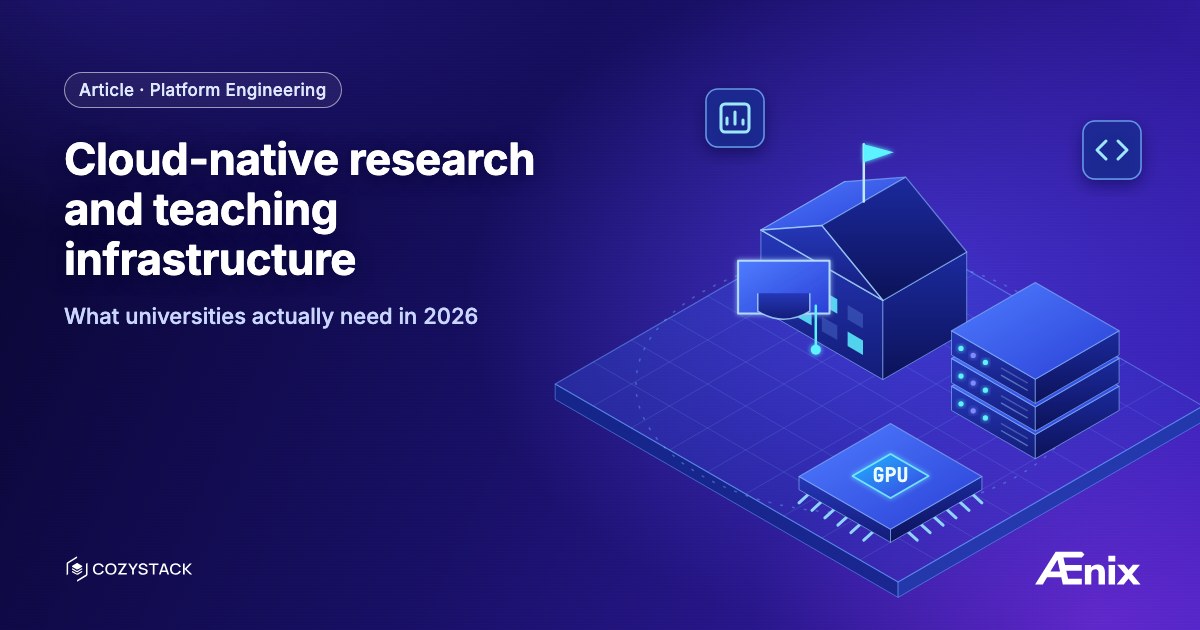
University and research-institute IT in 2026 sits at a difficult intersection: rising research computing demand (especially AI/ML), reproducibility mandates (Plan S, FAIR, Horizon Europe), curriculum needs for cloud-native technologies, multi-stakeholder governance, and budgets that don’t grow at the rate of compute demand. Cloud-native platforms — open-source, Kubernetes-native, multi-tenant — increasingly answer all of these simultaneously, where pre-cloud infrastructure had to be specialized per use case.
The three missions revisited
In the industry page we identified three university missions. Here we go deeper on each.
Mission 1 — research computing for the AI era
The shift in research computing demand over the past 5 years has been substantial. AI/ML workloads have moved from “specialized lab activity” to “general research methodology” across disciplines. Computational biology, materials science, climate modelling, NLP for humanities — all increasingly use deep-learning approaches that need GPU.
The infrastructure response has historically been:
- EuroHPC / national HPC — for the largest workloads
- Departmental clusters — for medium workloads, lab-managed
- Cloud GPU credits — for sporadic / experimental workloads
- Personal workstations — for lightweight workloads
Each has limits:
- HPC has gatekeeping, queue times, and isn’t ideal for iterative AI/ML development
- Departmental clusters fragment expertise; each lab maintains its own
- Cloud GPU credits aren’t sustainable at scale; sovereignty concerns for sensitive data
- Personal workstations cap at small models
What modern research computing increasingly wants: shared GPU pool with strong isolation, self-service for PIs, IaC-managed for reproducibility, integrated with national/European research infrastructure where applicable.
A Kubernetes-native platform like Cozystack delivers this. KubeVirt handles legacy VM-based research workflows; native containers handle modern ML pipelines. The NVIDIA GPU Operator hands whole GPUs to workloads and HAMi shares a single GPU across labs by memory and compute cores; VMs get passthrough of whole GPUs or NVIDIA vGPU (which requires your NVIDIA vGPU licence); on cards that support MIG, the GPU Operator can also split one GPU into hardware partitions for a lab’s Kubernetes cluster. Tenant CRD provides per-lab isolation. The Cozystack Dashboard gives PIs self-service. The same infrastructure can integrate with EuroHPC for largest workloads (many universities have hybrid arrangements).
Mission 2 — reproducible research infrastructure
Reproducibility has moved from aspiration to mandate in many funding contexts. Plan S, the FAIR data principles, Horizon Europe requirements, and discipline-specific replication crises (psychology, social sciences, biomedical) all push toward reproducible artifacts.
For computational research, reproducibility now typically requires:
- The data (with persistent identifiers, DOIs)
- The code (with versioning)
- The runtime environment (container images, IaC manifests, dependency specifications)
The third item is where the infrastructure layer matters. A research artifact that says “we used Python 3.10 with PyTorch 2.1 on Ubuntu 22.04” isn’t reproducible 5 years later — those packages have moved. A research artifact that includes a Dockerfile (or KubeVirt VM image) IS reproducible — bit-exact runtime preserved.
Cozystack supports this pattern natively:
- Containerized environments as Kubernetes manifests + image registry
- Long-term archival — registries with retention policies
- Air-gap deployment — for sensitive research that can’t depend on external registries
- Federated patterns — multi-institution research consortia can share container images via shared registry
The European Open Science Cloud (EOSC) is the umbrella initiative connecting reproducible-research infrastructure across European universities; Cozystack platforms can participate in EOSC federations.
Mission 3 — cloud-native curriculum delivery
CS and engineering departments increasingly teach Kubernetes, container orchestration, GitOps, observability, and adjacent topics. The challenge: students need hands-on infrastructure to learn on, and that infrastructure needs to:
- Match production reality (so graduates are immediately useful)
- Allow safe experimentation (broken environment shouldn’t break adjacent students)
- Reset cleanly between cohorts
- Run on academic IT capacity (not require commercial-grade ops)
Cozystack handles each:
- Production-grade real platform — students learn what industry uses (Cozystack is in production at hosting providers, banks, etc.)
- Tenant CRD per cohort — broken student environments don’t affect adjacent students
- Quota and RBAC enforced — student misconfigurations contained
- Self-service for instructors — instructor can create / destroy student environments without IT ticket
- CNCF Project status — students gain familiarity with CNCF ecosystem, valuable post-graduation
The CNOE (Cloud Native Operational Excellence) industry initiative is also worth mentioning — it provides reference cloud-native patterns suitable for academic teaching contexts.
Architecture patterns we’ve seen work
In universities and research institutes specifically, several architectural patterns have proven sustainable:
Pattern A — central research-computing service
Single Cozystack deployment operated by a central research-computing team, serving multiple departments / labs as tenants. Best for medium-to-large universities (10,000+ students, multiple research-active departments).
Pattern B — departmental clusters federated
Multiple Cozystack deployments, one per major department, with shared identity and federation for multi-department projects. Best for very large universities or multi-campus systems.
Pattern C — research consortium platform
Multi-institution research consortia operating shared Cozystack platform under joint governance. Best for collaborative research with significant compute demand.
Pattern D — R&D institute platform
Research institutes (IT, engineering, biotech) operating Cozystack as core research infrastructure. Often combined with industrial-partner access via tenant CRD model.
Specific university considerations
Open source ethos
Academic culture strongly prefers open-source infrastructure. Apache 2.0, transparent governance, ability to inspect and modify code — all align with academic values. Cozystack’s CNCF Project status and Apache 2.0 licence fit this.
Budget realism
University IT budgets don’t scale with compute demand. Open-source platform with optional commercial support is a sustainable economic model. Per-CPU subscription pricing (typical of commercial alternatives) doesn’t fit university economics.
Multi-decade horizons
Universities plan in decades, not quarters. Vendor-led platforms whose roadmap and pricing change with corporate decisions are risky for multi-decade planning. Community-governed open-source projects are more predictable in this dimension.
Sovereignty for some research
Medical research data, classified research, industrial-partner research with NDA constraints — these benefit from infrastructure that keeps data within institutional control. Cozystack’s air-gap support, opt-in volume encryption with a passphrase the institution holds, and on-prem deployment match these needs.
Federation with national / European infrastructure
EuroHPC for the largest workloads. EOSC for open-science federation. GÉANT for European research networking. National research networks. Cozystack platforms can integrate with all of these via standard Kubernetes APIs.
Industrial partnerships
Universities increasingly partner with industry for funded research. The platform must support multi-stakeholder access patterns — university researchers, industrial-partner researchers, with appropriate isolation and IP-protection. Tenant CRD with nested tenants handles this.
Common pitfalls
Pitfall 1: HPC-only mindset
Treating research computing as “small HPC” misses that AI/ML iterative development workflow doesn’t fit HPC queue model. Modern research computing platforms must handle both interactive (notebook-style) and batch workloads.
Pitfall 2: Per-lab clusters fragmentation
Each lab building its own cluster fragments expertise, doubles maintenance, and prevents resource sharing during peak workloads. Central or federated platform compounds value.
Pitfall 3: Underinvested operations
Research computing operated by graduate students or postdocs as side duties doesn’t sustain. Dedicated research-computing team (even small) is necessary.
Pitfall 4: Mismatched curriculum infrastructure
Teaching Kubernetes on a single-tenant minikube is teaching a toy. Teaching on production-pattern multi-tenant platform produces graduates ready to use the platforms industry actually runs.
Pitfall 5: Reproducibility as afterthought
Building research infrastructure without reproducibility patterns from day 1 means retrofitting later, which is expensive. Containerization and IaC discipline should be the default.
Ænix engagement specifics for universities
Ænix has built Cozystack-based platforms for university and research-institute customers across the EU and Central Asia. Engagement specifics:
- Public-procurement-aware — RFI / RFP through standard channels in EU member states and Kazakhstan
- Capacity-transfer first-class — knowledge handover to in-house academic IT is explicit deliverable
- Phased engagement aligned with grant cycles where applicable
- Multi-institution consortia supported
For details see universities industry page.
Test yourself: cloud-native infra for universities
5 questions · ~2 min