“Cloud strategy” is a saturated term. Hyperscalers offer it (Azure Cloud Adoption Framework, AWS Migration Acceleration Programme, Google Cloud Adoption Framework). The Big-4 offer it (Deloitte, KPMG, EY, PwC each have cloud advisory practices in the thousands of consultants). Hyperscaler partners offer it (system integrators with thousands of certified cloud consultants). Boutique firms offer it. In-house strategy teams generate it.
The market is crowded, and the methodologies look similar from the outside. The difference shows up in what the strategy actually recommends, who’s incentivised to recommend what, and whether the recommendation survives 18 months in practice.
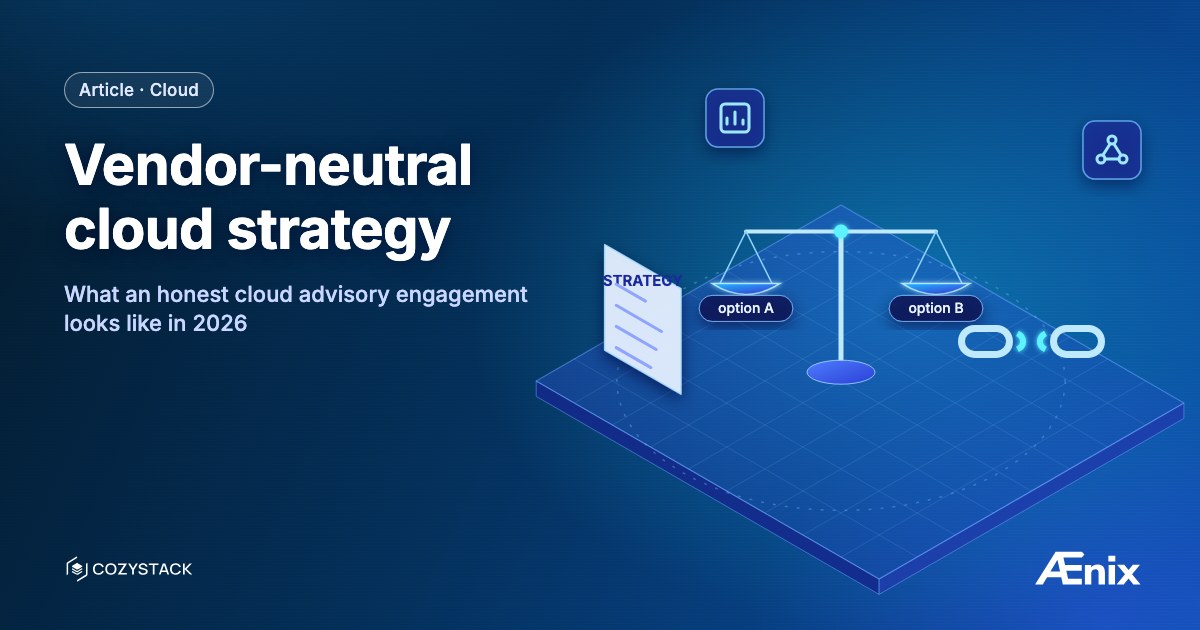
This article is the honest version. What does an Ænix-style vendor-neutral cloud strategy engagement deliver, why it’s different from hyperscaler-aligned or Big-4 alternatives, and when each is the right fit.
What “cloud strategy” actually has to answer in 2026
Five strategic questions dominate the 2026 conversation:
1. Where should each workload class live?
The 2018 default — “everything to public cloud” — has broken down. DORA-aligned workloads run differently than SaaS workloads. Sustained AI inference runs differently than spike-y customer-facing apps. Regulated data classes run differently than open data. The strategy has to take a position per workload class, not blanket all of them.
2. What’s the sovereignty position?
Different jurisdictions, different sectors, different customer relationships impose different sovereignty requirements. The strategy has to name the position explicitly — including what it costs in operational complexity and how it affects vendor selection.
3. What’s the cost trajectory?
Public-cloud bills compound. The strategy has to project cost across the next 3-5 years across each workload class and substrate option. Honest projection — including hardware refresh, platform-engineering capacity, vendor lock-in switching cost — not the marketing version.
4. What’s the operational model that scales?
DevOps-only? Platform engineering? SRE-embedded? Centralized SRE? The model has to fit the engineering organisation’s headcount profile and growth trajectory; mismatches cost more than they save.
5. How does the regulatory landscape evolve?
DORA applies since Jan 2025. NIS2 transposition deadline Oct 2024. EUCS adoption still pending. Sectoral overlays expanding. Sovereign-cloud frameworks sharpening. The strategy can’t be locked to today’s regulatory state; it has to incorporate likely 24-36 month evolution.
A “cloud strategy” engagement that doesn’t have positions on all five questions is not a strategy. It’s a tooling roadmap.
Why vendor-neutral matters
Hyperscaler-aligned and most Big-4 advisory practices have implicit commercial alignment that shapes recommendations:
- Hyperscaler-led advisory — AWS, Azure, GCP, IBM Cloud each fund their own and partner-led advisory practices. The advisory is structurally aligned to recommend that hyperscaler. Honest practitioners try to mitigate this, but the commercial incentive is clear.
- Big-4 cloud advisory — Deloitte, KPMG, EY, PwC each have partnership programmes with hyperscalers that influence recommendations. Most engagements end with a hyperscaler-aligned modernization plan because that’s where the integration revenue follows.
- Hyperscaler-partner SIs — Capgemini, Accenture, Infosys, Wipro have certified-partner status with hyperscalers and revenue alignment with hyperscaler-led implementation. Vendor-neutral by marketing; vendor-aligned by economics.
Vendor-neutral advisory means the engagement’s commercial outcome does not depend on the customer choosing any specific hyperscaler, distribution, or product. Ænix’s commercial model — we build and operate the Ænix cloud platform products — creates a different alignment: we want the strategy to land on one of them where it fits, but we explicitly do not push it when it doesn’t.
We will say “stay on hyperscaler” when the trade-offs warrant it. We say so in writing. The downside-incentive that creates is real — some engagements end with no follow-on platform work for Ænix — and that’s how vendor-neutrality is supposed to operate.
What our engagement actually delivers
A typical Ænix cloud strategy engagement covers:
Workstream 1 — Workload portfolio strategy
Workload-class taxonomy: regulated / non-regulated, sustained / spike-y, sensitive data class / non-sensitive, latency-critical / elastic. For each class, the substrate fit (public cloud / hyperscaler-managed / private cloud / sovereign / hybrid / edge).
Output: workload-class-to-substrate matrix with rationale per class.
Workstream 2 — Sovereignty position
Regulatory applicability across jurisdictions and sectors. Substantive sovereignty requirements per workload class. Vendor evaluation criteria from a sovereignty perspective.
Output: written sovereignty position with named jurisdictions, named substrate constraints, residual risk acceptance documented.
Workstream 3 — Cost trajectory
Three-to-five-year cost projection across substrate options. Honest TCO including hidden costs (egress, reservation under-utilization, platform-engineering capacity, vendor lock-in switching cost, hardware refresh cycles). Sensitivity analysis for key assumptions.
Output: spreadsheet your CFO can audit, plus narrative explanation.
Workstream 4 — Operational model recommendation
DevOps / SRE / platform engineering function design. Headcount projections. Hiring plan. Org-structure recommendations. Tooling priorities.
Output: org-design recommendations with named roles, RACI matrices, priority hiring queue.
Workstream 5 — Regulatory trajectory
24-36 month outlook on applicable regulations. EUCS adoption, NIS2 enforcement, sectoral overlay sharpening, sovereignty framework expansion. How the workload-portfolio strategy adapts as the regulatory landscape evolves.
Output: regulatory roadmap with checkpoint dates and decision triggers.
Synthesis: the 18-36 month plan
Five workstream outputs synthesised into a board-grade strategy document. Executive summary (3-5 pages). Workstream detail (5-8 pages per workstream). Roadmap with milestones (2-3 pages). Implementation sequencing recommendations.
Total: 30-50 page deliverable with executive deck for board / sponsor distribution.
Engagement variants
- 28-day strategic assessment — narrower scope, fixed-price, single workload portfolio segment
- 8-week strategy engagement — full five-workstream scope, fixed- price
- Quarterly strategic advisory — ongoing engagement for strategic decisions as they emerge (typically for tier-1 customers)
Where engagement value compounds
Strategic engagements often face a “shelfware” problem — the deliverable lands, gets distributed, and 18 months later nobody remembers what it said. Ænix engagement model addresses this:
- Engineer-written, not consultant-written — our deliverables are written by the same engineers who’d implement them; technical reproducibility means every claim traces to specific artefacts.
- Implementation continuity — if the customer engages Ænix for implementation, the engineering team that wrote the strategy participates in execution. No handoff loss.
- Decision-velocity over slide-grade polish — we deliver 30-50 pages of usable detail, not 100 pages of executive-grade theatre.
- Quarterly strategic advisory for tier-1 customers keeps the strategy current as the customer environment and regulatory landscape evolve.
When this engagement fits
Strong fit:
- CIO / CTO / Head of Cloud at €100M+ revenue organisation
- Pre-decision on a multi-year cloud direction (modernization, repatriation, sovereign cloud, AI infrastructure)
- Existing strategy work has produced vendor-aligned options that feel uncomfortable
- Regulatory pressure (DORA, NIS2, sectoral) requires substantive positioning beyond procurement-clause compliance
Marginal fit:
- Mid-size organisations with simpler decision space — may fit Platform Readiness Assessment (more tactical) rather than full strategy engagement
- Single workload class decision (e.g., AI infrastructure only) — may fit AI-specific Sovereign AI Architecture Review
Poor fit:
- Organisations that have already committed to a specific hyperscaler programme — Ænix can advise on specific architecture gaps within that commitment, but full strategy work assumes decisions remain open
- Strategy work that’s primarily change-management or organisational-restructure work — that’s a different category
How this differs from a Platform Readiness Assessment
The two engagements have overlapping scope but different purpose:
- Platform Readiness Assessment is tactical — assesses current state against a target architecture in 14 or 28 days and produces a remediation plan. Used when the strategic direction is settled.
- Cloud Strategy Consultancy is strategic — defines the target architecture and substrate position. Used when the strategic direction is still in question.
Most customers eventually engage both, sequentially: strategy engagement first, then assessment, then implementation.
Where to dig deeper
- Cloud strategy consultancy services — the commercial landing
- Platform Readiness Assessment — the tactical assessment engagement
- Cloud Readiness Assessment — 14-day methodology — methodology detail for the tactical engagement
- Cloud engineering disciplines in 2026 — the seven cloud-engineering disciplines
Test yourself: vendor-neutral cloud strategy
5 questions · ~2 min