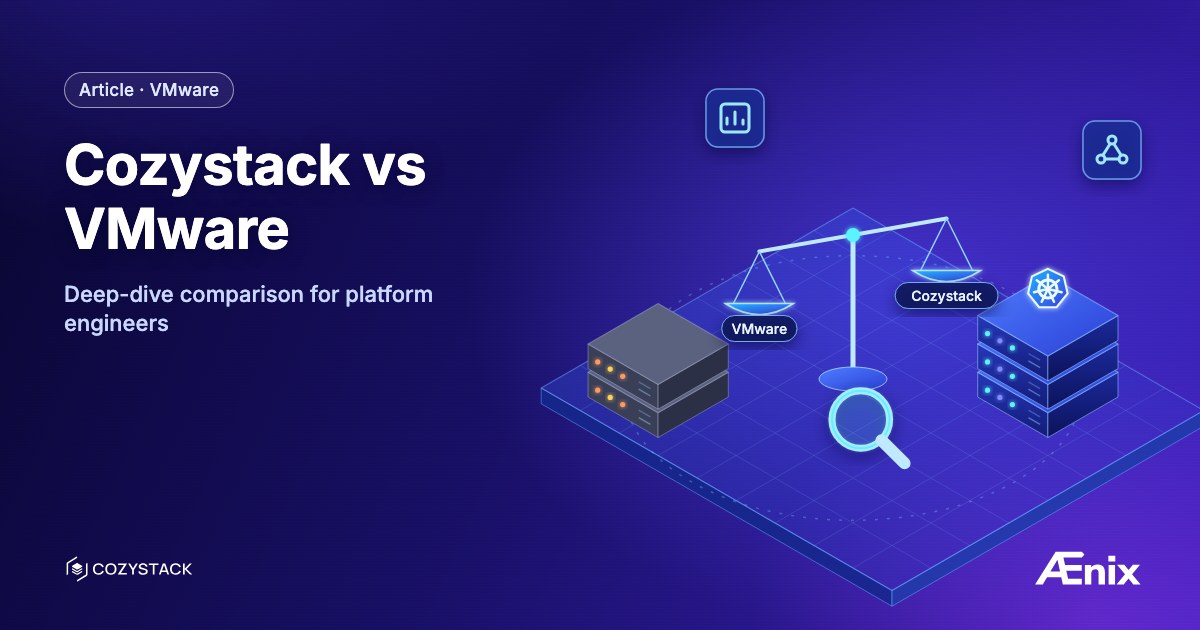
This article assumes familiarity with both platforms. For broader VMware exit guidance see VMware alternative or VMware migration.
Compute layer
VMware vSphere/ESXi: mature type-1 hypervisor. Strong VM lifecycle, live migration with shared storage, vMotion. Tight VMware Tools integration with guests.
Cozystack KubeVirt: qemu/KVM wrapped in Pods. KVM itself is a kernel-mode hypervisor, so the guest still runs on hardware virtualization extensions — the Pod is a scheduling and lifecycle wrapper, not an extra emulation layer. Live migration (CPU; GPU live migration is industry-wide limitation). Standard QEMU/KVM under the hood; broad guest OS support.
In practice both deliver production-grade VM workloads. The KubeVirt model adds Kubernetes operational integration (declarative VM config, GitOps lifecycle, native ingress, observability).
Storage layer
VMware vSAN: software-defined storage built into vSphere. Operationally smooth; tight integration. Tied to VMware licensing.
Cozystack LINSTOR: open-source replicated block storage, deployed through the Piraeus operator. LINSTOR uses DRBD for synchronous replication; object storage is a separate layer (SeaweedFS). More operational responsibility; more architectural flexibility.
For most workloads, LINSTOR matches vSAN in operational characteristics. Where S3-style object storage is also needed, Cozystack ships SeaweedFS as the managed Bucket service.
Network layer
VMware NSX: software-defined networking. L2 distributed virtual switches, L3 routing, micro-segmentation, edge gateway. Mature; complex.
Cozystack Cilium: eBPF-based CNI with L4/L7 policies, observability, service mesh integration, MetalLB / BGP. Newer architecture; often simpler.
Migration from NSX-heavy environment to Cilium requires policy redesign — not a 1:1 mapping. The architectural model is different.
Multi-tenancy layer
VMware vCloud Director: mature multi-tenant overlay on vSphere. Service-provider features (organization, vDC, catalogs).
Cozystack Tenant CRD: Kubernetes-native multi-tenant abstraction. Nested tenants, per-tenant quotas, scoped audit, billing-friendly.
Tenant model is conceptually different — vCD organizations vs Tenant CRD instances. Migration requires re-mapping tenant structure to Kubernetes-native equivalent.
Operational implications
Daily operations
VMware: vCenter UI for ad-hoc operations; PowerCLI / Ansible for automation. SSH not the default model.
Cozystack: kubectl + GitOps as the default model. Cozystack Dashboard UI for tenant operations. GitOps PR review for change-management.
The shift from vCenter-centric to kubectl-centric is a real operational learning curve for VMware-trained teams. Most engineers ramp in 4-8 weeks with focused training.
Upgrades
VMware: vCenter upgrade, then ESXi upgrade per host (rolling). Mature process.
Cozystack: Talos OS upgrade + Kubernetes upgrade + Cozystack operator upgrade. GitOps-driven. Rolling per host.
Both rolling-upgrade. Operationally similar in spirit; tooling different.
Backup / DR
VMware Site Recovery Manager: mature DR orchestration. Tested at scale.
Cozystack Velero + per-app PITR: Velero handles cluster-level backup; per-app patterns (PostgreSQL PITR, etc.) on top. More moving parts; more flexibility.
For mission-critical DR, both work. The pattern is different — SRM is plug-and-play vendor-managed orchestration; the Velero stack is backup and restore with rehearsed runbooks, more transparent and tunable, and there is no SRM-style orchestrated cross-site failover.
Migration patterns
VMware → Cozystack migration in production:
- Discovery — vSphere/VCF inventory; workload classification.
- Cozystack foundation — parallel deployment; not a tenant of VMware.
- Image migration — KubeVirt CDI imports VMDK or qcow2 images. Windows VMs get VMware Tools cleanup before first KubeVirt boot.
- Network cutover — VLAN mapping into Cilium; policy parity validated against NSX rules.
- Storage cutover — vSAN → LINSTOR (DRBD); data migration during cohort cutover.
- DR cutover — Velero backup and restore with rehearsed runbooks takes over from SRM-based plans (no orchestrated cross-site failover); tested per cohort.
- VMware decommission — staged as cohorts complete.
Typical elapsed time: about 8-12 months for ~100 VMs and 18-24 months for ~1,000 VMs, including planning and migration waves; mid-size estates fall in between, depending on dependencies. The driver is rarely raw copy speed — it is regression testing and the parallel-run windows application owners will agree to.
When the comparison matters
This level of detail is useful when:
- Architecture review is in progress
- Phase 2 implementation planning
- Specific operational concerns (storage performance, network latency, etc.)
- Team training planning
For higher-level evaluation, VMware alternative is more appropriate starting point.
Test yourself: Cozystack vs VMware deep-dive
5 questions · ~2 min