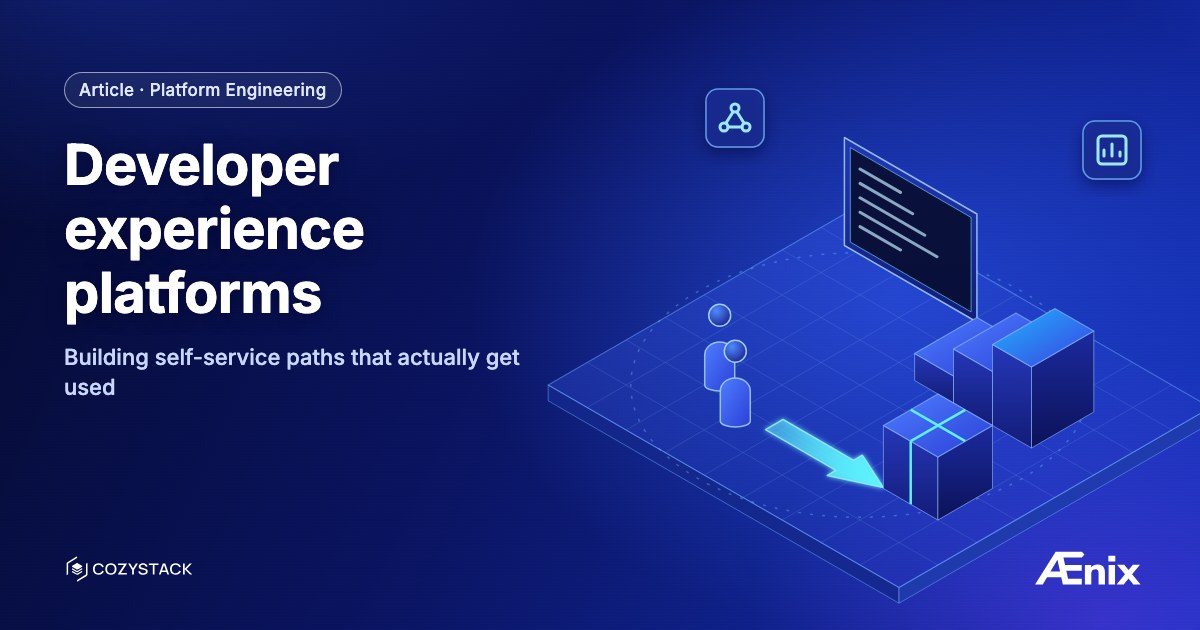
Most “developer experience” articles in 2026 stop at “use Backstage.” That’s not the answer; that’s a tooling decision that comes after the architectural decisions. The architectural decisions determine whether self-service paths actually work.
Why self-service is the leverage
For a 200-engineer organization, time-to-environment of 2-5 weeks costs ~5% of engineering productivity (rough estimate from our engagements). Compressing that to hours is worth the platform investment.
But the savings only realize if product teams actually use the self-service paths. A platform that’s technically self-service but operationally clunky doesn’t get adopted; teams keep filing tickets because tickets feel reliable.
Adoption is the metric. Architecture decisions cascade from there.
Five characteristics of golden paths that work
1. Faster than the ticket alternative
The self-service path produces a working result faster than the ticket alternative. If a ticket takes 3 days and self-service takes 2 days, teams will choose the ticket because waiting is easier than learning.
2. Reliable enough to trust
The self-service path works the first time, every time, for the documented use case. If it breaks 1 in 10 times, teams stop trusting it.
3. Documented in 1 page or less
Documentation longer than a page suggests architecture is wrong. Real golden paths are simple by design.
4. Owned by a real team
A team that maintains the path, fields edge cases, ships improvements. Without ownership, paths decay.
5. Has escape hatches
Product teams can deviate when their case is special. The escape is to a real conversation with platform team, not “you must use the path or fail.”
The 10 paths most worth building
Roughly in order of leverage:
- Environment provisioning — dev / staging / preview / prod. The biggest single self-service win.
- Application deployment — image push → automated deploy.
- Database provisioning — managed PostgreSQL most common; MySQL, Redis next.
- Observability onboarding — auto-instrumented metrics, logs, traces.
- Object storage bucket — S3-compatible, with lifecycle policies.
- Secrets management — secret creation and access binding.
- Network access — to legacy services, shared databases, partners.
- CI/CD pipeline setup — service template + automated pipeline.
- Identity / SSO integration — workforce identity to service identity.
- Backup/DR setup — for stateful workloads.
The first three (environment + deployment + database) cover ~60% of typical product-team request volume. Build them first.
Architectural decisions that shape self-service
Provisioning model
- GitOps + IaC — product teams commit IaC manifests; platform reacts. Most common in 2026.
- API-driven — REST/RPC API exposed by platform; product teams call directly or via portal.
- Operator-driven — Kubernetes operators per resource type; product teams create CRD instances.
- Click-ops via portal — Backstage / Port / custom UI exposing operator-backed actions.
Most organizations use a mix: GitOps + IaC as the source of truth, portal as the discoverability layer for non-Kubernetes-fluent teams.
Tenant model
- Namespace per team — soft isolation, simplest, default for trust-each-other organizations.
- Cluster per team — hard isolation, operationally expensive, necessary for high-isolation cases.
- Tenant CRD per team — Kubernetes-native isolation with shared cluster, operationally efficient. Cozystack default.
Identity model
Workforce identity (Keycloak / Okta / Azure AD) federates to platform identity. Service identity (SPIFFE/SPIRE or service accounts) handles service-to-service. Joining the two is platform-team work.
What goes wrong
Path 1: Backstage as the platform
Buying Backstage before the underlying capabilities are self-service produces a beautiful catalog over the same operational mess. Adoption stalls.
Path 2: too rigid
Golden paths must serve 80% of cases. The remaining 20% need escape hatches; without them, teams that have specialized needs route around the platform entirely.
Path 3: unstaffed paths
Platform team builds paths and moves on. Paths decay; bug reports pile up. Teams lose trust.
Path 4: optimizing for engineering elegance
Architecturally beautiful self-service that’s operationally clunky. Product teams care about results, not architecture.
Path 5: skipping the discovery
Building paths that platform team thinks are needed; turns out the actual top-10 requests are different. The fix: ask product teams what they request most often, build for those.
Implementation sequence
- Inventory current ticket flow — what 10 things do product teams request most? Per-team interviews surface this.
- Pick top 3-5 — covering ~60% of volume.
- Build golden path for each — typically 1-2 months elapsed per path with adequate platform-team capacity.
- Iterate on adoption — collect feedback; fix friction; add documentation.
- Add path 4-10 over subsequent quarters — based on observed demand.
How to assess and start
If self-service is on the table, the structured assessment names the top requests, where current paths fail, and what the priority build sequence looks like. Ænix runs this as part of Platform Readiness Assessment.
For details see developer self-service services and internal developer platform services.
Test yourself: self-service paths that get used
5 questions · ~2 min