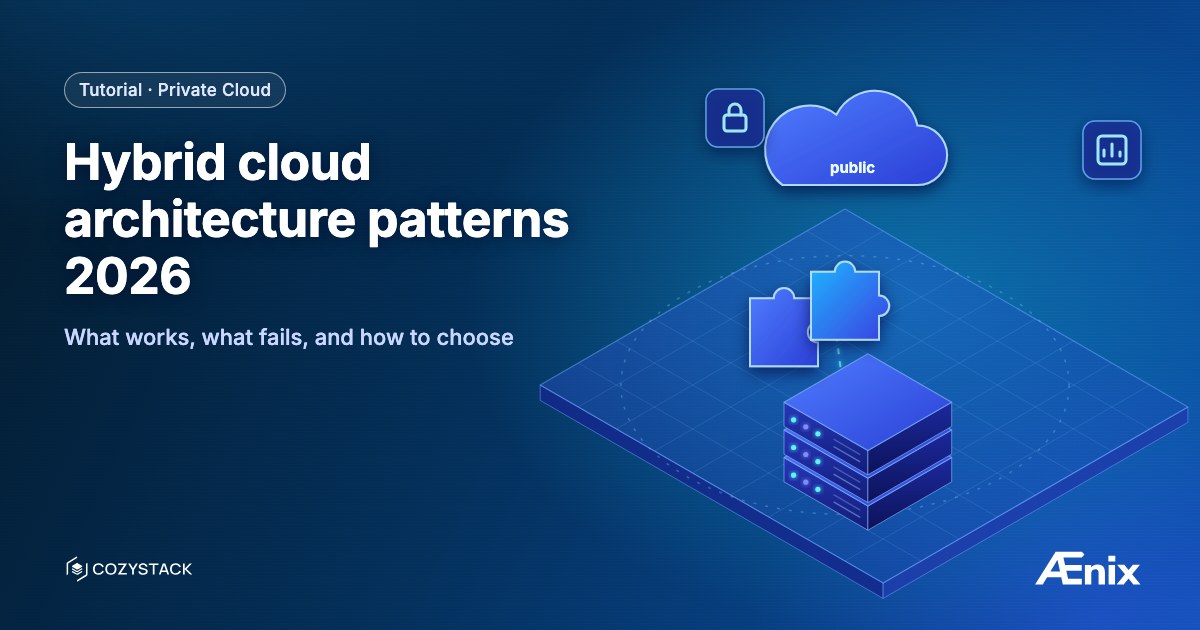
Hybrid cloud as a term has accumulated marketing weight. Vendors describe almost any non-pure-public-cloud architecture as “hybrid.” The architecturally-relevant question is more specific: what coherent integration pattern connects your private and public substrates, and does it actually work for your workload portfolio?
This is the working version.
What hybrid cloud actually means
Three definitions, in increasing order of architectural usefulness:
- Hybrid as workload distribution. Some workloads in public cloud, some in private cloud, no integration. Most “hybrid” architectures stop here. (Practical but operationally fragmented.)
- Hybrid as data flow. Some workloads in each substrate, with explicit data flow architectures connecting them. (Architecturally honest about cross-substrate dependencies.)
- Hybrid as unified platform. Single platform abstraction running on multiple substrates, with consistent operations, deployment, and observability. (Where the leverage is.)
We engineer toward (3) because (1) becomes operational debt, and (2) is half the work.
Five working hybrid patterns
Pattern 1: Steady-state on-prem + elastic in public cloud
What: Predictable steady-state workloads (databases, batch processing, internal apps) on private cloud. Elastic spike workloads (customer-facing web, ML training) in public cloud. Cross-substrate data flow is designed (not accidental).
Best for: SaaS companies with predictable steady-state customer count + spike-y customer-facing patterns. Most common hybrid pattern in 2026.
Operational pattern: Two substrates with shared platform abstraction (Cozystack on private + Cozystack control plane managing public-cloud Kubernetes). Workloads are portable in principle; in practice, steady-state ones don’t move.
Pattern 2: Critical on-prem + non-critical in public cloud
What: Regulated workloads (banking, healthcare, public-sector) on private cloud. Auxiliary workloads (analytics, internal tooling, dev/test) in public cloud. Sovereignty drives the split.
Best for: Financial services, healthcare, public-sector. The default when DORA / sectoral / data-residency rules drive architecture.
Operational pattern: Stricter isolation between substrates than Pattern 1. Cross-substrate flows audited and minimized. Audit-readiness drives architecture.
Pattern 3: Geographic split
What: EU workloads in EU on-prem; non-EU workloads in regional public cloud. Driven by sovereignty rather than cost or workload type.
Best for: Multinational enterprises with strong sovereignty pressure in some markets but commercial freedom in others.
Operational pattern: Per-jurisdiction tenant isolation. Cross-jurisdiction data flows under explicit legal basis (SCCs, BCRs, etc.).
Pattern 4: Edge + core hybrid
What: Centralized core (private cloud or hyperscaler region) plus edge sites at customer / branch / factory locations. Cross-edge synchronization handled at platform level.
Best for: Telco edge compute, retail, manufacturing, smart-grid operators.
Operational pattern: Edge sites are smaller, simpler instances of the platform; core has full feature surface.
Pattern 5: AI-specific split
What: AI training and inference on dedicated GPU infrastructure (private cloud); rest of business on public cloud or hybrid mix. AI workload economics drive the split.
Best for: AI-heavy organizations where sustained GPU utilization makes hyperscaler economics untenable. Increasingly common in 2026.
Operational pattern: AI cluster operates as a sub-platform; data and model flows between AI cluster and other workloads are designed.
What makes hybrid actually work
Beyond the pattern, three architectural principles separate working hybrid from fragmented multi-cloud:
Principle 1: one platform abstraction
The Kubernetes API (or equivalent) is the lingua franca across substrates. Workload deployment, observability, identity, and operational practices are consistent. The platform team operates one platform, not three.
Cozystack supports this directly: same control plane managing customer-hardware clusters, public-cloud-region deployments, and edge sites.
Principle 2: workload portability where it matters
Critical workloads use platform abstractions that work on multiple substrates. Non-critical workloads can be hyperscaler-native if that’s the right trade-off.
Principle 3: explicit data flow control
Cross-cloud and cross-region data flows are designed, costed, and monitored. Egress is a budget line; sovereignty implications are documented; latency profiles known.
Common failure modes
Failure 1: hybrid as fragmented teams
Public-cloud team and on-prem team operating separately. Different tooling, different deployment patterns, no shared platform. “Hybrid” in name; multi-team chaos in practice.
Failure 2: cloud bursting nobody uses
Architecture supports bursting from on-prem to public cloud for capacity overflow. In production, bursting capability is theoretical — cross-substrate data movement is too slow. Architecture is over-engineered for unused capability.
Failure 3: vendor-led hybrid platform
A vendor sells a “complete hybrid solution” running their software in your datacenter and theirs. Lock-in is structural; vendor’s roadmap becomes yours.
Failure 4: operational drift
Same workload runs differently on public cloud and on-prem because tooling diverges over time. Portability degrades; cost of moving workloads grows.
Failure 5: implicit data flows
Cross-substrate traffic emerges from accidental architecture decisions. Egress costs surprise; sovereignty audit finds compliance gaps.
When hybrid is wrong
A few honest cases where pure architecture beats hybrid:
- All workloads are elastic and not regulated — pure public cloud usually wins.
- All workloads are steady-state, regulated, and modest in scale — pure private cloud usually wins.
- Engineering organization is small — operating one substrate is hard enough; two is harder.
- Workload portability genuinely doesn’t matter — pure hyperscaler-native architecture has its merits.
The honest engagement says “stay pure” when that’s the answer.
Implementation sequence
A practical sequence for moving from fragmented multi-cloud to coherent hybrid:
- Workload classification — every workload labeled “this substrate, this reason.”
- Platform foundation — Cozystack (or chosen platform) deployed on private substrate; control plane reach extended to public-cloud regions.
- Migration cohort 1 — handful of workloads moved to the unified platform pattern; pattern validated.
- Operational unification — observability, identity, deployment unified across substrates.
- Migration cohorts 2-N — remaining workloads aligned with the pattern.
- Steady state — single platform team, single operations model, multiple substrates.
Total elapsed: typically about 8-12 months for ~100 VMs and 18-24 months for ~1,000 VMs, including planning and migration waves.
Want to dig deeper?
- Hybrid cloud platform services — engagement details
- Cloud repatriation — when leaving public cloud
- Private cloud consulting — private side
- Cozystack — the platform
Test yourself: hybrid cloud architecture
5 questions · ~2 min