The “should we invest in a platform team?” conversation tends to stall at one of two places: either the CFO can’t see the economic case (“we already pay DevOps engineers, why add more headcount?”), or the engineering organisation tried Backstage-as-a-platform once, found it shallow, and has lost trust in the category.
This article walks through both. What does the cost of developer drag actually look like in numbers? What does an IDP that works deliver? And what does the developer self-service layer of Ænix Private Cloud Platform do that you’d otherwise have to build?
The cost of developer drag
The most consistent finding across our platform-readiness assessments of 200-engineer-plus organisations is that time-to-environment is 2-6 weeks for what should be a 30-minute self-service action.
Where does the time go? Typically:
- IAM: a ticket to the security team, 2-5 days
- Network connectivity: a ticket to network engineering, 3-7 days
- Observability onboarding: ad-hoc, often discovered as missing late
- Compliance review: 1-3 days, sometimes longer for regulated data
- Approval chain: 2-4 days, occasionally longer in matrixed orgs
Each step requires a handoff, which means context loss, which means re-confirmation, which means more time. The standalone steps are small; the cumulative friction is large.
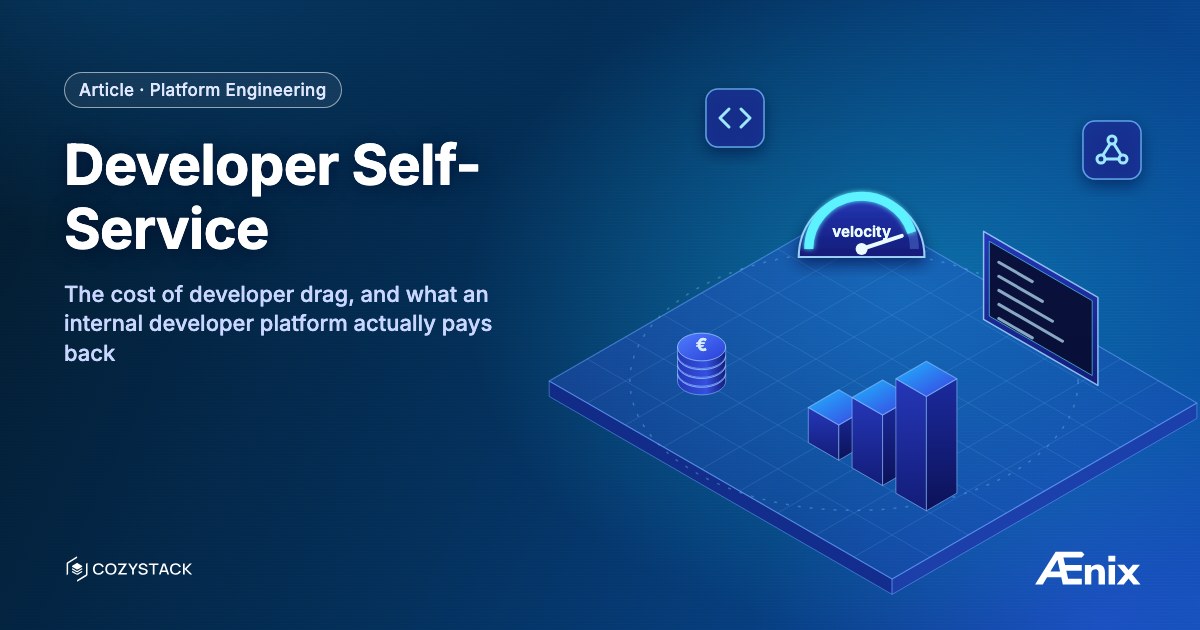
At 5% of engineering productivity (rough estimate from our engagements matching the 200-engineer scale and 2-6 week time-to-environment), the cost of drag on a 200-engineer organisation is ~10 engineers’ worth of lost throughput per year — roughly €1.5-2M at fully loaded rates. Compressing time-to-environment to hours captures most of that.
The internal-developer-platform investment that delivers this compression typically pays back inside 12 months for organisations of this scale.
What “platform that works” actually delivers
For a credible IDP, five characteristics matter more than tool choice:
1. Faster than the ticket alternative
If self-service takes 2 days and a ticket takes 3 days, teams will take the ticket — waiting is easier than learning. The platform has to be substantially faster for adoption to flip.
2. Reliable enough to trust
The self-service path works the first time, every time, for the documented use case. If it breaks 1 in 10 times, teams stop trusting it. Adoption stalls.
3. Documented in one page or less
If the docs are longer than a page, the architecture is too complex. Real golden paths are simple by design.
4. Owned by a real team
A team maintains the path, fields edge cases, ships improvements. Without ownership, paths decay. The platform-engineering function must be a function, not a hobby.
5. Has escape hatches
Product teams can deviate when their case is special. The escape is to a real conversation with the platform team, not “use the path or fail.”
What developer self-service on Private Cloud Platform ships
The developer self-service layer of Ænix Private Cloud Platform is the productisation of these characteristics on top of the Cozystack foundation. Specifically:
A multi-tenant Cozystack platform with Tenant CRD
Every product team gets a Tenant — a Kubernetes-native object with its own namespace, quota, RBAC, observability scope. Per-tenant isolation without per-team cluster overhead. Nested tenants support business-unit hierarchies.
This solves the “soft multi-tenancy is too leaky, cluster-per-team is operationally expensive” trilemma without compromise.
Golden-path-first Cozystack Dashboard
The Cozystack Dashboard in Private Cloud Platform exposes opinionated paths for the 5-10 most common product-team needs: environment provisioning, application deployment, managed-database provisioning, observability onboarding, secrets management. Each path completes in minutes.
Curated, not exhaustive — what your platform team can actually back with support, not every Cozystack capability.
GitOps automation
Argo CD and Argo Workflows pre-integrated with the platform. GitLab integration for the most common enterprise SCM. Product teams commit IaC; the platform reacts. No clicky-clicky for production changes.
Pre-built service templates
Standard service templates (HTTP API, batch worker, scheduled job) with embedded observability, deployment, alerting. New service = template instantiation. Time-to-first-production-deploy is hours, not weeks.
Internal-product-management discipline built in
The platform team is treated as a function with product-team customers. The engagement includes platform-team RACI, internal-NPS metrics, deprecation policy templates, roadmap-management patterns. The discipline is often the missing piece.
What stays the customer’s responsibility
Developer self-service on Private Cloud Platform is the platform substrate plus the operational discipline. Several things remain yours:
- Defining your specific golden paths — the 5-10 you build first depend on what your product teams actually request most.
- Platform-engineering team sizing — typical mature ratio is 1 platform engineer per 10-20 product engineers; we recommend hiring ahead of demand.
- Adoption — a great platform that nobody uses is a sunk cost. Platform-team product-management practices (interviewing product teams, measuring adoption per path, sunsetting paths that don’t get used) need to happen.
Ænix’s engagement model supports all three but doesn’t replace customer ownership. Platforms that customers don’t own organisationally don’t outlast the engagement.
The economic case versus alternatives
Versus DevOps-only
DevOps without separate platform engineering scales linearly with team count — every product team figures out infrastructure, observability, identity, release engineering independently. Above ~50 engineers the duplication overwhelms the savings. Above ~200 engineers it’s an operational drag.
Developer self-service on Private Cloud Platform shifts the model: platform engineering compounds sublinearly with team count. Adding the 21st product team doesn’t add 21st-team’s-worth of platform overhead — the existing platform absorbs them.
Versus building it yourself on vanilla Kubernetes + Backstage
This is a credible alternative for organisations with strong platform engineering capacity and clear architectural opinions. Trade-off: 12-24 months of build time before the platform reaches “production ready” for product teams; ongoing platform-component maintenance overhead.
Ænix Private Cloud Platform, which includes developer self-service, delivers the platform substrate within a 3-12 month build, with ongoing Ænix support. For organisations not staffed for a 12-24 month build, this is the difference between platform engineering happening this year or in 2028.
Versus Backstage-as-platform anti-pattern
Backstage is a portal, not a platform. Buying Backstage before the underlying capabilities are self-service produces a beautiful catalog over the same operational chaos. Adoption stalls.
Private Cloud Platform’s Cozystack Dashboard can be replaced or augmented by Backstage if the customer prefers — but the underlying capabilities (environment provisioning, observability, secrets, identity) are self-service because the platform is, not because the portal pretends they are.
Versus hyperscaler-managed Kubernetes (EKS / AKS / GKE)
Hyperscaler managed Kubernetes is operationally simpler than self- managed clusters. Trade-off: vendor lock-in (control plane is the vendor’s; you can’t replicate exactly elsewhere); cost ceiling (hyperscaler economics on sustained workloads); sovereignty implications.
Private Cloud Platform fits when the cost or sovereignty trade-offs make self-managed worth the operational investment. For early-stage companies without sovereignty pressure, hyperscaler-managed is still the right call.
When developer self-service is the right answer
Strong fit:
- 200+ engineers across 5+ product teams
- Time-to-environment is currently 2-6 weeks; target is hours
- Existing platform team is overwhelmed by ticket volume rather than building paths
- Multi-tenant isolation matters (regulated data, BU separation, or service-provider model)
- Investment in platform engineering is supported by engineering leadership
Marginal fit:
- 100-200 engineers with growing platform pain but limited budget; start with Cozystack Enterprise Support and scale into the Ænix Private Cloud Platform as the team grows
- Strong existing in-house platform with specific gaps — partial engagement may fit better than a full Private Cloud Platform build
Poor fit:
- Under 50 engineers, single product team; DevOps-only is right
- Hyperscaler-managed Kubernetes meets all requirements; sovereignty not a concern
Engagement structure
- Discovery call (30 min, free) — fit assessment
- Platform Readiness Assessment (14- or 28-day, IDP workstream emphasised) — current-state time-to-environment, maturity score, recommended golden paths
- Pilot deployment (3-6 months) — Cozystack platform + 3-5 golden paths + 2-3 pilot product teams onboarded
- Full build (within the 3-12 month Private Cloud Platform build, depending on scope) — platform expanded to the full engineering organisation, all targeted golden paths shipped
- Support subscription (ongoing) — Plus or Enterprise support tier for 24×7 escalation (see /pricing/)
Engagement size: project plus support subscription, quoted per RFP.
Where to dig deeper
- Private Cloud Platform landing — feature list, product-specific FAQ
- Internal Developer Platform services — engagement details
- Platform Engineering services — broader scope
- Developer self-service solutions — buyer-trigger landing
- Internal developer platform examples — 6 patterns — the six production IDP patterns
- Internal developer portal vs platform — Backstage’s place in 2026
Test yourself: developer self-service economics
5 questions · ~2 min