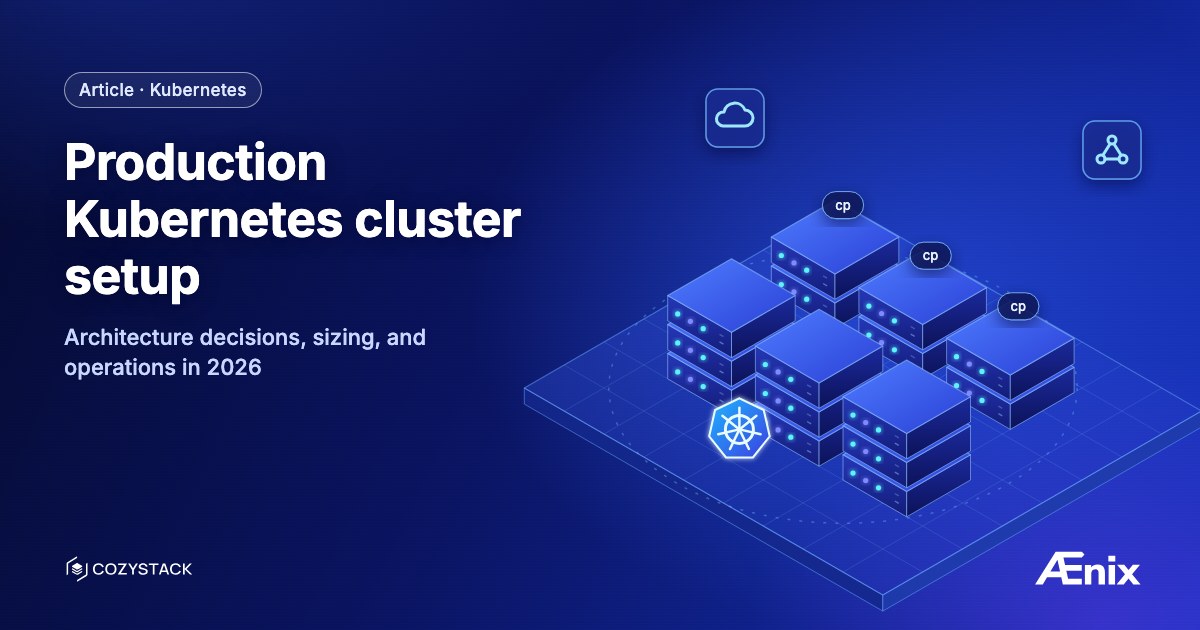
Most Kubernetes-setup tutorials get you a cluster. They don’t get you a production-ready cluster. The difference is the dozen architectural decisions that don’t show up in a “kubectl apply” workflow but that determine whether your cluster operates well at scale or becomes a permanent maintenance burden.
Decision 1: distribution choice
The question “which Kubernetes distribution” looks like a tooling decision. It’s actually an architectural decision because it determines:
- Operational model (managed vs self-managed control plane)
- Multi-tenancy approach
- Storage and networking integration
- Vendor relationship (open-source vs commercial)
- Long-term cost trajectory
Common 2026 options:
- Vanilla Kubernetes (kubeadm / Cluster API) — maximum control, maximum operational responsibility. Right for organizations with strong platform-engineering capability.
- Cozystack — open-source, CNCF Project, multi-tenant + virtualization (KubeVirt). Right for service providers, sovereign-cloud builders, regulated multi-tenant.
- OpenShift / OKD — Red Hat commercial / community. Right for enterprises already on Red Hat with established procurement relationship.
- Rancher / RKE2 — SUSE-backed, multi-cluster management. Right for distributed cluster fleets.
- Talos — minimal Linux + Kubernetes only. Right as the OS layer underneath Cozystack or vanilla Kubernetes.
- Hyperscaler-managed (EKS / AKS / GKE) — control plane managed; you operate workloads. Right when sovereignty isn’t a constraint and operational simplicity beats cost.
Distribution choice is structural; getting it wrong is expensive to undo.
Decision 2: multi-tenancy
Kubernetes ships with namespaces, not multi-tenancy. The question is how to bridge the gap.
Patterns:
- Soft multi-tenancy (namespaces + RBAC) — single cluster, multiple namespaces, RBAC to separate. Simplest, least isolation. Acceptable for trusting tenants (BUs of one organization).
- Hard multi-tenancy (Tenant CRD) — Kubernetes-native tenant abstraction, with namespace, quotas, RBAC, observability scope, audit trail. Right for service-provider model or regulated multi-tenancy. Cozystack ships this out of the box.
- Cluster per tenant — physical isolation. Highest assurance, highest operational cost. Right for customers requiring full isolation (high-stakes regulated, classified).
The choice depends on the trust model and isolation requirements. Most multi-tenant deployments in 2026 use Tenant CRD pattern — strong isolation without per-tenant cluster overhead.
Decision 3: networking (CNI)
CNI choice in 2026 has converged on:
- Cilium — eBPF-based, network policies + observability + service mesh in one. Default for new deployments. CNCF Graduated.
- Calico — long-standing, BGP-friendly, strong on network policies.
- Flannel — simpler, less feature-rich.
- Cloud-provider CNIs — AWS VPC CNI, Azure CNI, GCP — when running in cloud.
For production multi-tenant deployments, Cilium is increasingly the default — its network policies integrate with the multi-tenancy model and observability is native.
Decision 4: storage
Storage in Kubernetes is a separate operational discipline. Options:
- LINSTOR (DRBD) — replicated block storage. Production-grade for stateful workloads. Cozystack default.
- Rook + Ceph — object + block + file storage. Heavier operational footprint; powerful when justified.
- Longhorn — Rancher-led replicated block storage. Easier than Ceph, less mature than LINSTOR.
- Vendor SAN / hyperconverged — VMware vSAN, NetApp, Pure Storage. Operational handoff to vendor; cost ceiling.
- Cloud-provider storage — EBS, Azure Disks, GCP PD — when cloud-managed.
For production stateful workloads on bare metal, LINSTOR/DRBD are the realistic choices. Cozystack ships LINSTOR; it’s been validated in production.
Decision 5: identity and secrets
Workload identity in Kubernetes:
- SPIFFE/SPIRE — open-source, workload identity standard. Increasingly default for service-to-service auth.
- Cloud-provider workload identity — AWS IAM Roles for Service Accounts, Azure AD Workload Identity, GCP Workload Identity. Locks identity to the cloud provider.
- OIDC + service accounts — Kubernetes-native, federated with workforce identity (Keycloak, Okta).
Secrets management:
- External Secrets Operator + cloud-provider secret stores (AWS Secrets Manager, Azure Key Vault).
- HashiCorp Vault — for organizations already on Vault.
- Sealed Secrets — for GitOps-friendly encrypted-at-rest secrets in Git.
The right combination depends on your existing identity infrastructure.
Decision 6: GitOps engine
Two production-grade options:
- Argo CD — UI-rich, plugin ecosystem, multi-tenancy via projects.
- Flux — closer to upstream Kubernetes, Helm-controller-native, lighter operational footprint.
Both are CNCF Graduated. Cozystack uses Flux. The choice depends on team familiarity and operational style preferences.
Decision 7: observability stack
Three serious options for self-hosted:
- VictoriaMetrics + VictoriaLogs — low-overhead, single-binary, performant at scale. Cozystack default.
- Prometheus + Loki — Grafana ecosystem standard. More memory-intensive; complex at scale.
- Commercial (Datadog, New Relic, Splunk) — SaaS, sovereignty implications.
For sovereignty-sensitive or cost-sensitive deployments, VictoriaMetrics + VictoriaLogs has been our default recommendation since ~2024.
Decision 8: backup and DR
- Velero — Kubernetes-native backup, restore to any cluster. CNCF Project.
- Stash / Kanister — backup operators with stronger app-aware features.
- Cloud-provider backup — managed backup services on hyperscaler clusters.
For DR specifically: per-app patterns (PostgreSQL PITR, etc.) on top of Velero infrastructure is the production pattern.
Decision 9: ingress and load balancing
- Cloud LB + ingress controller (NGINX / Traefik / Contour) — when running in cloud.
- MetalLB + ingress controller — bare metal layer-2 load balancing.
- Cilium L7 load balancing — when Cilium is the CNI.
- Service mesh (Istio / Linkerd) — for advanced traffic management.
Bare-metal deployments default to MetalLB + Cilium today.
Decision 10: lifecycle management
How clusters get upgraded, scaled, and recovered:
- Cluster API — Kubernetes-native cluster lifecycle. Used by Cozystack.
- Kubeadm + manual upgrades — works for small fleet.
- Vendor-managed lifecycle — OpenShift, Rancher, vendor-led.
- Hyperscaler-managed — control plane upgrades automatic.
For production fleets >5 clusters, Cluster API or vendor-managed lifecycle pay back the operational cost.
Operational practices that matter
Beyond architecture, the practices that determine whether a cluster operates well:
SLOs and error budgets
Define cluster-level SLOs (control plane availability, ingress availability, etc.). Define workload-level SLOs per service. Use error budgets to drive prioritization.
Documented runbooks
Common operational scenarios documented: pod failure, node failure, control-plane recovery, certificate rotation, storage failure, network failure. Practice them.
Capacity planning
Compute, memory, and storage capacity tracked. Forecasted against workload growth. Decisions made before resource exhaustion.
Upgrade discipline
Kubernetes minor versions every quarter; cluster upgrades quarterly or twice-yearly. Skip-version upgrades are not supported by upstream — keep current.
Incident response
On-call rotation, incident commander role, blameless post-mortems with documented action items.
Security posture
Pod Security Standards enforced; network policies as default-deny; secrets in cloud secret stores or Vault; image scanning in CI; runtime threat detection where applicable.
Common production-readiness failures
Failure 1: dev cluster scaled to prod
Cluster started for dev; workloads moved to prod without re-architecting. Falls over the first time prod load arrives.
Failure 2: no observability budget
Prometheus runs out of memory at production scale; metrics retention dropped to 7 days; observability becomes useless. Should have been planned upfront.
Failure 3: security as afterthought
Pod Security Standards not enforced; network policies absent; secrets in plain ConfigMaps. Audit findings drive emergency remediation.
Failure 4: upgrade debt
Kubernetes 3-4 minor versions behind; upgrades are big-bang projects; technical debt compounds.
Failure 5: no platform team
Cluster is “owned” by everyone, operated by no one. Drift accumulates; nobody can confidently change anything.
How to assess what you have
Before building or scaling, an architecture review is the cheapest insurance. The output is a written assessment of where you stand, where the gaps are, and what production-readiness looks like for your scale.
Ænix runs Kubernetes architecture reviews as part of the fixed-price Platform Readiness Assessment: 14 days for a focused review, 28 days for the full assessment.
Want to dig deeper?
- Kubernetes consulting services — engagement details
- Platform engineering services — broader scope
- Internal developer platform — IDP layer
- Cozystack — open-source platform foundation
Test yourself: production Kubernetes setup
5 questions · ~2 min