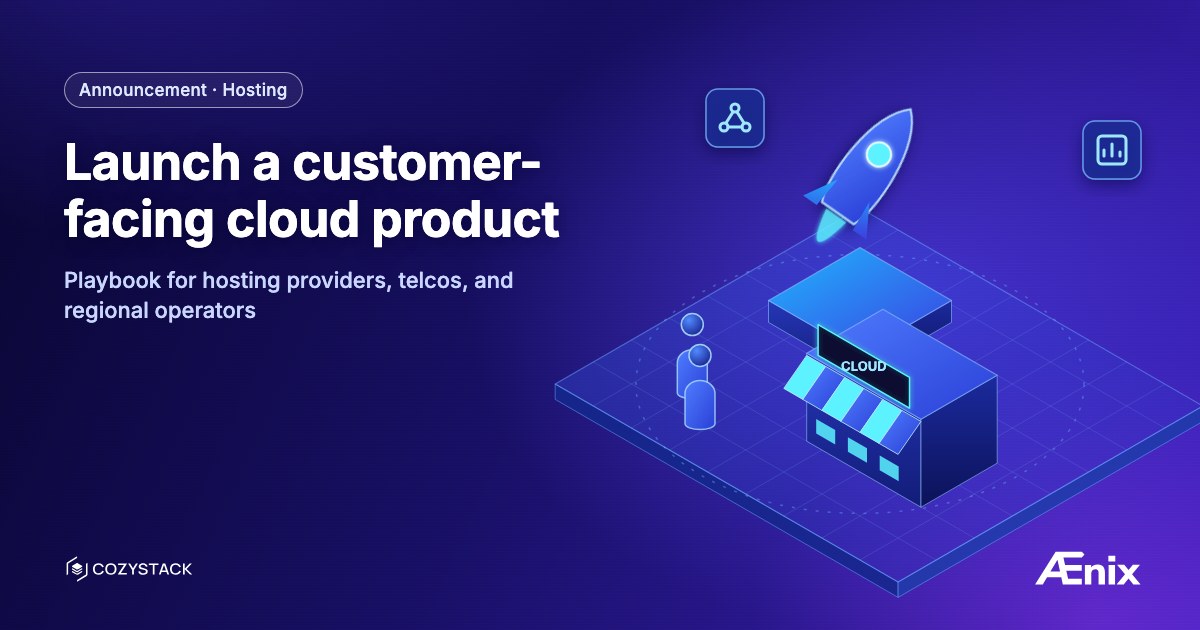
Regional and specialty cloud is having a moment in 2026. Hyperscaler economics, sovereignty pressure, and post-Broadcom market dynamics have all opened space for non-hyperscaler cloud products that didn’t make sense to launch 5 years ago. Sovereign cloud products from regional providers in the EU, Central Asia and MENA are visible examples. Many more are in stealth or early stages.
Why now
Three independent dynamics support new cloud product launches:
Hyperscaler economics breakdown for some workloads. Sustained inference, high-egress workloads, and regulated workloads are increasingly expensive on hyperscalers relative to dedicated infrastructure. A regional cloud serving these workloads has unit-economic advantages.
Sovereignty as competitive advantage. EU-member-state, Kazakhstan, several APAC jurisdictions have explicit sovereign-cloud mandates. Regional providers serving these mandates have regulatory moat that hyperscalers cannot access.
Post-Broadcom virtualization market disruption. VMware-exit-driven workloads have to land somewhere; regional providers can absorb a portion if they ship the right product.
Six layers of a cloud product
A working customer-facing cloud product has six layers, all of which need engineering:
1. Hardware
Compute servers, storage, network fabric, datacenter / colocation. Sized for initial customer cohort plus growth headroom.
2. Platform
Multi-tenant Kubernetes-native platform with KubeVirt for VMs, Cilium and Kube-OVN for networking, LINSTOR (DRBD-replicated block) for storage. Cozystack is the open-source default for this pattern.
3. Service catalog
What customers can self-provision: VMs, K8s clusters, managed databases (PostgreSQL, MariaDB, MongoDB, Redis, Valkey, Kafka, ClickHouse, OpenSearch, etc.), S3 buckets, GPU instances, networking primitives.
4. Customer-facing portal
Self-service UI (Cozystack Dashboard or custom). Catalog browsing, provisioning, monitoring, billing visibility.
5. Billing
WHMCS production-ready integration in two modes — shipped by Ænix as the WHMCS integration rather than as part of open-source Cozystack. Custom billing for specific markets.
6. Operations
24×7 NOC, customer support, SLA management, observability per tenant, incident response.
Architectural decisions specific to public cloud products
A public cloud product differs architecturally from an internal platform in several ways:
Multi-tenant isolation must be hard. Customers don’t trust each other; regulatory audits are real. Tenant CRD pattern with strong isolation is necessary, not optional.
Self-service must be polished. Internal platforms can have “ask the platform team” as escape hatch. Customer-facing products can’t.
Billing must be accurate from day one. Customers will dispute the first bill; the system has to support that conversation.
Observability for customers, not just for ops. Customers want their own metrics, not just SLA data.
Compliance posture is the product. Sovereignty, data residency, audit-readiness are differentiation features, not afterthoughts.
Go-to-market sequencing
Launch in cohorts:
- Beta with 3-5 friendly customers — fix the rough edges before paying customers see them.
- Limited GA with 10-50 customers — learn billing and support patterns at small scale.
- General availability — open to general market.
- Specialty expansion — add specific services (more GPU classes, AI services, etc.) based on observed demand.
Timing: at provider scale the platform goes live in weeks once hardware is ready, using the productized installer; the beta and limited-GA cohorts then run at your commercial pace. Multi-region national or operator programmes take longer: a 3-6 month pilot, then 9-18 months to full multi-region operation.
Where launches stumble
Stumble 1: under-engineered multi-tenancy
“We’ll add proper isolation in v2.” Customer #1 finds the gap; reputation damage is hard to recover from.
Stumble 2: billing as afterthought
Billing integration in the last month before launch. Doesn’t work; customers don’t pay; revenue collection is a multi-quarter project.
Stumble 3: operational under-investment
Platform built; ops team sized for 50 customers; they sign 200 in first quarter. Service quality collapses.
Stumble 4: copying hyperscaler architecture wholesale
Designed at hyperscaler scale; over-engineered for actual customer count. Operational complexity exceeds revenue.
Stumble 5: undifferentiated commodity offering
Generic cloud product with no differentiation from hyperscaler. Customers default to AWS / Azure / GCP. Specialty / sovereignty / regional matters as differentiator.
Ænix engagement
Ænix has built customer-facing cloud products end-to-end on Cozystack for hosting providers and regional cloud operators. The engagement structure:
- Free 30-minute discovery call, then a fixed-price Platform Readiness Assessment (14 days focused or 28 days full)
- Platform build — platform live in weeks once hardware is ready; portal, billing, operations workflows and first-cohort onboarding follow. Multi-region programmes: 3-6 month pilot, then 9-18 months to full multi-region
- Ongoing (optional) — support subscription from the published tiers, plus managed services during ramp
For details see the public cloud builder service and Ænix Public Cloud Platform.