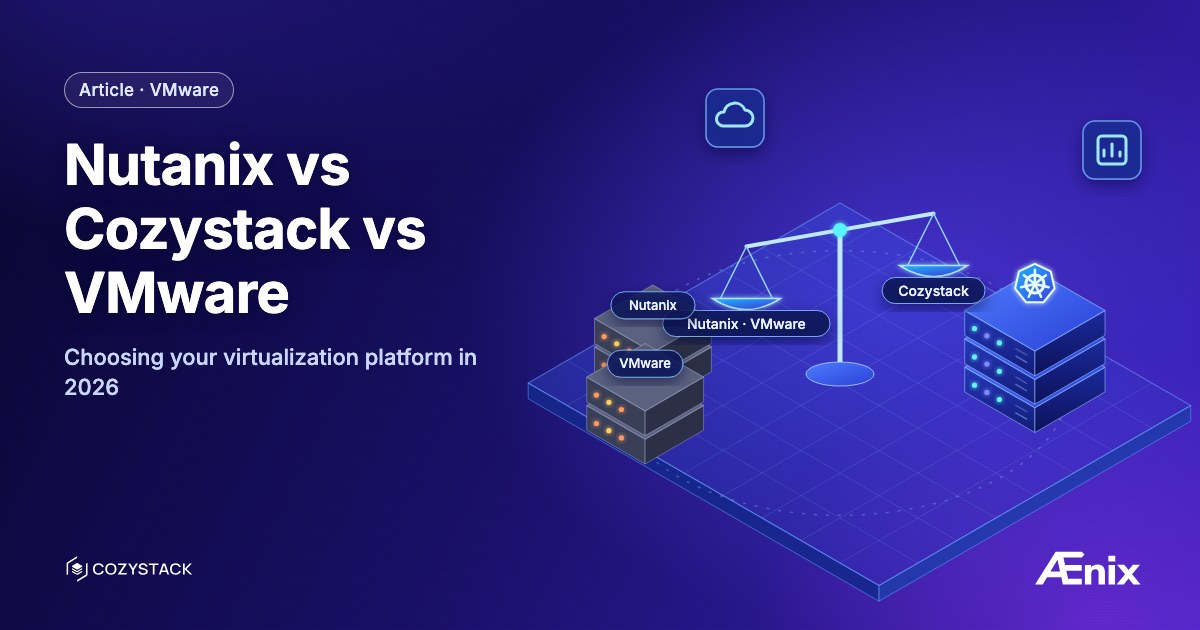
In 2026 the realistic shortlist for a production virtualization platform still includes Nutanix AHV and VMware Cloud Foundation, and increasingly Cozystack. They are not three versions of the same product. Each one answers a different question about who should own the complexity of running a data centre, and the right choice depends far more on which question your organisation is actually asking than on a feature checklist.
A disclosure first, because it matters for how you read this. Ænix created Cozystack and co-maintains it with maintainers from other companies, and we sell support and platforms built on it. That is exactly why this article spends as much time on where Nutanix and VMware are the better choice as on where Cozystack is. An architect would find those gaps in the first week of a proof of concept anyway.
Three platforms, three different bets
Nutanix bets on the appliance. Storage, hypervisor, management plane and, in practice, the hardware support path come from one vendor and are designed to be operated by a small team that does not want to think about the layers underneath. The value is operational simplicity, and Nutanix delivers it.
VMware bets on the ecosystem. Two decades of vSphere created a world of backup products, DR tooling, monitoring integrations, automation and application vendors that assume ESXi underneath. Under Broadcom it is sold as a subscription bundle, and the question for most estates is not whether VMware works — it does — but whether the renewal still makes sense.
Cozystack bets on the Kubernetes API. It is an open-source platform (Apache 2.0, a CNCF Sandbox project whose Incubation application is in due diligence) that runs virtual machines through KubeVirt, containers, tenant Kubernetes clusters and managed services such as databases and S3 storage, all on one API on servers you choose. The value is control: no per-node licence, no appliance list, and a multi-tenancy model built for running cloud for other people. The cost is that more of the platform’s design and sequencing becomes your team’s responsibility, or the responsibility of whoever you contract for it.
The comparison at a glance
| Nutanix AHV | VMware (VCF) | Cozystack | |
|---|---|---|---|
| Commercial model | Subscription | Subscription only | Apache 2.0; optional support subscription |
| Open source | No | No | Yes |
| Hypervisor | AHV (KVM-based, proprietary) | vSphere / ESXi | KubeVirt (KVM) on Kubernetes |
| Multi-tenancy | Projects, categories, RBAC — good delegation inside one organisation | VMware Cloud Director | Tenant CRD, nested tenants, per-tenant quotas |
| Storage | AOS distributed storage | vSAN | LINSTOR (DRBD) replicated block storage |
| Network | AHV networking | NSX | Cilium (eBPF) |
| Containers | Nutanix Kubernetes Platform (separate product) | Kubernetes layer on a VM-first platform | Native, same API as VMs |
| Hardware | Nutanix NX or OEM nodes from the hardware compatibility list | Hardware compatibility list | Commodity x86 servers you qualify |
| Best for | Enterprises wanting one accountable vendor and the least day-2 work | Existing VMware estates with tolerable renewals | Service providers, sovereign and regulated multi-tenant clouds |
The table hides the most important difference: on Nutanix and VMware, containers live on a second product next to the hypervisor, with its own lifecycle and often its own bill. On Cozystack, a VM and a container are both Kubernetes resources, so quotas, RBAC, audit and GitOps work the same way for both.
Where Nutanix is the better choice
Nutanix has the best day-2 experience of any platform we compare against, and it is not close. Prism Central with Life Cycle Manager sequences firmware, hypervisor and AOS upgrades together in one operation. On Cozystack, upgrades are Kubernetes upgrades: declarative and reproducible, but yours to plan and sequence.
Storage is the second advantage. Deduplication, compression, erasure coding and tiering are built into AOS, tuned and on by default. LINSTOR with DRBD is fast and simple, but choosing storage classes, replica counts and topology is a design exercise someone has to do properly.
Then there is accountability: one support number covers hardware, hypervisor, storage and management. On Cozystack, the hardware is yours and the platform support is a separate contract. Add the adjacent products — Nutanix Database Service, Files, Objects, and Nutanix DR with Metro availability — and the time it takes a generalist to stand up a first cluster, and the case is strong.
Choose Nutanix, or stay on it, if your workloads are mostly VMs inside one organisation, your team is small, Nutanix runs well and the renewal is affordable. The Nutanix alternative page sets out the same trade-off from the other side.
Where VMware is still the better choice
VMware’s advantage is depth. DRS, Storage DRS, Fault Tolerance and storage migration between arrays are the product of two decades of automated placement and rebalancing in production. KubeVirt has live migration and a working scheduler, but not the same depth of automated rebalancing, and it has not been tested by as many operators for as long.
The ecosystem is the second reason. VMware publishes a hardware compatibility list covering servers, HBAs, NICs and firmware combinations, and a vendor supports you on a listed configuration; with Cozystack, that qualification is yours. Backup and DR products such as Veeam, Commvault, Rubrik, Zerto and Site Recovery Manager integrate natively with vSphere. Some application vendors support their software only on ESXi and will not take a call about a workload on KubeVirt, whatever the technical merits.
Finally, there is the investment around vCenter: ServiceNow workflows, Ansible playbooks and internal tooling built over a decade. If your team is deep on vSphere, the renewal is tolerable and nothing else is pushing, staying and tuning is the right answer. The Cozystack vs VMware comparison goes through these gaps one by one.
Where Cozystack fits best
Cozystack is strongest where the organisation runs cloud for someone else, or must prove it controls its own stack.
Service providers and multi-tenant cloud builders. The Tenant CRD gives each customer an isolated tenant with its own quotas, RBAC and audit scope, and tenants can nest — a customer can split its tenant into production, development and test. The service catalogue offers VMs, tenant Kubernetes clusters and managed databases from the same dashboard, which can be white-labelled. Nutanix projects delegate well inside one company; a customer-facing model with untrusted tenants needs more. This is the ground of the Ænix Public Cloud Platform, and one anonymised example is a provider that moved off its previous hypervisor stack to a sovereign public cloud on Cozystack across three data centres.
Sovereignty and open-source-first procurement. The code is public, the licence is Apache 2.0, and the platform runs on hardware you own, including air-gapped installs. That makes it easier to show where data lives and who can change the stack; see data sovereignty. For regulated organisations running cloud for themselves, the Ænix Private Cloud Platform is built to support DORA and NIS2 work and runs alongside existing VMware estates while workloads move.
Mixed VM and container workloads. If you already run Kubernetes next to your hypervisor, consolidating both onto one platform removes a parallel stack and a parallel operations model.
GPU workloads. Virtual machines get whole GPUs through PCI passthrough, or NVIDIA vGPU with your own NVIDIA vGPU licence.
In tenant Kubernetes clusters, the NVIDIA GPU Operator exposes MIG partitions on cards that support it, and HAMi adds time-sliced sharing. The Ænix AI Platform builds on this.
What Cozystack does not give you
Cozystack has no orchestrated cross-site failover in the way Site Recovery Manager has one. It covers backup and restore with runbooks, and stretched multi-site designs with synchronous replication exist in production, but failover is a procedure, not a button. Backup policies and audit evidence built on the VMware ecosystem have to be rebuilt.
Hardware qualification is your job, or your integrator’s. And the team needs Kubernetes skills: the platform hides much of the complexity behind a dashboard and a catalogue, but the people who run it day to day should be comfortable with declarative configuration and GitOps. If you have neither the skills nor the appetite to buy them in, Nutanix is the more honest recommendation.
Migration economics between them
Moving between these platforms is a project, not a weekend. The durations below follow our migration hubs.
VMware to Cozystack typically takes about 8-12 months for an estate of roughly 100 VMs and 18-24 months for roughly 1,000 VMs, including planning and migration waves. Cohorts are aligned with VCF subscription expiry dates so you do not pay twice for capacity you have already moved. In the engagements we have modelled, the cumulative position is typically positive by the end of the second year; your renewal quote, hardware age and staffing decide it, which is why the number is computed for your estate rather than claimed here. The plan is on the VMware migration hub.
Nutanix to Cozystack typically takes 9-18 months for a full estate, depending on scope. KubeVirt uses the same KVM technology as AHV, so guest operating systems and disks carry over; the redesign is in storage, networking and tenancy. Details are on the Nutanix migration hub, and you can model the cost with the Nutanix vs Cozystack TCO calculator.
VMware to Nutanix is a well-trodden path with Nutanix’s own migration tooling, Nutanix Move. It is outside the scope of this article, and we do not quote a duration for it.
Both migrations to Cozystack start with a Platform Readiness Assessment: a fixed price, 14 or 28 days, ending in a written plan and destination architecture. Support for self-run Cozystack and the Ænix Public Cloud Platform starts at $1,250 per 10 nodes per month on annual billing (see pricing); Private Cloud and AI Platform programmes are quoted per RFP.
How to decide
Work through these in order and stop at the first that applies:
- Your current platform runs well, your team knows it, and the renewal is affordable? Stay, and revisit at the next renewal.
- You sell cloud to customers or need hard multi-tenancy? Cozystack.
- Sovereignty or open-source-first procurement is a requirement? Cozystack.
- You want an appliance, one accountable vendor and the least day-2 work, mostly for VMs? Nutanix.
- You have a VMware estate, deep vSphere skills, ISV support constraints and no trigger to leave? VMware, with an eye on the next renewal.
- Greenfield, with a team comfortable with Kubernetes? Cozystack.
You do not have to make the choice all at once, either. One anonymised financial group put a single self-service portal over OpenNebula, VMware and Kubernetes without replacing the existing estates. For a deeper look at the VMware side, read Cozystack vs VMware — deep-dive comparison and VMware migration tools and strategy. The project documentation lives at cozystack.io.
Frequently asked questions
Is Cozystack a drop-in replacement for Nutanix or VMware?
When is Nutanix the better choice than Cozystack?
When is VMware still the better choice?
How long does a migration to Cozystack take?
What does Cozystack cost compared with Nutanix and VMware?
Test yourself: Nutanix vs Cozystack vs VMware
5 questions · ~2 min