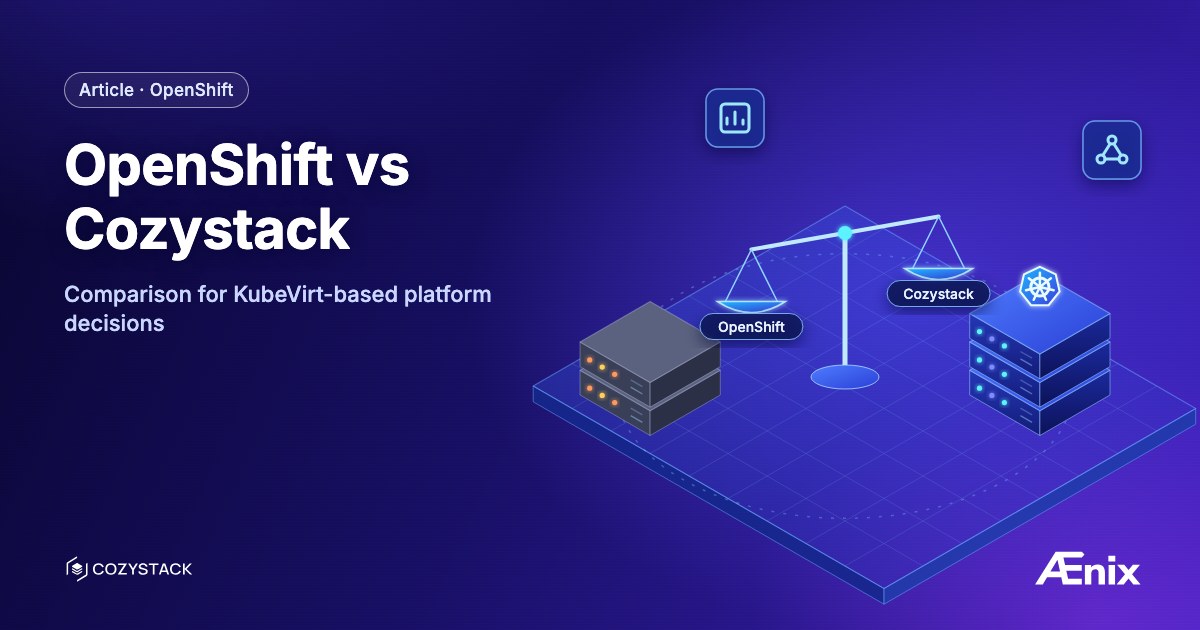
OpenShift Virtualization (Red Hat) and Cozystack (Ænix / CNCF Project) are the two most-mature KubeVirt-based platforms in 2026. They share architectural foundations but differ in commercial model, operational footprint, and vendor relationship.
Shared foundations
Both platforms run KubeVirt for VM workloads alongside Kubernetes containers. Both inherit Kubernetes operational patterns (declarative config, GitOps, RBAC, observability). Both support production VM workloads with live migration, snapshots, and multi-tenant isolation.
Where they differ
Commercial model
OpenShift Virtualization: Red Hat commercial subscription. Per-core or per-socket pricing. Includes Red Hat support, certification, and ecosystem access.
Cozystack: Apache 2.0 open source. Ænix offers commercial support tiers; you can self-deploy with no commercial relationship.
For organizations standardized on Red Hat procurement, OpenShift is administratively simpler. For organizations seeking open-source-first or service-provider economics, Cozystack fits better.
Operational footprint
OpenShift: broad surface area — OpenShift Container Platform plus Virtualization plus Service Mesh plus Pipelines plus other addons. Operationally rich; team needs OpenShift-specific expertise.
Cozystack: focused stack — KubeVirt + Cilium + Kube-OVN + LINSTOR + Cozystack Dashboard + observability. Lighter operational footprint; standard Kubernetes operational expertise transfers directly.
Multi-tenancy
OpenShift: namespace-based with Project CRD; RBAC and quotas at namespace level. Works for enterprise multi-BU.
Cozystack: Tenant CRD with nested tenants, scoped audit, billing-friendly model. Works for service-provider multi-customer plus enterprise multi-BU.
Vendor relationship
OpenShift: Red Hat / IBM relationship. Roadmap shaped by Red Hat’s commercial decisions.
Cozystack: open-source community-governed (CNCF Project). Ænix is the largest contributor but not the owner. Roadmap shaped by community + commercial users.
Ecosystem integration
OpenShift: integrates with broader Red Hat ecosystem (Ansible, Satellite, Identity Management, etc.).
Cozystack: integrates with broader CNCF ecosystem (Prometheus stack alternatives, Argo, Crossplane, etc.).
When OpenShift wins
- Existing Red Hat / OpenShift commitments
- Enterprise procurement standardized on Red Hat
- Need integrated Red Hat ecosystem (Ansible Automation Platform, etc.)
- Procurement that requires a Red Hat contract specifically
When Cozystack wins
- SLA-backed support from the maintainers — published response times, 24×7 on the Plus and Enterprise tiers (pricing); AENIX s.r.o. holds ISO/IEC 27001
- Open-source-first procurement
- Service-provider model (multi-customer cloud)
- Sovereignty / regulator requirements where open-source matters
- Cost-sensitive at scale (no per-core subscription)
- Greenfield with no existing Red Hat relationship
- Need lighter operational footprint than full OpenShift
Migration between them
Both KubeVirt-based, so VM-level migration is straightforward (image-level compatibility). The architectural delta is in:
- Multi-tenancy model (Project CRD vs Tenant CRD)
- Networking (OVN-Kubernetes, which replaced the deprecated OpenShift SDN, vs Cilium)
- Storage (OpenShift Data Foundation / Ceph vs LINSTOR / DRBD)
- Operational tooling (OpenShift CLI/Console vs Cozystack Dashboard/standard kubectl)
Realistic migration timeline: 3-9 months for mid-size deployment.
How to choose
If your situation matches OpenShift’s strengths (Red Hat ecosystem, enterprise procurement, broad capability surface) — OpenShift Virtualization. If your situation matches Cozystack’s strengths (open-source, service-provider, lighter footprint) — Cozystack.
For a specific evaluation, the assessment phase of either engagement helps clarify. See Platform Readiness Assessment.
Test yourself: OpenShift Virtualization vs Cozystack
5 questions · ~2 min