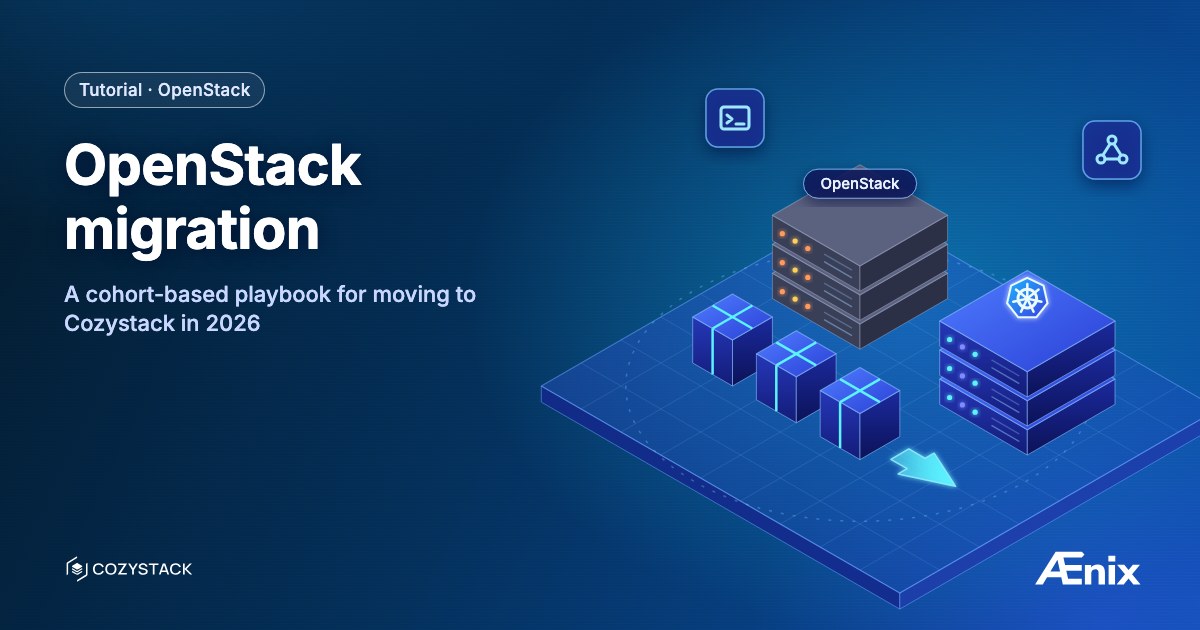
OpenStack remains widely deployed in telecom and large-enterprise infrastructure. Modernization is not a one-size-fits-all conversation: mature telco-scale OpenStack with deep vendor distro support is a different migration than a mid-size enterprise running upstream OpenStack with a small ops team. Both can move to Cozystack; the phasing and risk profile differ substantially.
Where OpenStack still works (and we’ll say so)
Before discussing migration, the honest reverse case. OpenStack remains the right answer for:
- Tier-1 telco NFV environments where vendor distro (Red Hat OSP, Mirantis, Canonical, Wind River) still has support runway and VNF certification is OpenStack-specific
- Very large estates (>1,000 nodes) with deep OpenStack expertise where operational complexity is already amortised
- Government clouds where OpenStack is the procurement-mandated platform (some EU member-state and APAC public-sector tenders)
- Existing investments at year 2-3 of a 5-year deployment where migration cost would exceed continuing operations cost
For everyone else, modernization typically warrants serious evaluation.
What pushes OpenStack-running organisations to migrate
Three pressures dominate the 2026 conversation:
1. Vendor distro lifecycle
Red Hat is steering OSP (OpenStack Platform) customers toward OpenShift-based offerings. Other distributions (Mirantis, Canonical) remain on the market, but the vendor landscape for OpenStack distributions is consolidating. Check the support dates in your own vendor contract: for many mid-2020s deployments they fall within the next few years.
2. Engineer scarcity
OpenStack expertise is a shrinking pool. New engineers are trained on Kubernetes, not on OpenStack’s Nova/Neutron/Cinder/Keystone component model. Operators with deep OpenStack expertise are aging out or moving to other roles. Hiring is harder; retention is harder.
3. Service-catalog ceiling
OpenStack’s primary scope is IaaS (compute, network, storage). Managed databases (Trove), container orchestration (Magnum), and modern service families (managed Kafka, S3-equivalent at scale, GPU-as-a- service, AI inference) either bolt on awkwardly or live outside the platform entirely. For operators whose customers or internal teams increasingly expect platform-grade services, OpenStack falls behind without significant additional engineering.
Component mapping
For OpenStack operators evaluating Cozystack, the canonical translation:
| OpenStack | Cozystack equivalent |
|---|---|
| Nova (compute) | KubeVirt on Talos |
| Neutron (networking) | Cilium (eBPF) |
| Cinder (block storage) | LINSTOR (DRBD-replicated block, via the Piraeus operator) |
| Swift (object storage) | SeaweedFS (S3-compatible, managed Bucket service) |
| Keystone (identity) | Kubernetes RBAC + workforce IdP federation (Keycloak / Okta / AD) |
| Glance (image registry) | KubeVirt CDI + container image registry |
| Magnum (managed Kubernetes) | Native — Kubernetes IS the platform |
| Heat (orchestration) | Kubernetes operators + GitOps (Flux / Argo CD) |
| Horizon (UI) | Cozystack Dashboard |
| Ceilometer / Telemetry | VictoriaMetrics + VictoriaLogs |
| Trove (DBaaS) | Cozystack managed databases (PostgreSQL, MariaDB, MongoDB, Redis, Valkey, Kafka, NATS, RabbitMQ, ClickHouse, OpenSearch, Qdrant, FoundationDB) |
| Designate (DNS) | external-dns operator + customer DNS provider |
| Octavia (load balancing) | MetalLB + Cilium L7 + ingress controllers |
| Manila (file share) | RWX volumes on DRBD-backed LINSTOR storage classes (Cozystack v1.0+); optional nfs-driver package for external NFS exports |
| Project / Domain / Role (tenancy) | Tenant CRD + nested tenants |
Most OpenStack engineers find Cozystack’s operational model simpler once they cross the Kubernetes learning curve — fewer moving parts, more declarative, integrated observability. The learning curve itself is real: 4-8 weeks per engineer for focused training, longer for domain depth.
Cohort-based migration phases
Phase 0 — Assessment (14 or 28 days)
Inventory the OpenStack deployment:
- Service-by-service usage — which OpenStack services do you actually use (Nova / Neutron / Cinder almost always; everything else is variable)
- Workload inventory — instance count, OS mix, vCPU/RAM/disk profiles, criticality tier
- Network inventory — subnets, security groups, floating IPs, external network configurations, Octavia load balancers
- Storage inventory — Cinder volume types, snapshot retention, Swift bucket usage
- Multi-tenancy — project / domain hierarchy, custom roles, RBAC policies
- Integrations — vendor VNF certifications, observability hooks, CI/CD pipelines, ITSM tooling
Output: migration plan with workload buckets (migrate-now / migrate-later / stay / re-architect), risk flags, phasing options.
Phase 1 — Cozystack foundation
Hardware procurement (or repurpose of OpenStack-freed capacity in later phases). Cozystack platform deployed on new hardware in parallel to existing OpenStack. Cilium networking validated against OpenStack network configurations expected to translate. LINSTOR storage operationalised at scale. Federated identity (Keycloak + customer IdP).
Tenant CRD model designed to map cleanly from OpenStack project / domain hierarchy. Each top-level OpenStack project typically becomes a Cozystack Tenant; nested projects become nested Tenants.
End state: Cozystack platform up, internally validated, ready for workload onboarding.
Phase 2 — Operational tooling
Observability stack (VictoriaMetrics + VictoriaLogs) integrated with customer SIEM. Backup/DR with Velero + per-app patterns. Runbook library. On-call rotation. Incident response process. GitOps deployment workflow (Flux default; Argo CD if customer prefers).
End state: production-operations-grade tooling in place; team training in progress.
Phase 3 — Workload migration cohorts
Cohorts of 50-200 instances migrating at a time. Per cohort:
- Image conversion — OpenStack Glance images converted to
KubeVirt-compatible format. Most KVM-based OpenStack images
convert with
qemu-img convert+ minor metadata adjustment. Windows instances get virtio driver injection. - Network mapping — OpenStack subnets to Cilium ClusterPool + NetworkPolicies, security groups to NetworkPolicies, Octavia load balancers to MetalLB + ingress controllers.
- Storage migration — Cinder volume data migrated to LINSTOR. Snapshot history preserved or pruned per retention policy. For Swift-stored data, S3 API compatibility allows direct migration to SeaweedFS.
- Validation window — workload runs in parallel on Cozystack for typically 7-14 days. Application owner sign-off required before final cutover.
- Final cutover — DNS / load balancer flip to Cozystack endpoint. OpenStack instance kept available for 7-30 days rollback window.
Phase 4 — Operational handover (parallel to Phase 3)
Ænix engineers reduce direct involvement. Customer operations team absorbs first- and second-line incidents. Ænix support (Plus or Enterprise tier for 24×7) continues for escalation. Documentation handover. Knowledge transfer sessions.
Phase 5 — OpenStack decommission
As migration cohorts complete, OpenStack capacity is repurposed into the Cozystack cluster. Hardware is the same commodity x86; OpenStack software stack is retired. Vendor distro contracts wound down per their lifecycle.
Where OpenStack-to-Cozystack migrations stumble
1. Network model redesign
OpenStack Neutron’s network model has historically been highly configurable — provider networks, tenant networks, security groups, floating IPs, FWaaS, VPNaaS, complex routing topologies. Cilium’s eBPF model is fundamentally different: L4/L7 NetworkPolicies, eBPF- based routing, Hubble for observability.
Translating elaborate Neutron configurations to Cilium requires careful architecture work in Phase 0-1. Skipping this produces production incidents in Phase 3 where customer workloads expected specific network behaviour that doesn’t translate directly.
2. Multi-tenant policy translation
OpenStack’s role-based access (Keystone roles, project policies) doesn’t map 1:1 to Kubernetes RBAC + Tenant CRD. Custom roles defined for specific OpenStack APIs may not have direct Kubernetes equivalents. Plan time for policy redesign rather than mechanical translation.
3. VNF certification
Tier-1 telco deployments running certified VNFs face a different challenge: the VNF vendor certifies on specific OpenStack distros, not on Cozystack. Three approaches:
- Run VNFs on KubeVirt under Cozystack — the VNF runs as a VM; vendor certification may or may not extend to this configuration. Vendor dialogue required.
- Keep certified VNFs on OpenStack — parallel platforms for the lifecycle of the certified VNF; modernization track for new VNFs on Cozystack.
- Negotiate cloud-native equivalent — many VNF vendors are migrating toward Cloud-Native Network Functions (CNFs) on Kubernetes; the migration may align with vendor’s own CNF modernization.
In practice all three patterns appear, often in the same operator, depending on which VNF vendor and which generation.
4. Operational culture shift
OpenStack operators are used to imperative APIs (CLI commands, REST calls, console actions). Cozystack expects GitOps for production changes. This is a culture shift, not just a tool shift. Engineers who built OpenStack expertise around imperative workflows need 4-8 weeks of focused training plus 3-6 months of practice to internalise the GitOps discipline.
Ænix engagement includes training as a workstream; customer investment in the cultural transition is also required.
Timeline realities
Mid-size enterprise (200-500 nodes, simple multi-tenancy, mostly default networking):
- Phase 0: 14 or 28 days
- Phases 1-2: foundation and tooling, overlapping the first cohorts
- Phase 3: the bulk of the elapsed time
- Phases 4-5: alongside the last cohorts
Total: 4-12 months for a mid-size deployment; 12-18 months with complex provider networks or tenant-facing OpenStack APIs
Tier-1 telco (1,000-5,000 nodes, complex multi-tenancy, certified VNF environments, NFV-specific networking):
- Phase 0: 2-3 months
- Phase 1: 4-6 months
- Phase 2: 2-3 months
- Phase 3: 12-24 months (multiple parallel cohorts)
- Phase 4-5: 6-12 months
- VNF modernization track: 18-36 months in parallel
Total: 24-48 months for full modernization; first production workloads on Cozystack within 12-18 months
When OpenStack-to-Cozystack migration is the right answer
Strong fit:
- Vendor distro lifecycle is forcing a decision within 24 months
- Engineer scarcity is starting to hurt operational quality
- Customer demand for managed databases / S3 / containers / GPU services exceeds what OpenStack natively handles
- Modernisation budget is available across 2-4 years
Marginal fit:
- Stable, mature OpenStack deployment with deep team expertise and no service-catalog pressure — modernisation can wait for vendor lifecycle
- Very large estates (>5,000 nodes) where modernisation cost is in the multi-tens-of-millions range — phased multi-year programme required
Poor fit:
- Recently-deployed OpenStack at year 1 of a 5-year programme — finish what you started; modernise at lifecycle
- OpenStack-on-government-procurement-mandate without flexibility to change platforms
Engagement structure
- Discovery call (30 min, free)
- Platform Readiness Assessment (fixed price, 14 days focused or 28 days full) — workload buckets, phasing options, risk flags
- Pilot deployment (2-3 months) — Cozystack stood up, 50-100 workloads migrated, billing / operational workflows validated
- Cohort migration — workload migration in cohorts; 4-12 months in total for a mid-size deployment, 12-18 months with complex provider networks or tenant-facing OpenStack APIs, longer at telco scale
- OpenStack decommission (parallel to cohort migration) — staged as cohorts complete
- Support subscription (ongoing) — Plus or Enterprise support tier for 24×7 escalation (see /pricing/)
Where to dig deeper
- OpenStack migration hub — commercial landing
- OpenStack vs Cozystack modernization — the modernization path analysis
- OpenStack alternative — alternative-focused commercial landing
- Public Cloud Platform product page — common target product for hosting-provider OpenStack migrations
Test yourself: OpenStack-to-Cozystack migration
5 questions · ~2 min