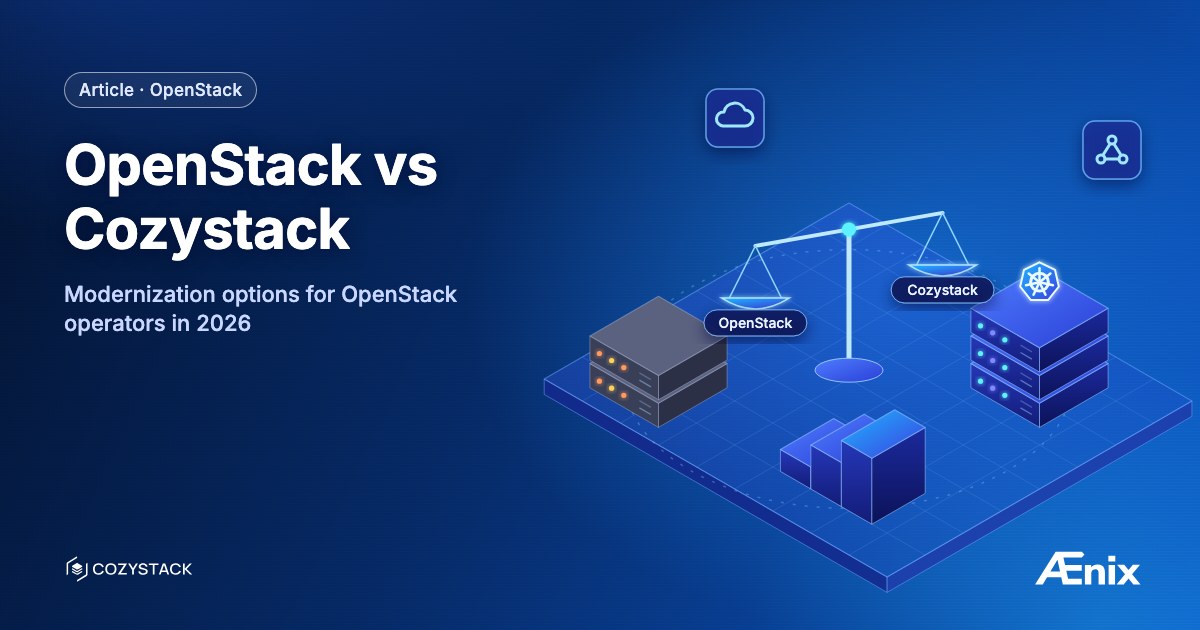
OpenStack remains widely deployed in telecom and government infrastructure. It also faces structural pressure: shrinking pool of OpenStack engineers, operational complexity that grows with deployment age, and competition from Kubernetes-native alternatives that didn’t exist when OpenStack was designed.
Where OpenStack still wins
- Telecom-scale deployments — running thousands of nodes with telecom-specific features (NFV, DPDK integration, SR-IOV, high-throughput networking). Established expertise; vendor distros mature.
- Government / sovereign clouds — large public-sector OpenStack deployments where OpenStack is the procurement-mandated platform.
- Existing investments — organizations 5+ years into OpenStack with deep expertise. Migration cost may exceed continuing operations cost.
- Specific features — some OpenStack capabilities (deep network programmability, specific telco features) don’t have direct Kubernetes equivalents yet.
Where the pressure is
- Engineer scarcity — OpenStack expertise pool is shrinking. New engineers are trained on Kubernetes, not OpenStack.
- Component sprawl — 30+ services in a typical OpenStack deployment, each with its own lifecycle, upgrade cadence, integration tests.
- Upgrade pain — major-version OpenStack upgrades remain operationally heavy.
- Vendor distro fragmentation — Red Hat OSP, Mirantis, Canonical, others — each with different opinions and support models.
Modernization paths
For OpenStack operators considering modernization:
Path 1: stay and tune
Continue OpenStack; invest in operational practices (Helm-based deployments, GitOps, automation). Right when OpenStack expertise is deep and migration cost exceeds value.
Path 2: Kubernetes-on-OpenStack
Run Kubernetes platforms (Cozystack or other) on top of OpenStack as a tenant. Adds another platform layer; some teams find this practical for gradual transition.
Path 3: parallel deployment
Build Cozystack alongside OpenStack on new hardware. Migrate workloads cohort by cohort. Decommission OpenStack as cohorts complete. Most common path for full modernization.
Path 4: full lift-and-shift to Kubernetes
Aggressive — replace OpenStack control plane with Kubernetes-based equivalent (Cozystack). Higher risk; faster outcome.
Cozystack architecture for OpenStack-trained teams
Some helpful translations:
| OpenStack | Cozystack |
|---|---|
| Nova | KubeVirt |
| Neutron | Cilium |
| Cinder | LINSTOR (DRBD-replicated block) |
| Swift | SeaweedFS (S3-compatible) |
| Keystone | Kubernetes RBAC + workforce-IdP integration |
| Glance | KubeVirt CDI image registry |
| Magnum | Native — Kubernetes is the platform |
| Heat | Kubernetes operators + GitOps |
| Horizon | Cozystack Dashboard |
| Ceilometer | VictoriaMetrics + VictoriaLogs |
| Trove | Cozystack managed databases |
| Designate | External-DNS operator |
| Octavia | MetalLB / ingress + Cilium L7 |
Most OpenStack engineers find Cozystack’s operational model simpler — fewer moving parts, more declarative, integrated observability.
Practical migration approach
For mid-size (50-500 hosts) OpenStack to Cozystack:
- Assessment (14 or 28 days) — current OpenStack deployment, workload classification, target Cozystack architecture.
- Cozystack foundation — parallel deployment on new or repurposed hardware, overlapping the first cohorts.
- Migration cohorts — workloads move cohort by cohort. Image migration via KVM→KubeVirt.
- OpenStack decommission — staged as cohorts complete.
Total elapsed: 4-12 months for a mid-size deployment; 12-18 months with complex provider networks or tenant-facing OpenStack APIs.
Test yourself: OpenStack modernization
5 questions · ~2 min