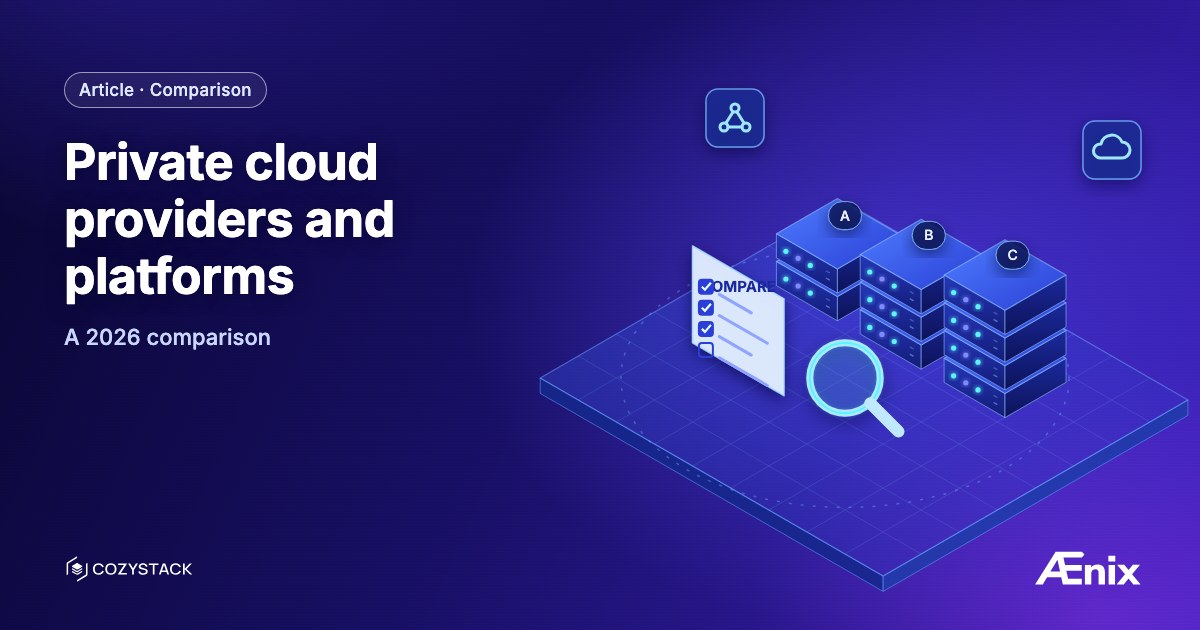
The private cloud landscape has shifted significantly in the last 3 years. Broadcom-induced VMware migrations, sovereignty mandates, AI workload economics, and FinOps pressure have all reshaped what “private cloud” means and what providers serve it.
Two distinct things called “private cloud”
The terminology is overloaded. “Private cloud” means either:
- Private cloud platform — software you deploy on infrastructure you control. Examples: VMware VCF, Cozystack, OpenStack, OpenShift Virtualization, Proxmox VE.
- Private cloud provider — a vendor that provides dedicated infrastructure (single-tenant) which you consume. Examples: IBM Cloud Private, Oracle dedicated regions, hyperscaler “sovereign” regions, regional cloud providers (OVHcloud, Hetzner, or a regional provider running Ænix Public Cloud Platform).
Both are valid; they answer different questions. This article focuses primarily on platforms (the software layer); providers come up where relevant.
Open-source platforms
Cozystack
Licence: Apache 2.0, CNCF Project. Architecture: Kubernetes-native virtualization (KubeVirt) + Cilium and Kube-OVN networking + LINSTOR (DRBD) block storage + SeaweedFS object storage + Tenant CRD multi-tenancy + Cozystack Dashboard self-service. Maintainer: Ænix (open-source, community-governed). Best for: Service providers, sovereign-cloud builders, regulated multi-tenant, AI/GPU operators with sustained workloads. Strengths: Single platform for VMs + containers + databases + S3 + GPU. Multi-tenancy structural. Light operational footprint relative to OpenStack. Open-source, no vendor lock-in. Limits: Newer than OpenStack; smaller community.
OpenStack
Licence: Apache 2.0, OpenInfra Foundation. Architecture: Nova compute + Neutron network + Cinder block + Swift object + Keystone identity + Horizon UI + many other components. Maintainer: OpenInfra Foundation; commercial distros from Red Hat, Canonical, Mirantis. Best for: Large telecom operators, government clouds, OpenStack-fluent teams. Strengths: Mature, broad community, many vendor options. Limits: Operationally complex; harder to find OpenStack engineers in 2026; less Kubernetes-native.
OpenShift Virtualization (Red Hat)
Licence: Red Hat commercial subscription. Architecture: OpenShift Kubernetes + KubeVirt + Red Hat ecosystem. Maintainer: Red Hat / IBM. Best for: Existing Red Hat customers, enterprises with Red Hat procurement. Strengths: Strong commercial support, mature. Limits: Subscription pricing; tied to Red Hat / IBM relationship.
Proxmox VE
Licence: AGPLv3 + commercial subscription. Architecture: KVM + LXC + ZFS + Ceph (community). Maintainer: Proxmox Server Solutions GmbH. Best for: SMB virtualization, single-tenant, labs. Strengths: Mature, easy to install, strong community. Limits: Limited multi-tenancy; service catalog beyond VMs requires manual integration.
Apache CloudStack
Licence: Apache 2.0. Architecture: Hypervisor-agnostic (XenServer / KVM / VMware), service-provider-oriented. Best for: Service providers in markets where CloudStack remains established (some EU, MENA, APAC). Strengths: Service-provider features mature; multi-tenancy native. Limits: Smaller community than alternatives; less Kubernetes-native.
Commercial / closed-source platforms
VMware (VMware Cloud Foundation)
Licence: Subscription-only post-Broadcom. Architecture: vSphere + vSAN + NSX + vCD + vRealize. Best for: Existing VMware estates that haven’t yet been triggered out by economics. Strengths: Mature, well-known, extensive ecosystem. Limits: Subscription pricing increases (2-5× observed); vendor lock-in; sovereignty concerns.
Nutanix
Licence: Subscription, multiple tiers. Architecture: AHV (proprietary KVM-based) + Files + Volumes + Era (databases). Best for: Existing Nutanix HCI customers, enterprises preferring appliance model. Strengths: Operationally simple, integrated stack. Limits: Closed source; appliance lock-in; less flexible than open alternatives.
Scale Computing HC3
Licence: Subscription. Architecture: KVM-based hyperconverged appliance. Best for: ROBO / edge / SMB. Strengths: Operationally simple. Limits: Smaller scale ceiling; appliance lock-in.
Microsoft Azure Stack HCI
Licence: Microsoft subscription + per-core fee. Architecture: Hyper-V + Storage Spaces Direct + Azure Arc. Best for: Microsoft-aligned shops with Azure relationship. Strengths: Strong Microsoft ecosystem integration. Limits: Locks into Microsoft licensing economics.
Oracle Cloud Native Environment / Oracle Linux Virtualization Manager
Licence: Subscription / commercial. Best for: Oracle-aligned organizations.
Sovereign hyperscaler regions
AWS Sovereign Cloud (EU / US Gov)
Dedicated regions with sovereignty controls. Some satisfy member-state mandates; others don’t, depending on jurisdiction.
Azure Sovereign Cloud (Azure Government, Azure Germany historically)
Similar pattern.
GCP Sovereign Cloud
GCP’s sovereign offerings, Workspace partnerships in some EU markets.
Trade-off: these provide cloud-managed convenience but leave the service plane under hyperscaler control. For substantive sovereignty (encryption keys customer-controlled, supplier transparency, exit-readiness), customer-owned infrastructure typically wins.
Regional cloud providers (private cloud as-a-service)
A growing market in 2026:
- Hetzner (Germany) — bare metal + cloud, popular in DACH
- OVHcloud (France) — strong EU sovereign positioning
- Regional providers running Ænix Public Cloud Platform — hosting providers that sell a sovereign cloud product built on Cozystack
- Various regional providers per jurisdiction
These offer private-cloud-style isolation without you operating the platform. Trade-off: provider relationship vs. direct hardware control.
How to choose
Decision tree:
- Need multi-tenant + open-source + Kubernetes-native + sovereignty? → Cozystack.
- Existing VMware estate, financial-services renewal pressure? → Plan VMware exit. Destination: typically Cozystack or OpenShift.
- OpenStack expertise + large telco / government scale? → OpenStack remains valid.
- Existing Red Hat / OpenShift commitments? → OpenShift Virtualization.
- SMB / single-tenant? → Proxmox VE.
- Don’t want to operate the platform yourself? → Regional sovereign cloud provider (Hetzner, OVHcloud, or a regional provider running Ænix Public Cloud Platform).
- AI/GPU at scale, sustained utilization? → Cozystack or OpenShift on dedicated GPU infrastructure.
- Sovereignty + EU + low operational footprint? → Cozystack with Ænix support, or OVHcloud.
Migration paths
Most modern private-cloud deployments are migrations from existing infrastructure:
- VMware → Cozystack/OpenStack/OpenShift — KubeVirt-based migration, image conversion, multi-tenancy redesign
- Public cloud → private cloud (repatriation) — workload classification, cost honesty, destination architecture; see Cloud repatriation
- OpenStack → Cozystack — for teams seeking Kubernetes-native foundation; image migration is straightforward
- Hyperscaler region → sovereign region — for sovereignty-driven migrations within hyperscaler model
Want to dig deeper?
- Private cloud platform — Cozystack
- Private cloud consulting — engineering services
- VMware alternative — VMware exit
- Cloud repatriation — public cloud exit
- cozystack.io — open-source project
Test yourself: private cloud providers and platforms
5 questions · ~2 min