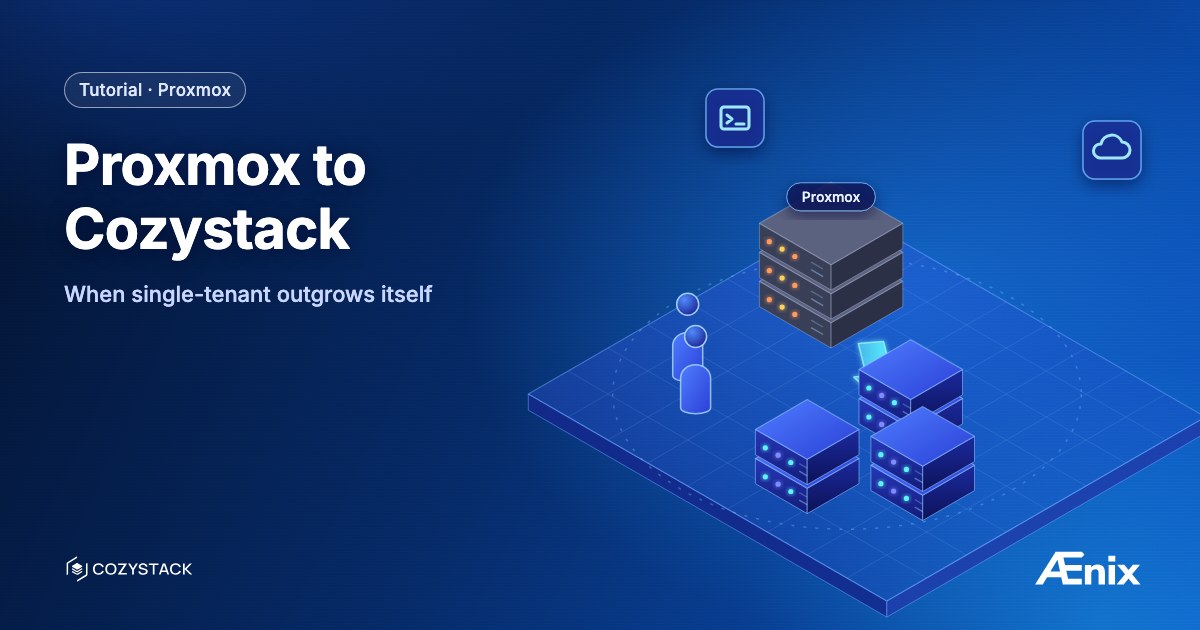
Proxmox VE is one of the most successful open-source virtualisation platforms of the last decade. Mature, easy to install, strong community, AGPLv3 with commercial subscription. We talk to a lot of operators who started on Proxmox, grew, and are evaluating what comes next.
Crucially: Proxmox is the right answer for many of them. This article covers when migration is warranted and when it’s premature.
Where Proxmox keeps winning
Proxmox VE remains the right answer for:
- SMB IT departments — small-to-mid businesses running 10-50 virtualised workloads on premises, no customer-facing multi- tenancy needs
- Single-tenant labs and dev environments — Proxmox’s operational simplicity beats any heavier alternative
- Mature operators with stable customer base under ~200 customers — Proxmox’s commercial economics still work; migration cost would exceed the value
- Mostly-VM workloads — Proxmox’s KVM + LXC scope fits cleanly
- Existing operators with deep Proxmox expertise and stable team — switching cost includes team retraining
If your situation matches these, don’t migrate. The Ænix Public Cloud Platform is over-engineered for SMB single-tenant operation. We say this in discovery calls rather than push the engagement.
When Proxmox is being outgrown
Migration warrants serious evaluation when at least three of these hold:
1. Customer count growing past ~300
Proxmox’s multi-tenancy model (pools, realms and permissions, not hard isolation) starts to feel thin above ~300 customer-facing tenants. Per-customer audit trails, isolation guarantees, and quota enforcement become operational pain.
2. Customers asking for services beyond VMs
Managed PostgreSQL, MariaDB, MongoDB, Redis, Valkey, Kafka, S3-compatible object storage, tenant Kubernetes clusters, GPU services. Proxmox’s scope is VMs + LXC; everything else is bolted on with manual integration or external systems.
3. WHMCS or similar customer-management integration
Proxmox has WHMCS integration, but the service catalog beyond VMs is manual integration work. Ænix Public Cloud Platform adds a WHMCS integration (a proprietary Ænix module, not part of open-source Cozystack) that covers the full service catalog.
4. Multi-DC active/active
Proxmox clustering is single-DC. Geographic distribution requires manual cross-cluster replication patterns. Cozystack handles multi- DC active/active as a first-class deployment mode.
5. Container-native customer demand
Customers want tenant Kubernetes clusters or container-native service catalogs. Proxmox can host containers via LXC but isn’t the right operational model for tenant-facing Kubernetes-as-a-service.
6. Recurring licence / subscription pressure on commercial Proxmox
Proxmox’s commercial subscription is competitive but real cost. Operators with growing infrastructure footprint sometimes find the total subscription cost approaching what Ænix charges for Public Cloud Platform support — at which point the service-catalog and operational upside of Cozystack tips the decision.
Architectural mapping: Proxmox → Cozystack
| Proxmox VE | Cozystack equivalent |
|---|---|
| KVM hypervisor | KubeVirt (KVM-based) |
| LXC containers | Native Kubernetes containers (different model — LXC system-style vs Kubernetes application-style) |
| ZFS storage | LINSTOR (DRBD) |
| Ceph (Proxmox-managed) | LINSTOR (DRBD); Cozystack does not ship Ceph |
| Linux SDN / bridges | Cilium (eBPF) |
| Proxmox web UI | Cozystack Dashboard |
| Proxmox Backup Server (PBS) | Velero + S3-compatible target + per-app PITR |
| PVE-Storage replication | LINSTOR DRBD replication |
| Proxmox API / pvesh, qm, pct | Kubernetes API |
| Datacenter / Pool / VM | Tenant CRD + namespace + KubeVirt VM |
| Permission model (roles) | Kubernetes RBAC + Tenant CRD scope |
Two areas need redesign rather than 1:1 mapping:
- LXC vs Kubernetes containers — Proxmox LXC is system-container (full OS image), Kubernetes container is application-container (single process or small set). Workloads using LXC for system- container patterns either migrate to KubeVirt VMs or get refactored.
- Multi-tenancy model — Proxmox tenant model (pools, realms and permissions) versus Cozystack Tenant CRD (Kubernetes-native). Customer-facing isolation is stronger in Cozystack; operational abstraction is different.
Migration phases
Phase 0 — Assessment (14 or 28 days)
Inventory: customer count, customer-facing services consumed, VM count, OS mix, LXC usage, storage tiers, network topology, backup patterns, WHMCS / customer-management integration.
Honest TCO comparison: current Proxmox + commercial subscription + operational team versus Ænix Public Cloud Platform + hardware refresh + Ænix support tier. For operators under ~300 customers, this often shows Proxmox staying competitive; above ~500, Cozystack typically wins on service-catalog and operational depth.
Output: go/no-go decision with quantified justification.
Phase 1 — Cozystack foundation (live in weeks)
The platform goes live in weeks once hardware is ready, using the productized installer; catalogue and brand work continue alongside the pilot. Cozystack platform deployed on new hardware or repurposed Proxmox hardware (commodity x86 servers move easily). Cilium networking configured. LINSTOR storage operationalised. Identity integration (typically Keycloak + customer IdP). Cozystack Dashboard brand customisation matching the operator’s existing brand.
WHMCS integration validated end-to-end. Service catalog populated with the operator’s chosen services (VMs first, managed databases next, S3 then, expanding from there).
Phase 2 — Pilot customer migration
5-20 friendly customers migrated to Cozystack as the first cohort. Pattern per customer:
- Customer VMs converted from Proxmox qcow2 to KubeVirt-compatible format
- Network configuration translated (Proxmox bridges → Cilium ClusterPool + NetworkPolicies)
- Storage migrated (ZFS / Ceph volumes → LINSTOR in Cozystack)
- Customer-side validation window (7-14 days)
- DNS / load balancer cutover
During the pilot, customer support team builds operational familiarity with Cozystack. Documentation patterns shake out.
Phase 3 — Production migration cohorts
Cohorts of 30-100 customers at a time. Same per-customer pattern as pilot, with operational efficiency improvements as the team internalises the workflow.
LXC-using customers receive special handling: either system-style KubeVirt VM (1:1 replacement) or refactor to Kubernetes-native application container (depending on customer’s preference and support).
Phase 4 — Proxmox decommission
As migration cohorts complete, Proxmox hardware moves into the Cozystack cluster. Proxmox subscription wound down per renewal cycle. Proxmox Backup Server data archived per customer agreements.
Timeline realities
For typical mid-size hosting provider (300-1,000 customers):
- Phase 0: 14 or 28 days
- Phase 1: platform live in weeks once hardware is ready
- Phases 2-3 (pilot and production cohorts): typically 3-9 months
- Phase 4: alongside the last cohorts, timed to Proxmox renewals
Total: the platform is live in weeks once hardware is ready; moving workloads and customers typically takes 3-9 months
For larger operators (1,000-5,000 customers), Phase 3 runs longer for sustainable cohort pacing; the assessment sets the schedule.
Where Proxmox-to-Cozystack migrations stumble
1. LXC workloads
If a substantial fraction of customer workloads use LXC for system-container patterns (e.g., per-customer LAMP stack as a single LXC), the migration to Kubernetes-native containers requires refactoring. The alternative is running them as KubeVirt VMs (1:1 mapping but heavier resource footprint). Plan time for this in Phase 0.
2. Customer-facing API divergence
Some customers built tooling against the Proxmox API. Cozystack exposes Kubernetes API + Cozystack Dashboard API; the contracts differ. Customer-facing migration support (documentation, sometimes API compatibility shim) is engagement work.
3. Operations team training
Proxmox operators are comfortable with the Proxmox web UI and the
imperative qm / pct / pvesh CLI tools. Cozystack expects GitOps for production
changes. Operations team needs 4-8 weeks of focused training plus
3-6 months of practice. Ænix engagement includes training; customer
investment in the transition is also required.
4. ZFS-specific workloads
Some customers chose Proxmox specifically for ZFS-on-host features (advanced snapshots, ZFS-replicated backups). Cozystack ships LINSTOR (DRBD); ZFS-specific operational patterns don’t translate. Customer dialogue about feature equivalence is part of Phase 0.
Versus other alternatives
Versus building it yourself on raw KVM + libvirt + Kubernetes: Same trade-offs as for any open-source-build option. Cozystack gets a multi-tenant platform to production in weeks to a few months; raw builds take 12-24 months to reach the same level. For operators with strong platform engineering capacity, the raw-build is a credible alternative.
Versus VMware (post-Broadcom): Proxmox-to-VMware migration is rare in 2026 — reverse migration usually doesn’t make economic sense post-Broadcom.
Versus Nutanix: Nutanix AHV is closed-source proprietary KVM. For operators valuing open-source substrate, Cozystack wins on that property alone. For operators valuing integrated commercial support without open-source overhead, Nutanix wins.
Versus OpenShift Virtualization: Both are KubeVirt-based. OpenShift fits existing Red Hat / OpenShift customers; Cozystack fits operators preferring open-source-first procurement and lighter operational footprint.
When this engagement model fits
Strong fit:
- Hosting provider or MSP with 300+ customers
- Growth trajectory toward 1,000+ customers
- Customer demand for services beyond VMs
- Multi-DC operational reality
- Budget for a migration programme (typically 3-9 months of customer moves)
Marginal fit:
- 200-300 customer providers — borderline; depends on growth trajectory and service-catalog ambition
Poor fit:
- SMB IT (<100 internal VMs) — Proxmox is still better
- Lab / dev environments — Proxmox simplicity wins
- Sub-200-customer hosting providers — poor fit for a full migration programme; consider a greenfield service line on Ænix Public Cloud Platform at provider scale instead
Engagement structure
- Discovery call (30 min, free)
- Platform Readiness Assessment (fixed price, 14 days focused or 28 days full) — go/no-go with TCO comparison
- Pilot deployment — Cozystack stood up (live in weeks once hardware is ready), 5-20 friendly customers migrated
- Cohort migration — customer migration in cohorts; pilot and cohorts together typically take 3-9 months
- Proxmox decommission (parallel) — as cohorts complete
- Support subscription (ongoing) — Plus or Enterprise support tier for 24×7 coverage (see /pricing/)
Where to dig deeper
- Proxmox migration hub — commercial landing
- Proxmox vs VMware vs Cozystack comparison — decision matrix
- Proxmox alternative — alternative-focused commercial landing
- Hosting providers industry page — industry-specific positioning
- Public Cloud Platform economics for hosting providers — unit-economics walkthrough
- Hosting provider platform modernization — modernisation pattern
Test yourself: Proxmox-to-Cozystack migration
5 questions · ~2 min