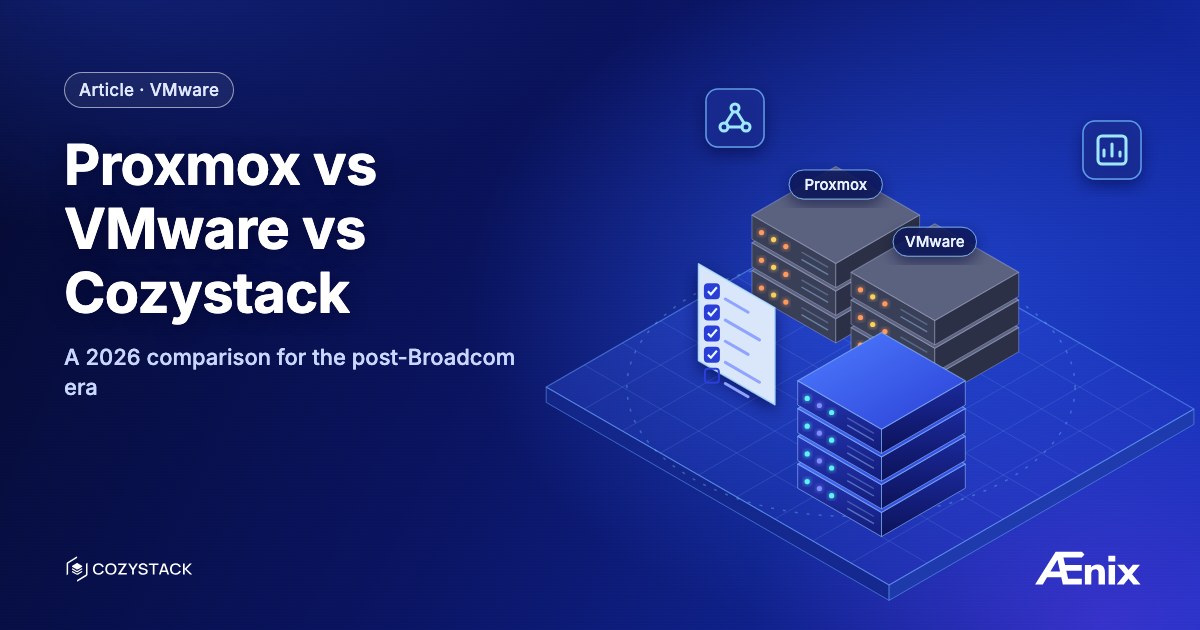
The post-Broadcom virtualization market has three main options this article compares: Proxmox VE and Cozystack (both open source) and VMware itself (XCP-ng is a less common fourth). Each has a different architectural target. Picking the right one is mostly a function of scale and use case.
Proxmox VE — SMB-friendly, VM-focused
Architecture: KVM + LXC + ZFS + Ceph (community), single-cluster Proxmox VE, no native multi-tenancy.
Strengths:
- Mature, stable, easy to install.
- Strong community.
- AGPLv3 licence, commercial subscription available.
- Excellent for single-team or single-tenant deployments.
- Proxmox Backup Server is good.
Limits:
- Multi-tenancy through namespaces and permissions; not designed for hard isolation.
- Service catalog beyond VMs (managed databases, S3, etc.) requires manual integration.
- Service-provider use cases (billing per tenant, self-service portal) require external software.
- Federation across clusters is heavier than Kubernetes.
Best for: SMB IT departments, labs, dev environments, single-tenant private virtualization, teams under ~50 hosts.
VMware (post-Broadcom) — enterprise legacy
Architecture: vSphere + vSAN + NSX + vCloud Director + vRealize/Aria. Closed source, subscription-licensed.
Strengths:
- Mature, well-known, extensive ecosystem.
- Strong enterprise tooling integration.
- Broad operational expertise in market.
Limits:
- Subscription-only licensing (post-Broadcom 2023).
- 2-5× price increases on renewal observed across our pipeline.
- Vendor lock-in across the stack.
- Sovereignty concerns (US-headquartered vendor).
Best for: Existing VMware estates that haven’t yet been triggered out by economics. New deployments rarely choose VMware in 2026.
(See VMware alternative for migration guidance.)
Cozystack — open-source, Kubernetes-native, multi-tenant
Architecture: KubeVirt + Cilium + Kube-OVN + LINSTOR (DRBD) + Tenant CRD + Cozystack Dashboard. Open-source CNCF Project.
Strengths:
- Kubernetes-native virtualization — same platform for VMs, containers, databases.
- Multi-tenancy structural (Tenant CRD) — production-grade for service providers and regulated multi-tenant.
- First-class managed database, S3 object storage, GPU services.
- Apache 2.0 licence, no per-CPU pricing.
- Air-gapped deployment supported.
Limits:
- Newer than Proxmox or VMware; smaller community.
- Kubernetes operational expertise required (mitigated by Ænix support tier).
- Not optimized for single-tenant SMB use case (Proxmox better here).
Best for: Service providers, regulated enterprises, multi-team platforms, AI/GPU operators, sovereign-cloud builders.
Comparison matrix
| Proxmox VE | VMware (VCF) | Cozystack | |
|---|---|---|---|
| Licence | AGPLv3 + commercial subscription | Subscription-only | Apache 2.0 |
| Compute | KVM + LXC | vSphere | KubeVirt (KVM) + K8s |
| Storage | ZFS, Ceph | vSAN | LINSTOR (DRBD) |
| Network | Linux SDN | NSX | Cilium |
| Multi-tenancy | Namespace + permissions | vCloud Director | Tenant CRD |
| Managed databases | Manual / community | Limited | First-class (PostgreSQL, MariaDB, MongoDB, Redis, Valkey, Kafka, ClickHouse, OpenSearch, etc.) |
| S3 object storage | Manual | Limited | First-class |
| GPU | Passthrough | vGPU under Horizon | Passthrough of whole GPUs or NVIDIA vGPU (requires your NVIDIA vGPU licence) for VMs; MIG partitions and HAMi time-sliced sharing for containers |
| Self-service | Web UI for ops | vCD | Cozystack Dashboard |
| Backup/DR | PBS | SRM | Velero + PG PITR |
| Best scale | <50 hosts | Enterprise | Multi-tenant scale |
| Best for | SMB, labs | Existing VMware | Cloud builders, regulated multi-tenant |
Migration paths
Proxmox → Cozystack
VM images (qcow2) import directly into KubeVirt CDI. Multi-tenant model designed during migration (Proxmox didn’t have one to migrate). Storage and network re-architecture. Typical: a 14- or 28-day assessment + 3-9 months implementation.
VMware → Cozystack
KubeVirt-based migration with image conversion. Windows VMs supported; specific tooling for VMware Tools cleanup. Multi-tenant model maps from vCloud Director to Tenant CRD. (Full guidance: VMware alternative landing.)
Proxmox → VMware
Rare in 2026; reverse migration usually doesn’t make economic sense post-Broadcom.
How to choose
- You’re under 50 hosts, single-tenant, mostly VMs: Proxmox VE.
- You’re a service provider, multi-tenant cloud, regulated multi-tenant: Cozystack.
- You’re already on VMware and the budget supports staying: stay (but plan an exit). If renewal pressures bite: see VMware alternative.
- AI/GPU workloads at scale: Cozystack (KubeVirt + GPU operators).
- Pure container workloads, no VMs: vanilla Kubernetes (Cozystack still works but is over-spec).
Test yourself: Proxmox vs VMware vs Cozystack
5 questions · ~2 min