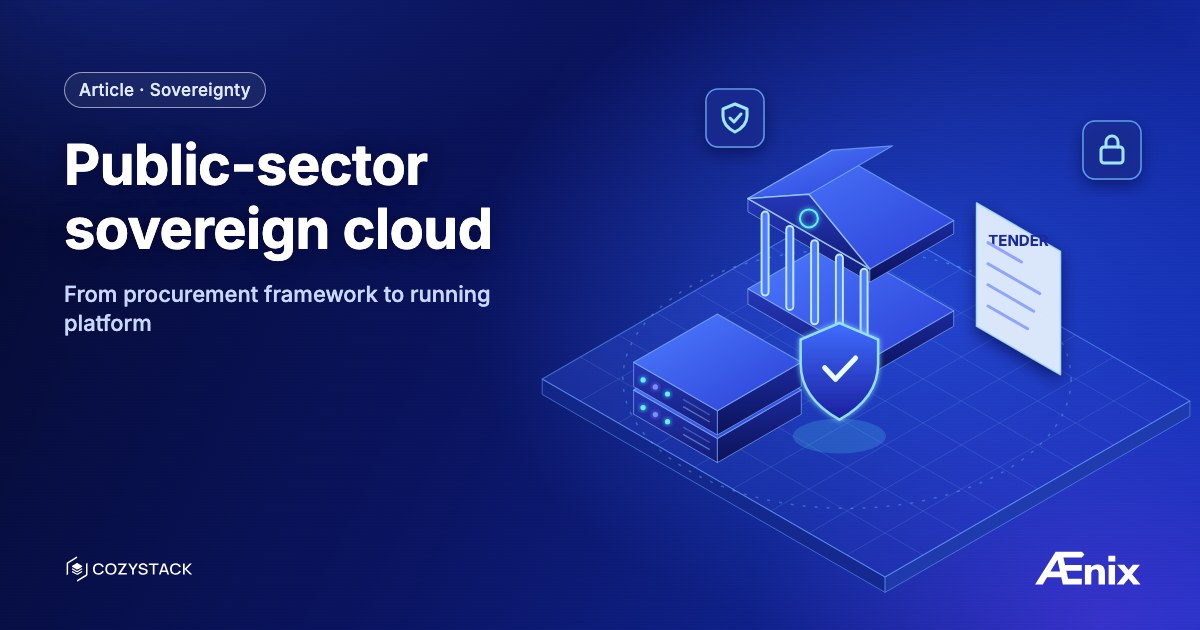
The public-sector sovereign-cloud conversation in 2026 is more fragmented than in financial services. There’s no single regulation like DORA driving alignment. Instead, each jurisdiction has its own framework, often layered on top of GDPR, NIS2, and sectoral overlays. A multinational public-sector engagement — or even a national one crossing regions — usually maps against three or more frameworks simultaneously.
The framework landscape
EU level
- EUCS (EU Cybersecurity Certification Scheme for Cloud Services) — proposed EU-wide scheme (adoption still pending). Three assurance levels (Basic, Substantial, High). High level requires substantive sovereignty controls.
- NIS2 — public administration is an Annex I sector; central-government entities are essential entities (Article 3). Article 21 + Article 23 obligations.
- GDPR — personal-data baseline, cross-border-transfer rules under Articles 44-50.
Member-state level
- France: SecNumCloud — strict French national framework. The most demanding EU-member-state sovereign-cloud scheme. Reference standard for several other national initiatives.
- Germany: BSI C5 — German cloud security catalogue. Now widely referenced beyond Germany for DACH operations.
- Italy: ACN — National Cybersecurity Agency frameworks; Polo Strategico Nazionale infrastructure rules.
- Spain: ENS High — Esquema Nacional de Seguridad highest level.
Other member states have variations.
Central Asia and APAC
- Kazakhstan — procurement-mandated sovereignty for public-sector workloads via goszakup.gov.kz / mitwork.kz / zakup.sk.kz.
- Singapore: IM8 — Government IT security standards.
- India: MeitY — Ministry of Electronics IT, including STQC Empanelled CSP framework.
- Australia: IRAP — Information Security Registered Assessors Program; Protected / Secret levels for government workloads.
Sectoral overlays
- Classified workloads (most jurisdictions): national classification overlay
- Healthcare: national health-data sovereignty rules
- Critical-infrastructure: sectoral cybersecurity overlays
What “substantively sovereign” means
A “sovereign cloud” product that doesn’t satisfy all of the following substantively will fail under audit at the High-assurance level of most frameworks:
1. Data residency at every layer
Not just production storage. Backup, observability, CI/CD artefacts, managed-service telemetry, cross-border replication, sub-contractor processing — every layer must respect the residency requirement.
2. Customer-controlled encryption keys
HSM-backed for sensitive data classes. Documented rotation. Emergency- access procedures. Provider personnel cannot extract or copy keys under any circumstances. This is the most common point where hyperscaler “sovereign” offerings fall short — the provider retains operational access to keys, which fails the substantive condition.
3. Open-source platform foundation
For transparency, exit-readiness, and auditability. Closed-source platforms tied to a single vendor’s roadmap fail several frameworks' substantive requirements (even where they pass procurement-policy checks).
4. Supplier-chain transparency
Supply-chain provisions across the frameworks (DORA Art. 28, NIS2 Art. 21(2)(d), national schemes) expect documentation of the supplier chain at least to the second hop. Most hyperscaler-based sovereign-cloud arrangements stop at the first hop (the hyperscaler itself).
5. Air-gap deployment option
For the most sensitive workloads — classified, healthcare-with-strict-residency. Updates flow through controlled channels (customer-side artefact registry, manual approval). Most sovereign-cloud frameworks at High level require air-gap support as an architectural option even if not used by every workload.
6. Audit-trail completeness in standard formats
Logs in standard formats (Syslog, CEF, OpenTelemetry) that the customer’s audit team can consume independently of the platform vendor. Tamper-evident. Retention per the longest applicable regulatory requirement.
7. No phone-home telemetry
Telemetry that leaves the customer perimeter must be opt-in and explicitly documented. Many hyperscaler-managed cloud products have non-optional telemetry channels that fail this criterion.
8. Operational independence under sovereign jurisdiction
Provider personnel access logged and time-limited. Sovereign jurisdiction for the support entity (Ænix has AENIX s.r.o. in Czechia for EU contracts and AENIX INC in Delaware for US contracts). No cross-jurisdictional support routing for sovereignty-sensitive workloads.
What Cozystack-based architecture delivers across frameworks
The architectural pattern that satisfies all major frameworks simultaneously:
- Open-source platform — Cozystack under Apache 2.0, CNCF Project, vendor-neutral substrate. Customer can audit, modify, or replace the platform vendor.
- Customer-held keys — volume encryption is opt-in per storage class and key management is designed with you; Ænix never holds keys.
- Air-gap support — documented air-gapped install workflow for classified-data use cases.
- Self-hosted observability — VictoriaMetrics + VictoriaLogs in jurisdiction; no SaaS-observability residency leak.
- Customer-controlled identity — Keycloak / Active Directory / national IdP integration; Ænix never holds production credentials.
- Multi-tenant Tenant CRD — strong isolation per data class / business unit / sectoral overlay.
- Audit-isolated environments — separate clusters for production, audit, and forensic copy.
- EU jurisdiction support entity — AENIX s.r.o. (Czechia).
The architectural pattern is the same; the certification work is framework-specific. For SecNumCloud-tier engagements, the customer typically engages a certified auditor; Ænix provides the architecture and documentation deliverables, the customer runs the audit cycle.
Procurement realities
Public-sector engagements are procurement-framework-driven in a way that private-sector engagements are not. A few practical realities:
Tender response
Public-sector RFPs typically specify which frameworks must be satisfied (SecNumCloud High, BSI C5, EUCS Substantial, etc.). The response must demonstrate substantive compliance, not just intent. Ænix engagement model includes tender-response support; references can be shared under NDA where the customer allows it.
Multi-year framework agreements
Many public-sector engagements run through framework agreements with specific compliance and exit clauses. Ænix’s commercial entity (AENIX s.r.o. in Czechia for EU; AENIX INC in Delaware for US) is the contracting entity; engagement structure adapts to framework- agreement requirements.
Ænix is not a hyperscaler — that’s the point
Several public-sector mandates explicitly require non-hyperscaler sovereign provision. Ænix’s open-core model — customer hardware, customer-held keys where encryption is enabled, customer operational control, optional Ænix support — fits these mandates structurally rather than via contractual workarounds.
Engagement phases for public-sector
Phase 0 — Framework scoping
Confirm applicable frameworks. Identify the highest-bar one (usually SecNumCloud High for French, BSI C5 for German, EUCS High where EU-wide requirements apply, national procurement rules elsewhere). Design the architecture against the highest bar; map down to the others.
Phase 1 — Architecture and procurement-response work
Produce procurement-response artefacts: technical proposal, framework compliance mapping, reference architecture, sample evidence catalogue. Typical duration: 2-4 months.
Phase 2 — Phase-1 platform build (per Public Cloud Platform /
Private Cloud Platform models)
Multi-DC deployment, air-gap option enabled if applicable, sovereign identity integration, audit-isolated environments. A national multi-region programme runs a 3-6 month pilot, then 9-18 months to full multi-region operation; a single-agency private cloud is a 3-12 month build after a 14- or 28-day assessment.
Phase 3 — Certification cycle
Customer engages accredited auditor; Ænix provides architecture documentation, control mapping, evidence catalogue. Ænix engineers participate in technical interviews with the auditor where allowed. Typical certification cycle: 6-12 months parallel to Phase 2.
Phase 4 — Production operations
Customer team operates the platform with Ænix advisory and a Plus or Enterprise support tier (see /pricing/). Annual recertification cycle (most frameworks).
Certified production comes later than in private-sector engagements because of the certification cycle, but the certification value compounds — once certified, the platform retains certification with annual recertification rather than per-engagement.
Ænix’s existing public-sector posture
Ænix contracts through AENIX s.r.o. (EU) and AENIX INC (US) and works within public-sector procurement frameworks. Specific engagements are confidential; references are available under NDA in the discovery call.
When this engagement model fits
Strong fit:
- National sovereign cloud initiatives (public, public-private partnership, sovereign cloud operator)
- EU member-state regional / sectoral cloud programmes
- Classified-data hosting with an air-gap requirement
- Healthcare sovereign cloud at national or regional level
- Education / research consortia with multi-decade planning horizon
Marginal fit:
- Single ministry / agency procurement with smaller scope — may fit Private Cloud Platform rather than Public Cloud Platform
Poor fit:
- Workloads where hyperscaler-managed cloud is already framework- compliant (some specific procurement frameworks)
- Organisations without sovereignty pressure (use the private-sector product matching the workload profile)
Where to dig deeper
- Public-sector industry page — the commercial landing
- Data sovereignty services — buyer-trigger sovereignty landing
- NIS2 compliance services — for the NIS2 overlay (public administration is Annex I)
- Sovereign Cloud Builder services — the engagement type
- Build sovereign cloud — playbook for EU and Central Asia — EU and Central Asia sovereign cloud playbook
- Data residency requirements in 2026 — per-layer residency walkthrough
Test yourself: public-sector sovereign cloud
5 questions · ~2 min