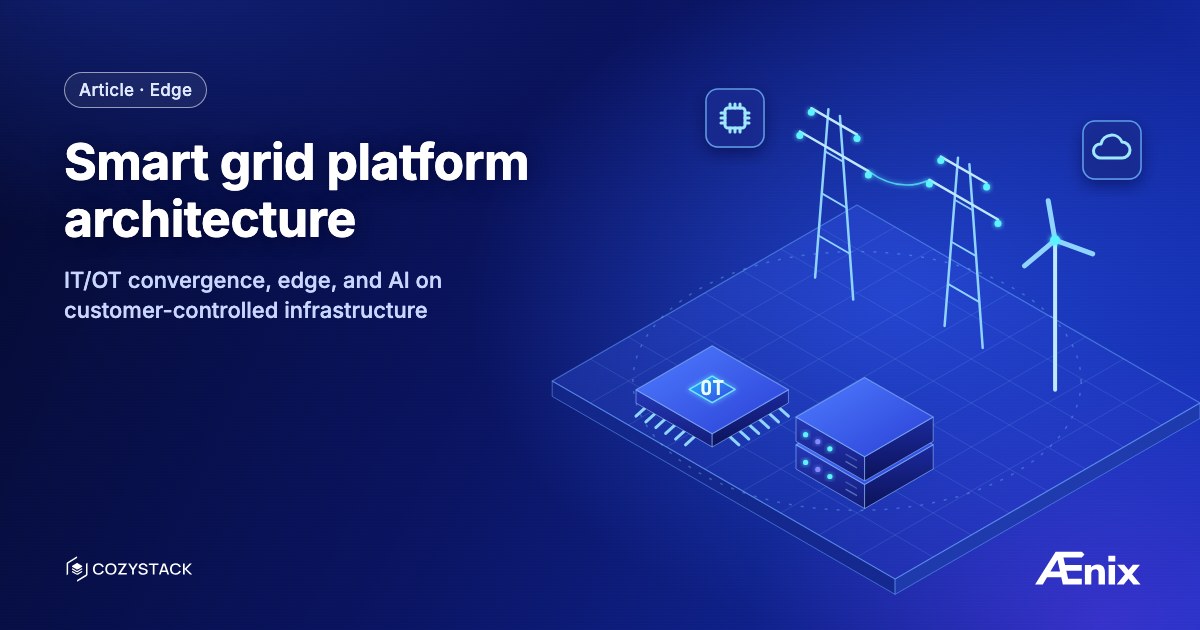
The energy sector’s infrastructure-modernization conversation in 2026 sits at an unusual intersection: NIS2 compliance pressure, AI-driven grid-optimization demand, IT/OT convergence reality, edge compute requirements at substation density, and the irreducible operational fact that grid hardware refresh cycles are measured in decades. Few other sectors face this combination simultaneously.
Three pressures converging on energy infrastructure
Pressure 1: NIS2 compliance with operational reality
NIS2 Article 21 risk-management measures apply to energy operators (Annex I sector; essential or important entity depending on size). Article 23 incident reporting (24-hour / 72-hour / 1-month timelines) requires telemetry tuned for security, not just performance. Article 21(2)(d) supply-chain security requires mapping ICT third parties to the second hop at minimum.
For energy operators with legacy SCADA + DCS + GIS + energy-management systems integrated through years of one-off engineering, Article 21’s “documented risk register per critical workload” is non-trivial.
Pressure 2: AI for grid operations
Grid forecasting (load, generation, weather impact), demand response automation, predictive maintenance (transformer / line / substation health), market-price optimization — all increasingly use ML.
The economics drive sustained workloads (24/7 model serving) where dedicated GPU infrastructure usually wins over hyperscaler GPU. Combined with grid-operational data sensitivity (often legally protected), sovereign AI is the natural answer.
Pressure 3: Edge compute at substation density
Modern grid operations distribute compute toward generation, distribution, and storage edges. Substations (10s-100s per operator), distributed generation sites, microgrids, EV charging clusters — each may host workload that needs local compute with intermittent central connectivity.
Traditional centralized SCADA architecture doesn’t scale to this density. Modern smart-grid architecture distributes the platform.
Smart-grid architectural reference
Bring the three pressures together and the architecture looks roughly like this:
HQ Cloud (Cozystack)
   ├── Energy management system (EMS)
   ├── Grid analytics + AI training
   ├── Forecasting models (load, generation, weather)
   ├── Market integration (ENTSO-E, market operators)
   ├── Customer billing + customer-facing portals
   └── Compliance + audit log aggregation
        ↓
Regional control sites (Cozystack)
   ├── SCADA aggregation
   ├── Regional grid management
   ├── AI inference (forecasting models)
   └── Disaster recovery
        ↓
Substation edge (Cozystack)
   ├── Local SCADA / RTU integration
   ├── Real-time grid-edge compute
   ├── IoT data ingestion (sensors, smart meters)
   └── Air-gapped OT boundary
Cozystack runs at all three layers under one operational model, with policy and identity federated, but the OT/IT boundary at substation tier is intentionally restricted.
IT/OT convergence — boundaries that work
The naive “merge IT and OT” pattern is dangerous. The working pattern in 2026 is convergence with boundaries:
Strict boundary: OT zone
- Substation OT systems (SCADA, RTU, IEDs) live in OT zone
- Air-gapped or strictly restricted-egress to IT zone
- Updates via controlled channels (Harbor mirror, manual approval)
- Cybersecurity tooling is OT-aware (not generic IT EDR)
- Identity model separate from workforce IT
Permeable boundary: IT zone
- Grid analytics, AI inference, forecasting, customer-facing apps live in IT zone
- Standard cloud-native operational model
- IT cybersecurity tools and identity federation
- Cloud-native observability + compliance tooling
Bridge: data fabric
- Carefully-controlled data flows from OT to IT (typically read-only or one-way)
- Data validation + sanitization at boundary
- Audit-trail completeness at boundary
The architectural pattern: Cozystack runs the IT zone and the bridge layer. OT zone is its own dedicated infrastructure with controlled egress. Both can be deployed on Cozystack but with strict policy boundaries.
Cozystack architectural advantages for energy
1. Multi-site under one operational model
Cozystack platforms federate across central + regional + substation tiers. Single operational model, single platform team, consistent observability, GitOps-driven changes.
2. Air-gap support for OT
Documented air-gap install workflow. Suitable for OT zones that cannot have internet egress. Updates via Harbor mirror or controlled channels.
3. AI infrastructure native
KubeVirt for legacy AI workloads, native Kubernetes for modern ML pipelines. Passthrough of whole GPUs or NVIDIA vGPU (requires your NVIDIA vGPU licence) for VM-bound workloads, and HAMi fractional sharing (GPU memory and compute cores) for containers sharing GPUs across forecasting models. NVIDIA data-centre GPUs are supported through the NVIDIA GPU Operator, which on MIG-capable cards can also hand containers hardware-separated MIG partitions.
4. Multi-tenant for cross-BU
Tenant CRD model accommodates generation / transmission / distribution / retail BUs with separate isolation. For unbundled markets, this is non-optional.
5. Sovereign by architecture
Open-source platform on customer-controlled hardware. Opt-in volume encryption at rest (LINSTOR and LUKS) with a passphrase you hold. Audit-trail completeness in regulator-consumable formats. NIS2-aligned without bolt-on workarounds.
6. Long operational horizon
Apache 2.0 licence + CNCF Project community governance fits decade-plus grid operational planning. Vendor roadmap risk is minimized.
NIS2-specific architecture controls
For each Article 21 sub-requirement that touches infrastructure:
- Risk register per critical function — workload-level mapping, including OT-zone boundaries
- Incident detection at 24-hour timeline — telemetry tuned for security, not just performance
- Business continuity tested — annual exercises with documented results, including substation-tier failover
- Supply-chain transparency to second hop — every ICT vendor + sub-contractor mapped
- MFA for privileged accounts — universal in IT zone; appropriate substitutes in OT zone (smart-card, dedicated KVM)
- Cryptography with customer-controlled keys — HSM-based for sensitive grid-operational data
- Vulnerability management with CVE response SLA — challenging in OT zone (long maintenance windows); architecture must support staged remediation
AI workloads on grid-operational data
Common AI use cases at energy operators:
- Load forecasting — short-term (1-24 hours), medium-term (1-30 days), long-term (1-5 years)
- Generation forecasting — especially for renewables (wind, solar) where weather is decisive
- Predictive maintenance — transformer health, line condition, substation equipment
- Demand response automation — for flexible loads (industrial customers, EV charging, storage)
- Market price optimization — for participating in wholesale markets
- Grid topology optimization — power flow analysis, congestion management
- Customer-facing AI — chatbot, billing analysis, energy-advice AI
The data feeding these models is often legally protected (customer data, grid-operational data, market-sensitive data). Sovereign AI infrastructure on customer hardware is the natural deployment pattern.
Typical hardware sizing for mid-size energy operator (5-10 GW generation portfolio): 16-64 GPUs across H100/L40S, with elastic burst capacity for re-training cycles.
Migration patterns from legacy
Most energy-sector smart-grid platforms in 2026 are migrations from legacy mixes of:
- Vendor-specific SCADA platforms (often heavily customized)
- Legacy virtualization (VMware-heavy)
- Standalone forecasting systems (commercial software)
- Spreadsheet-based grid analytics (still surprisingly common)
Migration sequencing:
- Discovery — workload inventory, OT/IT zone mapping, regulatory scope
- Cozystack foundation — central tier first
- Regional tier rollout — cohort by cohort
- AI workload migration — from legacy forecasting to Kubernetes-native
- Edge tier rollout — substation-by-substation, slowest tier due to operational risk
- Legacy decommission — staged as cohorts complete
For a mid-size operator, the multi-site platform follows the operator-scale pattern: a 3-6 month pilot on the central tier, then 9-18 months to full multi-site operation. The substation roll-out can run longer, paced by maintenance windows.
Common pitfalls
Pitfall 1: weak OT/IT boundary
“We’ll converge OT and IT” without strict boundary controls produces operational risk. The cybersecurity model in OT is different; the boundary must be deliberate.
Pitfall 2: hyperscaler-only AI
Putting grid-operational AI in hyperscaler region. Often incompatible with NIS2 supplier-concentration requirements; sometimes legally problematic for customer-data-driven workloads.
Pitfall 3: substation-tier underspecified
Treating substation tier as “just SCADA” misses that modern smart-grid architecture distributes compute to substations. Needs platform-engineering treatment.
Pitfall 4: skipping NIS2 architecture during platform build
“We’ll add NIS2 controls in v2” produces retrofit cost that exceeds doing it from start.
Pitfall 5: under-engineered DR for grid criticality
Grid operations have public-safety implications. DR posture must be tested and proven, not documented only.
Where Ænix engages
The standard Platform Readiness Assessment with energy-specific workstream emphasis covers the full picture. For details and engagement structure see energy industry page.
For specific triggers see NIS2 compliance, Sovereign AI, Data sovereignty.
Want to dig deeper?
- Energy industry page — engagement details
- NIS2 compliance — essential-entity regulatory
- Sovereign AI — AI on grid data
- Platform Readiness Assessment — methodology
- Cozystack — open-source platform foundation
Test yourself: smart-grid platform architecture
5 questions · ~2 min