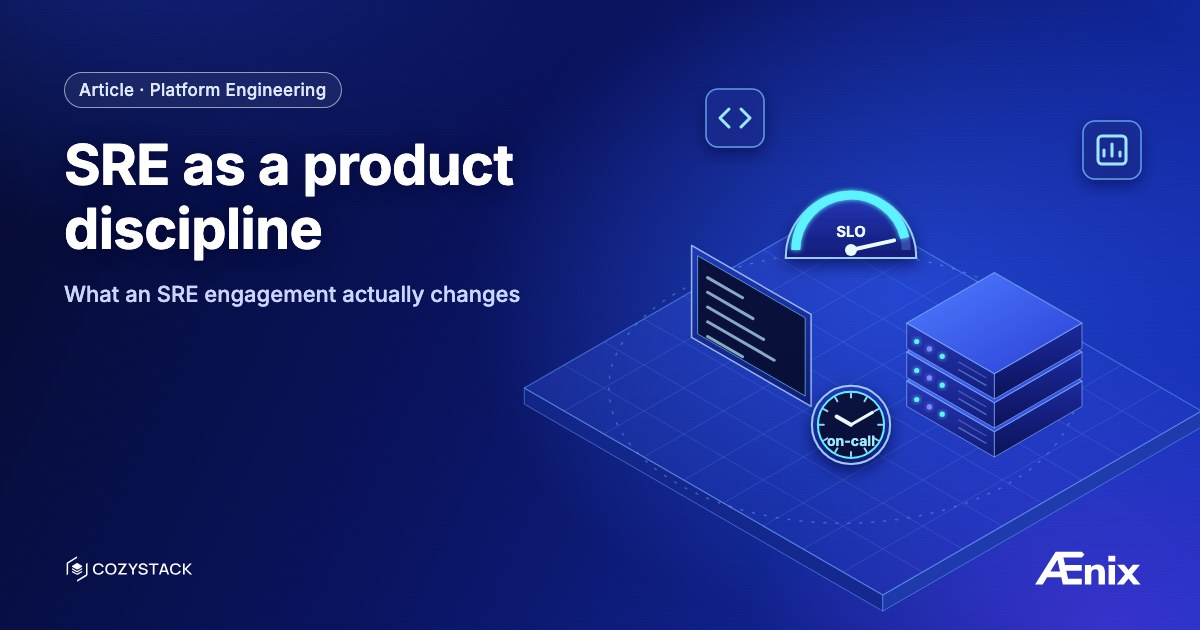
SRE — Site Reliability Engineering — is one of the most-adopted and most-misunderstood engineering disciplines of the past decade. Most mid-to-large engineering organisations claim to “do SRE.” Far fewer actually run the discipline as Google’s original SRE book describes it: software engineering applied to operations, with explicit error budgets, SLOs that affect prioritisation, and a hard ceiling on operational toil.
What SRE means, precisely
The original Google formulation has three load-bearing properties:
1. SRE is software engineering applied to operations
SREs are software engineers — they write code, they ship systems, they automate operations. Not a relabelled ops team with the same job and a fancier title. The “is your SRE actually writing code?” test is a real test; teams that fail it have an ops function, not an SRE function.
2. Error budgets affect prioritisation
The SLO defines the bar. The error budget is the difference between 100% and the SLO target. When the error budget burns down, the product team’s prioritisation shifts — feature work pauses, reliability work becomes the priority. When the error budget is healthy, feature work can proceed.
Crucially, this is a contract, not a suggestion. SLO breach has real consequences for product roadmap. Organisations that have SLOs but don’t let them affect roadmap have observability, not SRE practice.
3. Operational toil is capped (often at 50%)
The Google formulation: SREs cannot spend more than 50% of their time on operational toil (repetitive, manual, automatable work). The remainder must go to software engineering that reduces toil. This makes the function self-improving over time — toil decreases, engineering capacity increases.
Teams that exceed the toil cap structurally have an ops function masquerading as SRE. The discipline degrades over months until the function is indistinguishable from traditional ops.
Three engagement models
In 2026, three structurally different SRE models exist in production:
Model 1: embedded SRE
SREs sit inside product teams. The product team includes 2-5 engineers, one of whom holds the SRE function. Same team owns features and reliability; the SRE shapes the architecture and on-call from inside.
Strengths: alignment between SRE and product priorities, fast feedback, no cross-team friction.
Weaknesses: SRE-quality varies per team, depending on the embedded person. Centralised SRE expertise doesn’t compound. Hard to scale across many product teams without losing consistency.
Fits: 100-300-engineer organisations where each product team has clear ownership and ~1 SRE-skilled engineer is available per team.
Model 2: centralised SRE function
SREs sit in a separate function with their own reporting line. They consult with product teams, set reliability standards, run shared infrastructure components, and operate the critical-path services.
Strengths: SRE expertise compounds. Standards are consistent across teams. Critical-path services have dedicated reliability owners.
Weaknesses: cross-team friction when SRE recommendations conflict with product team priorities. Risk of SRE-as-blocker rather than SRE-as-enabler.
Fits: 300+-engineer organisations with multiple critical-path services and a clear platform-engineering function. Often paired with platform engineering as a sister function.
Model 3: hybrid (embedded + centralised)
Embedded SREs in product teams handle team-specific reliability. Centralised SRE function operates shared infrastructure, sets standards, escalates for cross-team incidents.
Strengths: gets benefits of both. Most common pattern at large organisations (Google, Netflix, large fintech).
Weaknesses: requires substantial scale to justify the dual investment. Below 500 engineers, the overhead is hard to amortise.
Fits: 500+-engineer organisations with multiple business units and substantial reliability-sensitive workload portfolio.
Where SRE shows up as theatre
Patterns we see in assessments:
Theatre 1: SLOs exist, but don’t affect roadmap
SLOs are documented. Dashboards show SLO compliance. Quarterly reviews mention SLO trends. But product team prioritisation proceeds independently of error-budget state. When SLO breach happens, the response is incident-specific firefighting, not a roadmap re-prioritisation.
This is observability with SLO labels, not SRE practice. The distinction matters for buying decisions: organisations in this state don’t need more dashboards, they need a different governance model.
Theatre 2: SRE title applied to traditional ops
Operations engineers get retitled “SRE” without a change in job content. They still spend 90% of their time on ticket queue. They write no code beyond shell scripts. They have no error-budget authority.
This is a label change, not a discipline shift. Often happens during DevOps-to-SRE transitions that didn’t get executive sponsor investment.
Theatre 3: error budgets defined but never invoked
Error budgets are calculated. Some dashboards show them. But no process exists for what happens when they burn down. Effectively the same as no error budget.
Fix: write down the explicit feature-pause protocol that activates on error budget burn. Get product leadership to sign off on it. Test it once with an artificial burn-down before assuming it works in production.
Theatre 4: incident post-mortems without action items
Post-mortems happen after incidents. They get written. They go into a folder. No action items are tracked to completion. The same incident class recurs within 6 months.
Fix: post-mortem action items go into the same backlog as feature work, with named owners, due dates, and explicit prioritisation. The post-mortem hasn’t worked if its action items don’t ship.
What Ænix SRE engagement delivers
We typically engage with organisations where SRE practice is at one of three states:
- Pre-SRE — no formal SRE function; reliability is incident- driven firefighting. Engagement covers function definition, hiring plan, initial SLO definition for critical services.
- Theatre-state SRE — SRE titles and dashboards exist, but discipline hasn’t landed. Engagement diagnoses which theatre patterns are operating, designs corrections, often involves cross-functional governance work.
- Mature SRE needing expansion — discipline works in one business unit, needs to scale across the organisation or pick up new service families (AI/GPU workloads, edge compute, sovereign cloud). Engagement focuses on consistency and expertise transfer.
Workstream 1 — SLO definition
For each critical service, define:
- SLI (Service Level Indicator) — what we measure
- SLO (Service Level Objective) — the target
- Error budget — the difference between 100% and the SLO
- Burn-down policy — what happens when the budget is being consumed
- Recovery threshold — what restores feature-work prioritisation
Ænix doesn’t define SLOs for you in isolation — we facilitate the workshop where engineering and product leadership co-author them. SLOs without joint ownership don’t stick.
Workstream 2 — Incident response process
Roles (incident commander, scribe, communicator). Severity classification. Runbook structure. Escalation paths. Blameless post-mortem template. Action-item tracking.
This is often the highest-leverage workstream — the framework multiplies the effectiveness of every future incident.
Workstream 3 — Toil measurement and reduction
Inventory current SRE / ops team work. Categorise: toil (repetitive, manual, automatable) versus engineering (durable, automation- generating). Measure toil ratio.
Recommend the 3-5 automations that reduce the most toil. Stage them by ROI. Hand off to engineering team for implementation; we support if needed.
Workstream 4 — Observability stack
Ænix’s default observability recommendation: VictoriaMetrics for metrics, VictoriaLogs for logs, OpenTelemetry for tracing where applicable. Self-hosted (sovereignty-friendly, lower-overhead than Prometheus + Loki at scale, no SaaS vendor data-residency leak).
For organisations already on a different stack, we work with what’s in place rather than push replacement. Observability stack matters; SRE discipline matters more.
Workstream 5 — Function design
Embedded / centralised / hybrid model recommendation per the engineering organisation’s profile. Headcount planning. Hiring priorities. Reporting line. Interface with platform engineering (if separate function) and product teams.
The Cozystack reliability defaults
For organisations running an Ænix platform product, SRE practice gets a head start because the platform ships with SRE-aligned defaults:
- Observability built in — VictoriaMetrics + VictoriaLogs pre-deployed, with alert rules for the platform components
- Declarative change history — tenants and services are Kubernetes resources managed through GitOps, so every change has a commit, an author and a review
- Backup-restore patterns — Velero + per-app PITR, with RPO / RTO documented per service during the engagement
SLO definitions and failure-injection (chaos) tooling are not shipped as platform features; they are designed with you in the engagement.
This lets the SRE engagement focus on the organisation-specific work (function design, SLOs aligned to business priorities, governance) rather than rebuilding the technical substrate.
When this engagement fits
Strong fit:
- Engineering organisation 200+ engineers with reliability becoming a board-level concern
- Recent incident pattern that exposed reliability gaps
- Regulator-driven RTO/RPO obligations (DORA Articles 11-12, NIS2 Article 21(2)(c))
- Existing observability investment but no clear SRE discipline
- Platform engineering function exists or is being built (SRE pairs naturally with platform engineering)
Marginal fit:
- Smaller organisations (<100 engineers) — usually embedded SRE rather than separate function; Ænix engagement can be lighter (workshop + advisory rather than full multi-month engagement)
- Organisations with mature SRE in one BU needing expansion — scope can be narrower
Poor fit:
- Pure firefighting culture without engineering leadership sponsorship for the discipline shift — SRE engagement without executive backing degrades to incident response training, which is helpful but not what we sell
Where to dig deeper
- SRE consulting services — the commercial landing
- DevOps best practices for 2026 — the eight DevOps practices including SRE
- Platform engineering vs DevOps vs SRE — terminology and function design
- Cloud engineering disciplines — the seven disciplines that compound
Test yourself: SRE as a discipline
5 questions · ~2 min