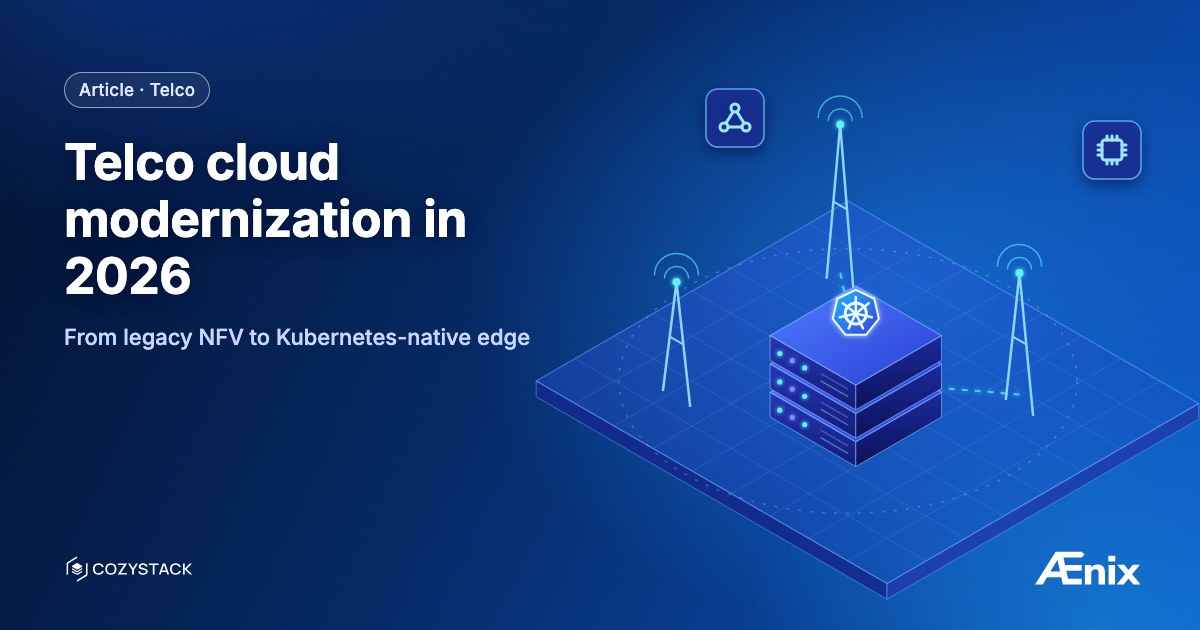
The telco cloud conversation in 2026 sits at an unusual intersection of pressures that no other vertical faces simultaneously. NFV deployments from 2015-2020 are aging out. NIS2 obligations apply across the operator’s infrastructure. Sovereign-cloud branded products are commercially attractive (regional sovereignty positioning is hard for hyperscalers to replicate). Edge-compute demand for 5G/6G workloads is growing. AI for network operations (traffic prediction, anomaly detection, customer-facing assistants) is emerging.
The architectural answer is rarely “one platform for everything” — telcos have multiple operational domains, each with its own constraints. But the patterns that work across all of them have converged on Kubernetes-native multi-site platforms with strong multi-tenant isolation, sovereign operation, and edge-aware scheduling.
What modernization actually replaces
Most tier-1 European telcos in 2026 operate three or four parallel infrastructure environments:
1. Legacy NFV environment (2015-2020 vintage)
Typically built on VMware Cloud Foundation, OpenStack-based vendor distros (Red Hat OSP, Mirantis Cloud Platform, Wind River, etc.), or vendor-specific NFVI (Ericsson CEE, Nokia CloudBand). Hosts VNFs from network-equipment vendors with vendor-specific certification requirements.
Modernization driver: vendor distribution lifecycles (Red Hat OSP EOL, Mirantis transition), VMware Broadcom pricing, operational complexity that compounds with team turnover. Most tier-1 operators have parallel modernization programmes running.
2. IT cloud (separate from NFV)
For business workloads, customer-facing portals, billing, OSS/BSS. Typically a separate VMware estate or hyperscaler-region deployment. Same Broadcom pressure on VMware; sovereignty pressure on hyperscaler deployment.
3. Edge compute (5G/6G era)
Distributed edge sites at substations, central offices, MEC nodes. Smaller-footprint deployments with intermittent connectivity to core. Often built on different stack from core platform (legacy small- footprint orchestration).
4. AI / data lake / network analytics
Newer environment for traffic prediction, anomaly detection, customer- facing AI. Often hyperscaler-based today; under sovereignty pressure to move on-prem for sensitive workload patterns.
The single-platform vision (and where it works)
The architectural attraction of Cozystack-based modernization is a unified platform across all four environments. One operational model, one upgrade lifecycle, one observability stack, federated identity, GitOps-driven changes.
Where this works:
- IT cloud workloads — straightforward Cozystack-based deployment. Most tier-1 telco IT cloud modernizations follow this pattern.
- AI / data lake / analytics — Ænix AI Platform workload patterns; sovereign by default; multi-tenant for cross-BU access.
- Edge compute — Cozystack supports small-footprint edge deployments with federation to core. Standardised across sites.
Where it requires nuance:
- NFV environment specifically — VNF certification with vendor equipment is still vendor-managed. The Cozystack platform underneath can host KubeVirt-based VNFs, but the certification stack remains vendor-bound. Some VNFs are certified on specific OpenStack distributions and need a parallel modernization track.
- Critical SCADA-style network OAM — air-gapped network management systems with their own operational model. Cozystack can host them, but the OT-style operational discipline differs from IT cloud.
The practical pattern: Cozystack as the IT cloud platform + AI platform + edge platform; NFV gets its own modernization track with Cozystack-equivalent architecture where vendor certification allows.
Multi-tenancy for telco
Telco operators have layered multi-tenancy needs:
- Operational BU separation — fixed broadband, mobile, enterprise, consumer; each BU has different operational ownership.
- Customer-facing services — telco offers cloud capacity to its business customers (sovereign cloud product line); each customer is its own tenant.
- Internal vs external workloads — internal-only workloads (OAM, observability backends) versus customer-facing workloads (cloud product, customer portal).
- Sectoral / regulated tenants — telcos increasingly host regulated workloads (financial sector adjacencies, public-sector contracts) under sectoral tenant isolation.
Cozystack’s Tenant CRD model with nested tenants supports all four layers natively. A tier-1 telco typically operates 5-50 top-level tenants with hundreds to thousands of nested tenants.
Sovereignty positioning
For telcos, sovereignty is not just compliance — it’s a commercial differentiator. European customers increasingly view US-headquartered hyperscaler dependencies as structural risk. Telcos can offer sovereign cloud products in their region that hyperscaler-managed offerings cannot match on the substantive sovereignty criteria.
Cozystack-based architecture supports this commercially:
- Encryption with a customer-held passphrase — opt-in volume encryption at rest (LINSTOR and LUKS); the key-management process is designed with the telco, which provides operational support
- Air-gap option — for classified or restricted-egress use cases
- Open-source substrate — exit-readiness built in; telco doesn’t lock customers into vendor relationship
- EU jurisdiction — telco’s EU presence + Ænix EU contracting entity (AENIX s.r.o.)
For sovereign cloud commercial product lines, the Ænix Public Cloud Platform is the typical pairing — multi-region, multi-DC, service-catalog depth, brand-engineered customer portal.
Edge compute realities
5G/6G drove distributed compute requirements that NFV-era architecture didn’t anticipate. Modern edge compute for telco operations spans:
- MEC (Multi-access Edge Computing) nodes at base-station or central-office locations for low-latency customer workloads
- Distributed RAN intelligence — vRAN / O-RAN workloads with real-time constraints
- Customer-edge compute — telco-managed edge instances on customer premises (factories, smart-grid sites, transport hubs)
- Sectoral edge — telco-operated edge for sectoral customers (financial branch offices, healthcare facilities, retail)
Cozystack supports edge deployment with reduced footprint (~3-node clusters at edge sites typical) with federation to regional and core platforms. Same operational model; same observability; differentiated service catalog per tier.
AI for telco operations
The AI workload patterns at tier-1 telcos:
- Traffic prediction and capacity planning — 24/7 inference on network telemetry
- Anomaly detection — security and operational anomalies in real- time
- Customer-facing AI — chatbot, billing assistance, customer service routing
- Network optimization — routing, traffic engineering, energy efficiency
- Fraud detection — transaction anomaly detection, identity validation
- Sectoral AI services — telco-hosted AI capacity for sectoral customers (banking AI, healthcare AI, public-sector AI)
Sustained-utilisation workload profiles dominate; this is exactly the case where dedicated GPU economics beat hyperscaler. The Ænix AI Platform fits.
Phasing a tier-1 telco modernization
The cloud platform follows the operator-scale pattern: a 3-6 month pilot, then 9-18 months to full multi-region operation. Edge expansion and NFV modernization run as longer parallel tracks, paced by site roll-outs and vendor lifecycles. Typical phasing:
Phase 0 — Strategic engagement (start of the pilot)
Architecture review across all four environments. Commercial alignment on sovereign cloud product line, sectoral positioning, modernization sequencing. Sponsor and workstream-lead identification.
Phase 1 — IT cloud modernization
Ænix Private Cloud Platform / Public Cloud Platform deployed. Internal workloads migrated. Customer-facing portal launched for sovereign cloud product.
Phase 2 — AI / data lake (parallel)
Ænix AI Platform deployed. Network analytics workloads moved on-prem. Customer-facing AI services launched.
Phase 3 — Edge expansion (ongoing, paced by site roll-out)
Edge sites stood up at MEC / central-office / customer-edge locations. Federated identity and observability across.
Phase 4 — NFV modernization (parallel, paced by vendor lifecycles)
Vendor-certified VNF replatforming where allowed. Greenfield deployments of new VNFs on Cozystack-based architecture. Legacy NFV maintained in parallel until vendor lifecycle forces upgrade.
Phase 5+ depends on customer-facing product growth: regional expansion, sectoral SKUs, new service families.
When this fits a telco
Strong fit:
- Tier-1 or tier-2 European telecom operator
- Active legacy NFV modernization programme
- Strategic intent to offer sovereign cloud product line
- Multi-million-euro budget envelope across multi-year programme
- Senior executive sponsorship (CIO / CTO / Cloud BU lead)
Marginal fit:
- Smaller operators (regional, MVNO-style) that sell cloud — Ænix Public Cloud Platform at provider scale, from the published price list, rather than a full operator-scale programme
- Operators with deep OpenStack-based NFV investment that still works — modernization can wait for vendor lifecycle to force it
Where to dig deeper
- Telco industry page — commercial landing
- Public Cloud Platform product page — the product for telcos that sell cloud services
- Sovereign cloud builder services — for sovereign cloud product line builds
- Sovereign AI services — for AI workload patterns
- Public Cloud Platform build phasing — operator-scale build phasing
- Sovereign AI architecture decisions — seven decisions for sovereign AI
Test yourself: telco cloud modernization
5 questions · ~2 min