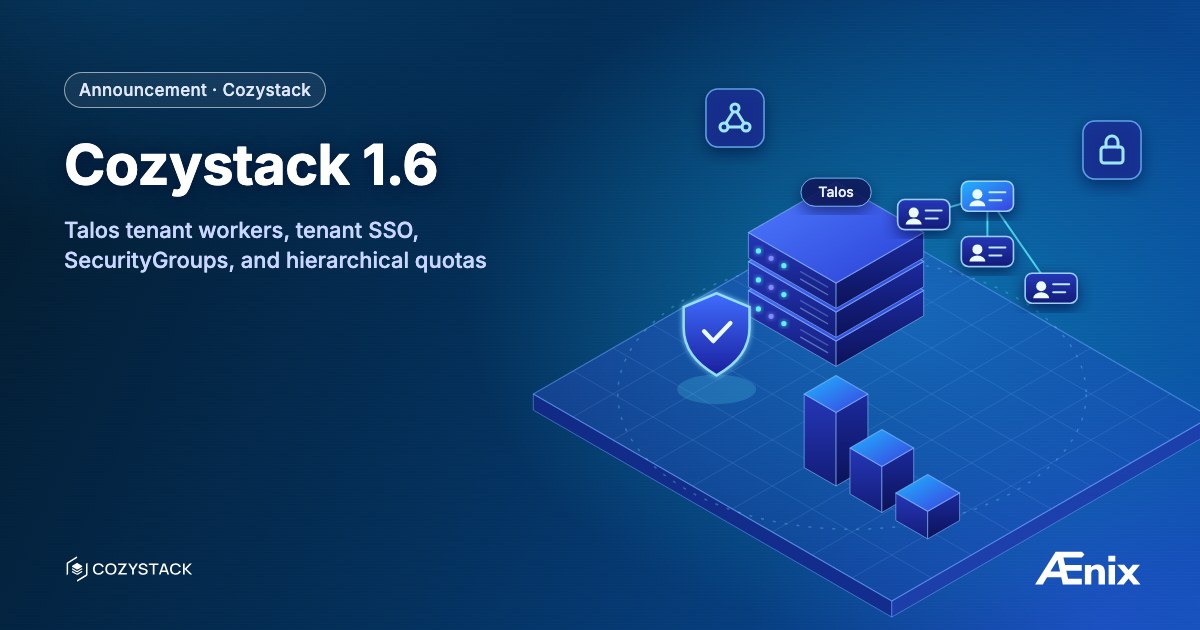
Cozystack v1.6.0 was published on 22 July 2026. It replaces the Ubuntu and kubeadm bootstrap of tenant Kubernetes workers with Talos Linux driven by Cluster API, completes the etcd-operator v1alpha2 migration with in-place adoption of live clusters, adds OIDC single sign-on for tenant kube-apiservers and per-instance Grafana, introduces a tenant-facing SecurityGroup firewall API, and makes tenant resource quotas hierarchical. It rolls up every fix from v1.5.1 and v1.5.2.
It also carries the largest upgrade surface since v1.0. The platform migration targetVersion moves from 45 to 54, so migrations 45 through 53 run as pre-upgrade hooks — and three of them can block or wedge the upgrade if their preconditions are not met. Plan a window and read the checks below.
Read this before upgrading
Upgrade to v1.6.4 (or the latest 1.6.x), not v1.6.0. Three of the fixes that landed after v1.6.0 are the kind that fail silently:
- v1.6.0 shipped a fail-open copy of
hack/seaweedfs-naming-audit.sh— the script whose output gates a runbook step that deletes PVCs. Everykubectlcall in it was silenced with2>/dev/null, so a timeout or an RBAC denial produced an empty “all clean” table byte-identical to an honestly clean fleet. Fixed in v1.6.1. Run the audit from a v1.6.1-or-later checkout, and read the exit code, not the table. A clean result from the v1.6.0 copy is not evidence of anything. - v1.6.2 fixes Velero CRDs staying frozen at whatever version was first installed, because Helm never touches a chart’s
crds/directory on upgrade. Once the Velero image moved to a version with new backup phases, the apiserver rejected phase transitions against the stale CRDs and backups stopped while the HelmRelease stayed green. - v1.6.2 also repairs the default backup
StrategyCRs and the VeleroBackupStorageLocation, which were gated on a Helmlookupperformed while the referenced object was still being created. When the lookup came back empty the objects were skipped permanently, since helm-controller does not re-render a release whose chart and values are unchanged.
If you are coming from the 1.5 line, go through v1.5.4 first. v1.5.4 is the first 1.5.x release stamped targetVersion: 46, and its slot 45 stamps helm.sh/resource-policy: keep onto the CAPI KubeadmConfigTemplate objects. 1.6 drops KubeadmConfigTemplate from the tenant kubernetes chart entirely — workers move to TalosConfigTemplate — so without that pin Helm deletes the template while the kubeadm-backed MachineSet is still mid-rollover with its bootstrap.configRef pointing at it. Verify before upgrading:
kubectl get kubeadmconfigtemplates.bootstrap.cluster.x-k8s.io -A \
  -o custom-columns='NS:.metadata.namespace,NAME:.metadata.name,KEEP:.metadata.annotations.helm\.sh/resource-policy'
A row showing <none> means the pin did not land. Fix it before going to 1.6.
Pre-upgrade checks
Run these against the management cluster before applying the v1.6 Platform Package.
1. etcd adoption needs a reachable backup target. Migration 50 adopts every legacy etcd.aenix.io/v1alpha1 cluster onto the new operator and takes a mandatory snapshot first. If it cannot resolve the snapshot target it exits 1 and halts the upgrade.
kubectl get etcdclusters.etcd.aenix.io -A
kubectl get etcds.strategy.backups.cozystack.io cozy-default-etcd
kubectl get secret cozy-backups-creds -n cozy-velero
kubectl get buckets.apps.cozystack.io cozy-backups -n tenant-root
If the first command prints nothing, migration 50 is a no-op.
2. SeaweedFS naming audit. v1.6.0 pins fullnameOverride: seaweedfs and adopts the running workload set in place, but two states cannot be adopted automatically and the chart fails the render rather than guess: class S (installed fresh on 1.5.x, data on data1-seaweedfs-system-volume-* PVCs) and class MIXED (both naming generations present). Both must be recovered before upgrading, following the seaweedfs-431-rename-recovery runbook. Class L needs nothing. A cluster that went 1.4.x straight to 1.6 never renamed and is unaffected.
3. Tenant clusters still on Kubernetes v1.30. v1.30 leaves the Talos-to-Kubernetes support matrix and the chart refuses to render it. Migration 46 patches live CRs to v1.31, but a GitOps-managed CR is overwritten again by the next source reconcile — so bump spec.version in Git.
kubectl get kuberneteses.apps.cozystack.io -A \
  -o custom-columns='NS:.metadata.namespace,NAME:.metadata.name,VERSION:.spec.version'
4. Hand-made tenant StorageClasses that collide. Remote-accessible LINSTOR StorageClasses are now created inside each tenant cluster under the same name. A manually created tenant StorageClass with a colliding name — typically replicated — blocks the propagated class and stalls the tenant CSI release. Delete any such class that is not Helm-managed. Infra classes that must stay node-local need an explicit linstor.csi.linbit.com/allowRemoteVolumeAccess: "false"; an absent annotation is treated as remote-accessible.
5. Deprecated etcd module backup values. The backup.* block on the etcd tenant module is removed in this release. Move to a BackupClass bound to the Etcd strategy first.
6. Coming from v1.4.x? The v1.5.0 requirement still applies: Kubernetes 1.33 or newer on the management cluster and on any tenant cluster enabling the Flux addon.
Talos Linux for tenant Kubernetes workers
Tenant worker nodes no longer boot Ubuntu and bootstrap through kubeadm. Phase 1 of the Kubernetes-app split replaces that path with Talos Linux, driven by cluster-api-bootstrap-provider-talos (CABPT v0.6.12) registered as a second bootstrap provider alongside kubeadm, plus a clastix/talos-csr-signer sidecar embedded in the Kamaji control-plane pod.
Talos PKI — an Ed25519 CA plus trustd TLS — is generated through cert-manager with stable, lookup-and-reuse Talos secrets. The Kamaji control-plane provider carries an upstream-bound patch exposing KamajiControlPlane.spec.network.additionalServicePorts, so trustd (50001/TCP) can be published on the apiserver Service. Workers boot the Talos openstack raw image via a CDI DataVolume streamed from the image factory, with the system disk exposed as virtio-blk using blockSize.custom: logical=512, physical=4096 — so 4Ki-native backends such as LINSTOR/DRBD behave under QEMU’s O_DIRECT writes while SeaBIOS still boots.
The separate disk-kubelet PVC is gone. Talos lays out EPHEMERAL itself on the single system disk that nodeGroups[*].diskSize now sizes.
What this means operationally:
- Existing tenants roll over automatically. Old machines are replaced by Talos workers without manual intervention, and migration 45 pins the outgoing
KubeadmConfigTemplateobjects withhelm.sh/resource-policy: keepso Helm cannot prune them mid-rollover. But plan for a full worker-pool replacement per tenant cluster: worker disks are reprovisioned and container images re-pulled. - Worker MachineHealthCheck remediation is now ON by default.
maxUnhealthymoved from a hard-coded0tonodeHealthCheck.maxUnhealthy, defaulting to"50%". CAPI now deletes and replaces unhealthy worker Machines. SetnodeHealthCheck.maxUnhealthy: "0%"to keep the old behaviour until your fleet is stable on Talos. Per-node-groupmaxUnhealthyandnodeStartupTimeoutoverrides also ship, so a stateful group can sit at0%while a stateless one tolerates50%. - The default
md0node group is no longer merged into every cluster.nodeGroupsdefaults to{}and the built-inmd0applies only when no node groups are configured. Migration 47 pinsmd0explicitly on existing CRs to preserve live topology; it is fail-closed, aborting the upgrade rather than letting Helm prune a livemd0MachineDeployment. - Fresh clusters with
nodeGroups: {}come up with zero workers. The chart no longer managesMachineDeployment.spec.replicas— the cluster-autoscaler owns it alone, seeded fromminReplicas: 0. Supply a node group withroles: [ingress-nginx]andminReplicas >= 1, or let the autoscaler bring upmd0once ingress-nginx pods goPending. The upside for existing clusters:helm upgradeno longer drains workers back to a hardcodedreplicas: 2on every platform bump. - Air-gapped installations lose the
registries.mirrorspassthrough to tenant workers — the Helm-rendered*-patch-containerdSecret has no consumer in the Talos machine config and was removed. The Talos OS image and installer are overridable viatalos.imageFactoryURLandtalos.installerRepository, but in-guest registry mirroring is a Phase 2 follow-up. - Worker node disks now default to the application-level
replicatedStorageClass. A node group leavingstorageClassempty previously took the management-cluster default; it now falls back to the applicationstorageClass, because linstor-csi v1.11.2 rejects ReadWriteMany volumes on a non-DRBD class and worker VMs need RWX to live-migrate. The rendered worker template changes, so each tenant’s worker MachineDeployment rolls once.
The tenant kubernetes HelmRelease now reports Ready as soon as Helm completes (DisableWait) and no longer blocks on worker or addon readiness; worker-rollout health is tracked by WorkloadMonitor instead.
etcd-operator v1alpha2 with in-place adoption
The etcd stack moves to the donated etcd-operator.cozystack.io/v1alpha2 API — a Membership-API lifecycle replacing the StatefulSet model — served by a Cozystack-authored chart at appVersion v0.5.2, with CRDs split into their own etcd-operator-crds package so they can be installed ahead of the controller.
The interesting part is the upgrade. Migration 50 runs as a pre-upgrade hook, while the legacy operator is still the running one, and uses the etcd-migrate tool baked into the migrations image to rewrite ownership, labels and CRs so the new operator takes over the live data plane on its first reconcile — no data move, no pod restart. Before touching anything it takes a mandatory snapshot of every adopted cluster to the cozy-backups bucket under a system key prefix with tenant-invisible credentials, and it fails loudly rather than adopt without one. It also re-issues each cluster’s server and peer certificates with the new operator’s native member wildcard SAN, because in secretRef TLS mode the operator never mints certs — an adopted cluster whose certs lack the native domain would silently fail TLS the first time a member is replaced, while still reporting Available=True.
If migration 50 halts on a cluster that genuinely has no backup storage, the documented escape hatch is:
kubectl edit package.cozystack.io cozystack.cozystack-platform
spec:
  components:
    platform:
      values:
        migrations:
          etcdAdoptSkipBackup: true
Flux re-renders the platform chart and re-runs the hook, adopting every legacy etcd without a snapshot. A botched adoption on a tenant control-plane etcd is unrecoverable without a snapshot. Set the flag back to false afterwards, or the next etcd migration skips its snapshot too.
SecurityGroup: tenant-managed network policy
A new tenant-facing, namespace-scoped firewall resource — sdn.cozystack.io/v1alpha1 SecurityGroup — lets tenants manage their applications’ network policy without any access to the cilium.io API group.
A SecurityGroup is a membership group. It owns a membership label (securitygroup.sdn.cozystack.io/<name>) that a new securitygroup-controller stamps onto the pods of every managed application listed in spec.attachments, and removes when an attachment is dropped. The group projects 1:1 onto a CiliumNetworkPolicy in the same namespace whose endpointSelector is exactly that membership label — so one SecurityGroup can cover several applications at once, and fromSG / toSG peers resolve group-to-group references live in the Cilium dataplane. A finalizer guards the backing policy so member labels are always stripped before it is removed, and the aggregated-API REST storage re-asserts them on every write so a full-replace PUT cannot orphan them.
The important limitation: ingress and egress rules only ever add allowed traffic. An empty rule list does not isolate the member pods, because effective connectivity remains the union of every policy selecting a pod — including the platform’s blanket-allow baseline. Default-deny enforcement is tracked separately as future work. Do not treat a SecurityGroup as a segmentation boundary in this release.
Hierarchical tenant resource quotas
tenant.spec.resourceQuotas previously became a plain per-namespace ResourceQuota that ignored the tenant tree entirely: a super-admin inside a quota’d tenant could create a sub-tenant with a larger quota, or with no quota at all, and consume more than was allocated. A tenant’s declared quota is now the budget for its whole sub-tree.
Enforcement is two cooperating layers, mirroring OpenShift’s ClusterResourceQuota split. A declaration-time gate in the aggregated apiserver deterministically rejects a sub-tenant whose declared quota exceeds the parent’s remaining budget. A runtime enforcer in cozystack-controller maintains a per-namespace tenant-quota-allocated ResourceQuota that clamps each pool member to its share, aggregating sub-tree usage so members collectively stay within it — Kubernetes enforces the most restrictive ResourceQuota in a namespace, so this binds without fighting Flux over the chart-rendered tenant-quota.
Review sub-tenant quotas before upgrading. A parent quota lowered below the sum of its children emits a QuotaOvercommitted event, and --tenant-quota-buffer-percent on cozystack-controller temporarily inflates pool budgets during rollout so workloads already over a freshly-binding quota keep running. There are no API type changes and no tenant chart changes — the feature works with the existing field.
OIDC single sign-on for tenant Kubernetes and Grafana
Two symmetric Phase 1 features let a tenant opt an individual workload into the platform’s Keycloak cozy realm through one flat selector, with no platform-level configuration.
Tenant kube-apiserver. Each Kubernetes CR gains spec.oidc.mode: System | CustomConfig | None, defaulting to None. System trusts the cozy realm via a per-cluster public client and audience binding; CustomConfig accepts a tenant-supplied structured AuthenticationConfiguration. spec.oidc.users[] drives one ClusterRoleBinding per user inside the tenant cluster (admin maps to cluster-admin, view to view). In System mode a <release>-oidc-kubeconfig Secret carrying a ready-to-use kubectl oidc-login exec block is surfaced through the Cozystack Dashboard, so a tenant user gets from “cluster exists” to “kubectl works with my SSO identity” without an operator in the loop. The underlying controlPlane.apiServer.extraArgs, extraVolumes and extraVolumeMounts passthrough on KamajiControlPlane is also exposed for anyone hand-rolling authentication.
Grafana. Each Monitoring CR gains the same selector. System wires a per-instance confidential Keycloak client with audience binding; authorization is app-side, with spec.oidc.users: [{email, role: Admin|Editor|Viewer}] reconciled into Grafana’s Main Org by a chart-owned post-install and post-upgrade Job that pre-provisions users, adds them to the org, patches their role and prunes stale members. CustomConfig accepts a tenant-supplied [auth.generic_oauth] payload, inline as a map or as a Secret with an auth.ini key — in the Secret case spec.oidc.users is unsupported and the chart fails the render on that combination rather than silently ignoring it. The admin_user / admin_password Secret remains a documented break-glass path in every mode.
Reference: enabling OIDC.
Application deletion now reclaims storage
Deleting a managed application used to leave its volumes and operator-generated Secrets behind. A ten-PR sweep across the catalog adds post-delete cleanup hooks and PVC retention policies so a deleted application actually releases what it held: ClickHouse keeper, data and log PVCs; Qdrant’s data PVC; OpenBAO’s data PVC; the tenant monitoring module’s VictoriaMetrics and VictoriaLogs storage and TLS Secrets; the tenant seaweedfs module’s volume PVCs; the tenant etcd module’s data-etcd-* PVCs; Harbor’s jobservice and trivy PVCs; MariaDB’s operator-generated password Secrets; Bucket and Gateway ACME resources.
This makes deletion irreversible. That is the point of the change, but it is a real behaviour change from “delete leaks the volume, and you could recover from it”. Harbor’s PVCs are force-deleted, overriding persistence.resourcePolicy=keep; Harbor’s CNPG database PVCs are not touched. Migrations 48 and 51 backfill the release label onto pre-existing ClickHouse keeper and monitoring storage PVCs so already-deployed clusters are covered; both are best-effort, and the worst case if a relabel is skipped is the pre-existing leak.
Back up before deleting. Tell your tenants.
Also in v1.6.0
- Wildcard certificates, end to end. v1.5’s
publishing.certificates.wildcardSecretNamecovered the root tenant only. The platform controller now replicates that certificate into every tenant namespace that terminates TLS, so per-tenant ingress controllers and Gateways serve it automatically, with no cross-namespace Secret read. A new opt-inpublishing.certificates.wildcard(defaultfalse) has the platform mint a single*.<root-host>certificate via DNS-01 on the default ingress-nginx path — the practical fix for hitting Let’s Encrypt rate limits at scale. - Keycloak gains four independent opt-ins: a KMS-encrypting database proxy for column-level PII encryption at rest, backed by a static KEK or Vault Transit (with Vault Kubernetes and AppRole auth); an
ingress.adminHostthat serves the admin console and Administration REST API on a separate hostname and route, attachable to a private Gateway or ingressClass viapublishing.ingressNameAdmin; Barman-based S3 backups of the CNPG database; and a selectable realm login theme shipped through platformbrandingvalues. All are off by default. - Immutable tags and rc-to-stable promotion. A stable release is now the byte-identical promotion of the release candidate that was tested: no tag is ever force-moved, stable is never rebuilt, and images are retagged by digest. The cron-driven
auto-release.yamlpatch-tag workflow is deleted outright. - Kamaji defaults to 2 replicas with soft pod anti-affinity, and its telemetry handler and webhook are removed — cutting apiserver admission p99 for
TenantControlPlanewebhooks by roughly 70% on multi-tenant clusters. - Remote-accessible LINSTOR StorageClasses propagate into tenant clusters under the same name, with the class named by
storageClass(defaultreplicated) becoming the tenant default and the legacykubevirtclass kept as an alias. - The Cozystack Dashboard now shows the LoadBalancer external IP on the application Services tab, and renders explicit error and unknown-type states instead of an infinite spinner. The console SPA is now built from in-tree source; the shipped image and digest are unchanged.
- After upgrading, re-check metrics scrape targets on port 10250 — cert-manager’s webhook, external-secrets’ webhook and metrics-server’s listener all moved off it.
Platform components
| Component | Change |
|---|---|
| Talos Linux | v1.13.0 → v1.13.6, kernel 6.18.29 → 6.18.38; closes CVE-2026-53359 and CVE-2026-46113 KVM guest-to-host escapes |
| etcd-operator | v0.4.5 → v0.5.2, new v1alpha2 API |
| Cilium | 1.19.3 → 1.19.5 |
| KubeVirt | v1.8.4 (fixes VMIs stuck Scheduled on Kubernetes 1.36; closes CVE-2026-35469) |
| Velero | 1.17.0 → 1.18.1, concurrent backup processing, cache volumes for data movers |
| Vertical Pod Autoscaler | 1.3.0 → 1.5.0, in-place pod resizing promoted to Beta |
| Harbor | 2.14.2 → 2.15.1 |
| Keycloak | 26.5.2 → 26.6.3 |
| LINSTOR | 1.33.2 → 1.33.3, linstor-csi v1.11.2 |
| FoundationDB operator | v2.13.0 → v2.30.0 |
| HAMi | 2.8.1 → 2.9.0 |
| Percona MongoDB operator | 1.21.1 → 1.22.0 |
| OpenBAO | v2.5.0 → v2.5.1 |
| csi-driver-nfs | 4.11.0 → 4.13.3 |
| CoreDNS chart | 1.43.2 → 1.46.0 |
| OpenCost | 1.111.0 → 1.120.3 |
Talos system extensions are refreshed to the 20260622 set, including DRBD 9.3.2 and ZFS 2.4.3. Applying that alone rolls each tenant worker pool once, since the worker template is renamed to carry the new image. Managed Kubernetes patch versions move to v1.32.13, v1.33.13, v1.34.9 and v1.35.6; v1.30 is out of the tenant support matrix.
Two API groups are worth knowing about as non-events. SecurityGroup had spec.targetRef replaced by the spec.attachments[] membership model before release, so only people tracking main between 30 June and 16 July 2026 need to rewrite objects. The network.cozystack.io group (ExposureClass / ServiceExposure) was introduced and removed within the cycle and is not part of v1.6.0 — native Service type: LoadBalancer plus loadBalancerClass covers the same ground, exposed as publishing.loadBalancerClass.
The 1.6 patch line
- v1.6.1 (5 August 2026): CNPG operator and CRDs aligned to 1.28.2, fixing a PVC resize deadlock that could leave a single-instance PostgreSQL cluster with zero instances; the
talos-reconcileJob now renders for the implicitmd0group, so the first autoscaler-driven scale-up no longer leaves Machines permanently blocked with no matchingTalosConfigTemplate; thekeycloak-configurepre-delete Job patches the HelmRelease in the right namespace, unblocking Keycloak uninstall and reinstall; the SeaweedFS naming audit fails closed; etcd-operator to v0.5.4. - v1.6.2 (19 August 2026): the backup-strategy lookup gate, the Velero CRD upgrade, and the kube-ovn webhook certificate reload — that last one mattering because
kube-ovn-webhookloaded its serving certificate once at startup and never re-read it, so after a cert-manager renewal every pod creation in tenant namespaces was rejected underfailurePolicy: Fail, includingvirt-launcherpods, blocking VMI startup. Also: barman-cloud requests an S3 checksum only when required, so backups to Ceph RGW and some MinIO and R2 builds stop failing outright; sharded helm-controllers no longer crashloop behind an HTTP proxy;kubectl apply --validateworks again against thecoreandsdnAPI groups. - Later patch releases v1.6.3 and v1.6.4 followed. Use the latest 1.6.x; see the Cozystack releases.
Upgrading
kubectl annotate namespace cozy-system helm.sh/resource-policy=keep --overwrite
kubectl annotate configmap -n cozy-system cozystack-version helm.sh/resource-policy=keep --overwrite

helm upgrade cozystack oci://ghcr.io/cozystack/cozystack/cozy-installer \
  --version 1.6.4 \
  --namespace cozy-system
The annotations are required — without them, removing or upgrading the installer release can delete the cozy-system namespace and everything in it. Reuse your existing values, watch the migration hooks, and expect the rollouts listed above: tenant worker pools, the dashboard and linstor-gui gatekeepers, the VPA admission controller, and the linstor-scheduler admission Deployment. Full procedure: upgrade guide.
Where Ænix fits
Cozystack is a CNCF Sandbox project under Apache 2.0. v1.6 is a good release and a demanding upgrade — the Talos worker rollover, the etcd adoption and the deletion-semantics change all deserve a rehearsal on a non-production cluster first. Ænix created Cozystack and is one of its maintainers; it sells enterprise support for Cozystack, including upgrade planning and hands-on migration for teams running it at scale.