
A large telecom operator and systems integrator built a corporate AI platform on Cozystack and used the same distribution as a universal installer — shipping its own AI services into a state-owned end customer’s environment, with data staying inside the customer’s boundary. The engagement moved the integrator from a CapEx “hardware and licences” model to a long-term OpEx service contract.
About the project
The client is a large telecom operator and systems integrator building a corporate AI platform for an end customer — a large state-owned enterprise in the transport sector. The commercial goal was to shift from buying hardware and licences (CapEx) to a service model (OpEx) under a long-term contract.
The starting pain is typical for a large integrator: heterogeneous legacy hardware and virtualization with vendor lock-in, a slow path to shipping new services, and capital spend instead of predictable subscription. The client needed a single layer to quickly assemble and sell its own AI services — and to ship them into the end customer’s environment just as fast.
The client builds the AI services itself — corporate LLM assistants, RAG search over regulatory documentation, classic ML and computer vision — and uses Cozystack as a universal substrate and installer: the same platform its applications sit on, deployable both in-house and inside the end customer’s environment.
Goals and objectives
- A single orchestrator over heterogeneous hardware (bare metal, virtualization, third-party clouds) — escaping lock-in, with unified monitoring, billing and security.
- Self-service multi-tenancy: each team or customer is an isolated tenant that orders services from the catalog (Postgres, Redis, Kafka, S3, vector DB, Kubernetes, GPU VMs).
- GPU as a resource: passthrough into VMs and clusters, LLM inference with usage accounting.
- Ship the same platform distribution, with the client’s services, into the end customer’s infrastructure — with data sovereignty (storage stays inside their boundary).
Proposed solution
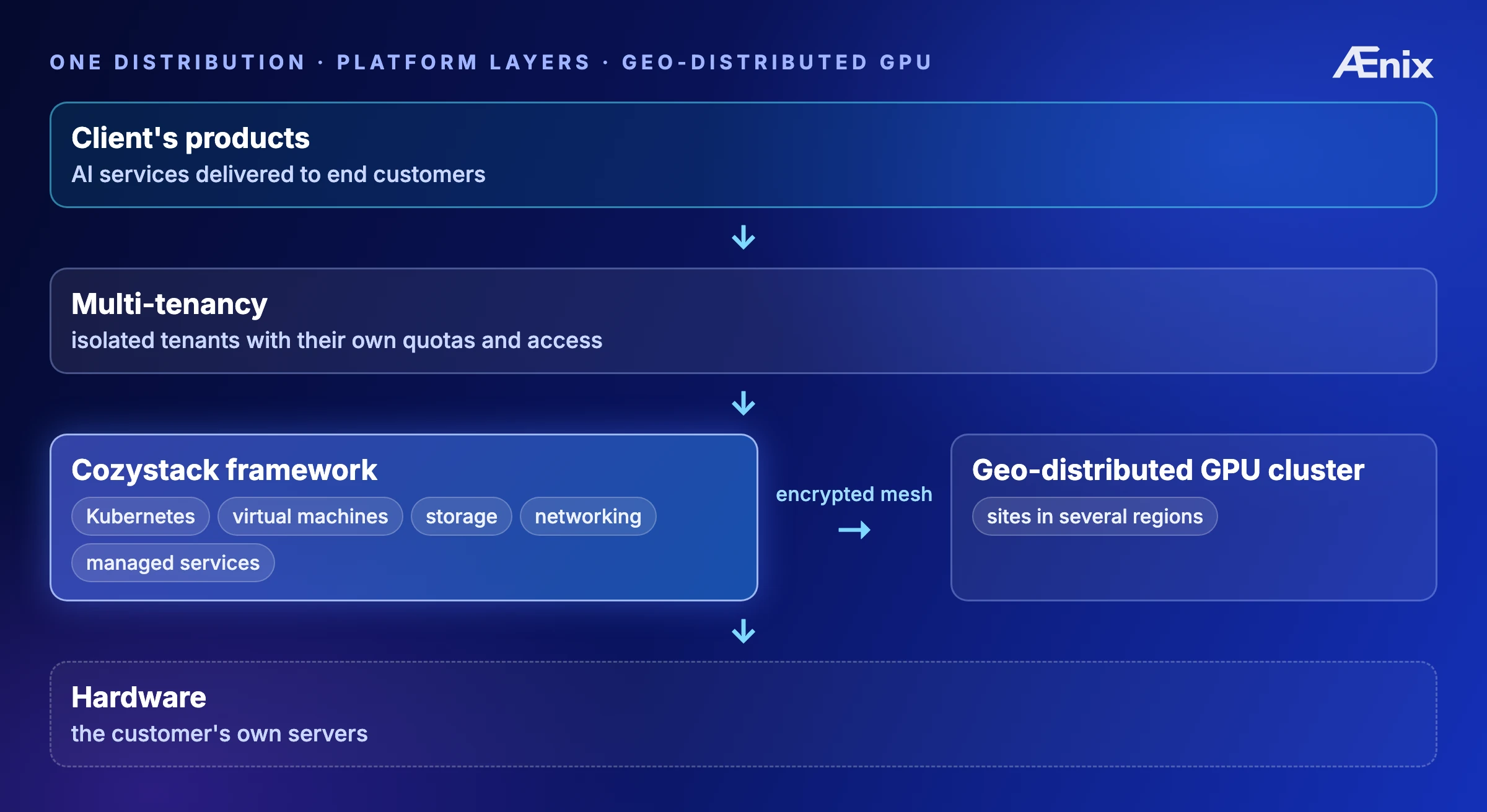
Cozystack here is not a “box” but a framework that already ships storage, networking, virtualization, monitoring and GPU, plus a catalog of managed services. The client builds its products on top. The architecture is layered:
- Hardware — bare metal and the customer’s existing virtualization.
- Cozystack framework — IaaS (LINSTOR, Cilium/Kube-OVN, KubeVirt, GPU passthrough) and a PaaS service catalog.
- Multi-tenancy — a
root → umbrella tenant → dev/staging/prodhierarchy, single sign-on via Keycloak, RBAC, namespace isolation, quotas, unified monitoring. - Client’s products — LLM assistants and internal services, deployed into tenants as code, consuming GPU and the vector DB.
We proposed a phased rollout: first the base infrastructure and catalog, then distributed training and model serving, then full MLOps and a data lake.
Execution: new requirements and how we handled them
- Vector DB for RAG. The client asked for a vector database for document search — we packaged Qdrant as a Cozystack app and deployed it next to the GPU workloads; integration took about a week.
- NVIDIA Dynamo — new development for the client. To use the expensive cards more efficiently, we packaged Dynamo as a full platform package (a dedicated resource in the Cozystack API that the controller renders into a ready inference stack). Dynamo raises GPU utilization through disaggregated inference serving and KV-cache-aware routing across the fleet — with no extra vendor licences.
- Geo-distributed GPU. A powerful GPU node sits in one data centre, the main cluster in another, 12–20 ms apart. We joined the clusters with an encrypted tunnel (WireGuard/Kilo): the GPU node connects to the main cluster’s API, brings up the tunnel and sets routing.
- Single access to models from all tenants. We built a multi-cluster service proxy: a scheduled job syncs the remote GPU cluster’s services and publishes them behind a shared address. Tenants reach the models as ordinary Kubernetes services.
- Self-service for access and networking. We added an intermediate level to the tenant hierarchy (dev → staging → prod via GitLab), expanded the address pool, switched to MetalLB, and scaled resources for heavy analytical queries — all on request.
Worth noting the engineering depth of support: some of the needed fixes (bucket-readiness propagation, a series of TLS fixes for managed services) went straight upstream into the platform.
Results and current state
- A working cluster on Cozystack/Talos: 141 of 141 managed releases in Ready state, all catalog service types available.
- The tenant hierarchy is implemented on GitOps:
root → umbrella tenant → three environments; each with guest Kubernetes clusters and managed databases; shared services (secrets, image registry, backup buckets) at the umbrella level. - A geo-distributed GPU cluster is up with an AI/ML service set (the NVIDIA Dynamo inference stack, LLM gateway, Qdrant vector DB, speech recognition and other RAG-stack services), bridged into the main cluster via the multi-cluster proxy syncing every 5 minutes.
- A demo for top management was prepared and shown: service provisioning and GPU passthrough through the web UI, single sign-on, multi-tenancy — with no YAML or direct cluster access.
- The move to production on the customer’s infrastructure has begun — that “one distribution → deploys at the end customer”.
Roadmap
- Scaling for a large AI-factory project (tens of thousands of GPUs), token-based billing, a front-end and metering on top of the platform.
- Next phases: distributed training and serving (Ray/KServe), then MLOps and a data lake.
- Tenant-level self-service for access, catalog expansion with third-party services, a dev→staging→prod pipeline.
- A long-term service contract and shipping the distribution with the client’s services into the end customer’s boundary.
Why this case matters
Cozystack as a universal installer
The client builds the product; the platform provides one distribution — for in-house SaaS and for the end customer's isolated boundary.
Real AI/ML GPU workloads
A RAG stack and LLM inference with GPU utilization raised via NVIDIA Dynamo, packaged into the platform for the client.
Geo-distribution
Two clusters in different data centres stitched by an encrypted mesh; models available to all tenants as ordinary services.
Speed and customization
Non-standard requirements closed in "a day to a week", with some improvements going upstream into Cozystack.
Discuss a similar project
A 30-minute discovery call is enough to tell whether this architecture fits your estate and what the first step would be.
This case study is published in anonymized form: the integrator and end customer are described by profile, not by name. For a reference call under NDA on an active opportunity, talk to Ænix sales.
Ænix created Cozystack, a CNCF Sandbox project (Incubation application in due diligence) under Apache 2.0, and co-maintains it with maintainers from other companies. On it, Ænix builds three platforms that combine rather than exclude each other: Ænix Public Cloud Platform, Ænix Private Cloud Platform and Ænix AI Platform.