
A fast-growing developer of a mass-market mobile photo/video editing app moved its AI inference off a rented per-hour GPU cloud onto its own bare-metal 8xH100 server — keeping the familiar cloud UX (API, queues, autoscaling, model storage, monitoring) but on hardware it owns and controls. On Cozystack, running on generic Linux/k3s, the platform reached production traffic in about two months and delivers 2-3x better GPU efficiency than the previous rental.
About the project
The client is a fast-growing developer of a mass-market mobile app for creative photo and video editing. Several of its headline features — background removal and replacement, beautification, visual effects — are powered by the company’s own AI models rather than third-party APIs.
Those models ran on a rented public GPU cloud, billed by the hour. As usage grew the rental became expensive and capacity-capped: cost scaled linearly with load, and peak throughput was bounded by what the provider would hand out. The client decided to move inference onto its own bare-metal GPU server, while keeping the “cloud” developer experience its team was used to — an API, task queues, autoscaling, model storage and monitoring.
Goals and objectives
- Repatriate AI inference from a per-hour rented GPU cloud onto an owned bare-metal 8xH100 server, cutting cost and lifting the capacity ceiling.
- Preserve the cloud-native UX: API gateway, task queues, autoscaling, model-weight storage, full monitoring.
- Split responsibilities cleanly: the client writes and owns the ML business logic; Ænix owns architecture, DevOps and 24x7 support of the GPU infrastructure, Kubernetes and monitoring.
- Keep model weights and user data on infrastructure the client controls (data locality).
- No technology lock-in — an explicit, non-negotiable requirement: an all-open-source, CNCF-aligned stack with no proprietary control plane.
Proposed solution
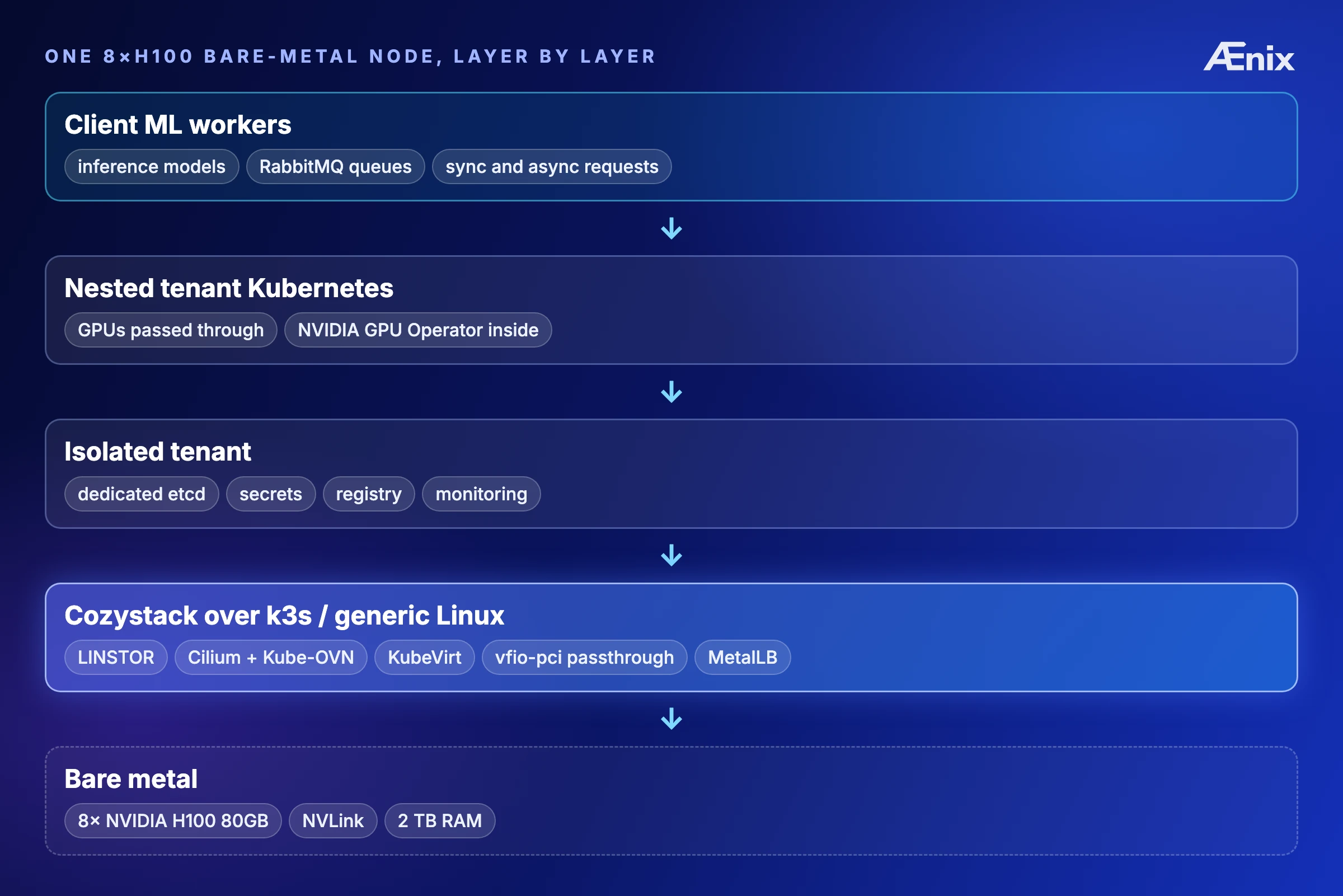
A single 8xH100 server, layered top to bottom, turns owned bare metal into a private GPU cloud with an isolated tenant boundary:
- Client ML workers — the customer’s inference models, queue consumers and synchronous/asynchronous handlers, running as pods inside the tenant.
- Nested Kubernetes (“main”) — the GPUs are passed through to the tenant VM; the NVIDIA GPU Operator runs inside the VM for driver and device management, with ingress in front.
- Isolated tenant — a dedicated etcd, secrets, container registry and monitoring, so the workload never shares a control plane with anyone else.
- Cozystack on k3s / generic Linux — LINSTOR for storage, Cilium + KubeOVN for networking, KubeVirt for virtualization, GPU passthrough via vfio-pci, MetalLB for service publishing.
- Bare metal — 8x NVIDIA H100 80GB with NVLink and 2TB RAM.
Inference runs as two complementary pipelines. Asynchronous: API gateway → RabbitMQ queue → GPU ML workers → webhook callback. Synchronous: HTTP inference endpoints autoscaled with KEDA on nginx-ingress request rate (RPS), using VictoriaMetrics as the metrics source.
Execution: new requirements and how we handled them
- Talos to k3s, without losing manageability. The provider handed over SSH-only access — no console, no IPMI — which makes installing immutable Talos Linux impossible. We built a generic-Linux Cozystack on k3s over Ubuntu instead. The full platform (LINSTOR, Cilium/KubeOVN, KubeVirt, GPU passthrough, monitoring) works identically; nothing was given up.
- GPU passthrough of all eight H100s. Every H100 is handed to the KubeVirt tenant VM via vfio-pci. The classic “nvidia driver vs vfio-pci” race at boot — where the host driver claims a card before vfio can — was solved with an initramfs
driver_override, so the devices land in the VM deterministically. - RWX storage for shared model weights. Many worker pods need the same model weights concurrently. We provided shared read-write-many storage via a CSI wrapper plus NFS-Ganesha; the fix was contributed upstream to Cozystack.
- Traffic-based autoscaling. Synchronous inference workers scale with live demand using KEDA driven by nginx-ingress RPS metrics from VictoriaMetrics. The metrics-path fix that made this reliable also went upstream.
- GPU density. To pack more inference onto each card, we enabled fractional GPU sharing with HAMi, so several jobs share one physical H100.
Results and current state
- In about two months the platform went live: end-to-end QA passed and all production inference traffic moved onto the client’s own cluster, where it has run stably since.
- Both pipelines are in production — asynchronous RabbitMQ jobs with webhook callbacks, and synchronous HTTP inference autoscaled on traffic.
- Grafana and VictoriaMetrics provide monitoring, with centralized logging across the platform.
- The customer runs its ML business logic on infrastructure it owns, at 2-3x the GPU efficiency of the previous per-hour rental, with no proprietary lock-in.
What’s next
- Grow the GPU-server fleet beyond the first node.
- Higher inference density per card: further HAMi tuning, and MIG partitions through the GPU Operator where a workload needs hardware isolation.
- A dedicated Harbor registry for heavy (~100GB) model images.
- Expand self-service on top of the multi-tenancy model.
Why this case matters
Cozystack runs on generic k3s
Not only Talos — an SSH-only host with no IPMI became a full private GPU cloud on k3s over Ubuntu, with nothing lost.
8xH100 NVLink, virtualized and isolated
All eight cards passed through into one isolated tenant via KubeVirt — dedicated etcd, secrets, registry and monitoring per workload.
Real AI inference, two pipelines
Asynchronous RabbitMQ queues plus synchronous HTTP inference autoscaled on live traffic with KEDA and VictoriaMetrics.
Engineering depth that compounds
RWX-storage and metrics fixes went upstream to Cozystack — the platform itself improved over the course of the project.
Discuss a similar project
A 30-minute discovery call is enough to tell whether this architecture fits your estate and what the first step would be.
This case study is published in anonymized form: the customer is described by profile, not by name. A customer reference is available under NDA on request — talk to Ænix sales.
Ænix created Cozystack, a CNCF Sandbox project (Incubation application in due diligence) under Apache 2.0, and co-maintains it with maintainers from other companies. On it, Ænix builds three platforms that combine rather than exclude each other: Ænix Public Cloud Platform, Ænix Private Cloud Platform and Ænix AI Platform.