
A Swiss cloud provider moved off a hypervisor stack and stood up a full commercial public cloud on Cozystack — VMs, managed Kubernetes, databases and GPUs on owned infrastructure, with no hyperscalers. The compute cluster is geo-distributed across three Swiss data centres with synchronous replication; a major 20-hour storage incident during an upgrade was recovered with zero data loss.
About the project
The client is a Swiss cloud provider. Before the project it ran on a hypervisor stack (Harvester) and, historically, on a Jelastic/Virtuozzo legacy — hence the pain with vendor lock-in, licensing and the inability to add features quickly. Before Cozystack it evaluated OpenShift and OpenStack and considered building its own platform — “we didn’t have the bandwidth or the people”.
The goal — a full-fledged commercial public cloud under its own brand: VMs, managed Kubernetes, databases and GPUs, entirely on owned infrastructure, with no hyperscalers. For the Swiss market (public sector, finance) this is about sovereignty: data must stay in-country and be encrypted, and the provider must offer a contractual SLA on top of an open CNCF project. Two delivery formats: a public cloud and an on-prem appliance for large customers (banks, government) with thousands of VMs.
Goals and objectives
- Move off the hypervisor stack entirely and stand up a public cloud on Cozystack.
- An operator model like the big clouds: the admin provisions tenants and sub-tenants (customer → their prod/dev/test) with role separation.
- Managed services: VMs (with custom image/template upload for Windows/Linux), Kubernetes, databases, S3 object storage, GPU.
- Multi-region and resilience: multiple DCs, synchronous replication, tolerance to a node failure and a whole DC.
- Sovereignty and encryption: at-rest volume encryption, encrypted replication and inter-DC traffic, a secured S3, a path to BYOK.
- Transparent billing (by dedicated resources, like the big clouds).
Proposed solution
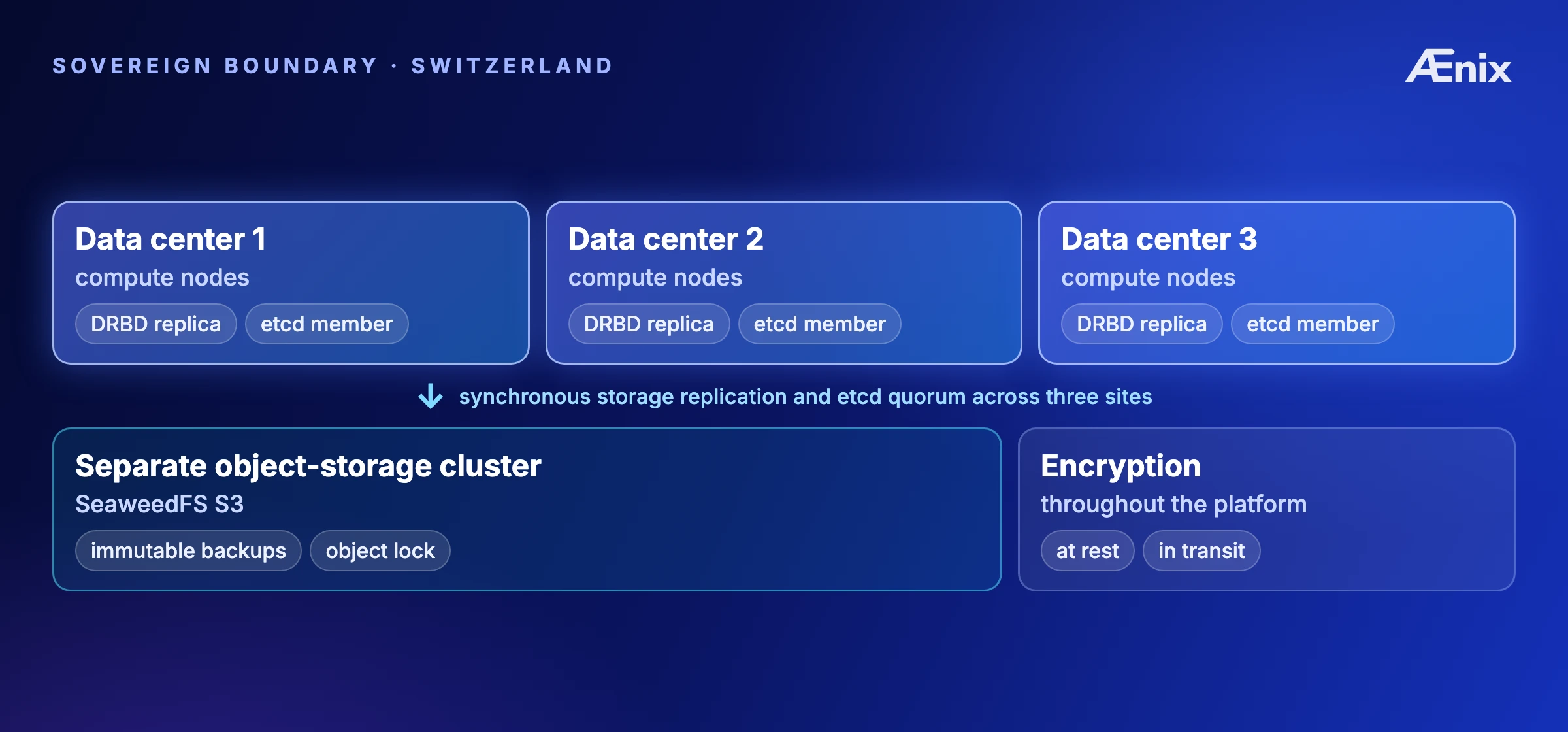
- Compute & services — VMs on KubeVirt, tenant Kubernetes clusters (control plane via Kamaji), managed databases, object storage on SeaweedFS. Two clusters: compute and a separate storage cluster (S3 backend).
- Multi-region — the compute cluster is geo-distributed across three Swiss DCs: synchronous LINSTOR/DRBD volume replication across DCs, geo-distributed etcd, replication factor 3 (one replica per DC).
- Storage — LINSTOR/DRBD on ZFS, four classes (local / replicated × encrypted LUKS, master-passphrase per cluster), BYOK on the roadmap (OpenBao); RWX for tenant clusters via LINSTOR-NFS; for backup buckets — Object Lock and versioning (immutable copies).
- Networking — Kube-OVN + Cilium + MetalLB; VPC, firewall gateways, dual uplinks with policy routing.
- Billing — an in-house system: selling dedicated vCPU/RAM (like the big clouds), hourly metering into an external database.
The engagement grew into ongoing support and co-development: the client’s engineers became Cozystack maintainers.
Execution: new requirements and how we handled them
- Encryption for regulatory requirements. As clients from regulated sectors onboarded, requests appeared: encrypted storage classes, an encrypted S3 endpoint, encrypted DRBD replication and inter-DC traffic. Part shipped, part (bucket encryption, BYOK) is being driven upstream.
- Real DR drills. The client regularly tests resilience “for real” — powering nodes off to see what happens. This surfaced non-obvious cascades (e.g. the network controller’s sensitivity to leader loss). We rolled out backups (Velero at platform and tenant level), tenant-cluster snapshots, and a protection webhook that prevents critical objects (volumes, namespaces, load balancers) from being deleted by accident.
- A major incident — recovered with zero data loss. During a major upgrade, a cascading storage failure hit: a DRBD race, loss of some patches at an intermediate step, network-port exhaustion due to OS defaults, and a breaking change in the network layer. The team worked around the clock for about 20 hours and recovered the cloud with no data loss; the bugs found went upstream (LINSTOR and its CSI driver; the KubeVirt CSI driver).
- Operational maturity. We built a process around it: notify before changes, rehearse upgrades on staging “on the record” then repeat on prod, drop non-declarative commands, AI-assisted incident analysis and ready runbooks (DRBD recovery, Cozystack upgrade).
- Proactive security. For Linux kernel vulnerabilities we sent advance write-ups assessing whether the platform was affected, with mitigations. An external pentest found a cross-tenant listing leak (one tenant could see another’s object list) — fixed.
- A stream of enterprise features on demand. Next-gen GPUs, Windows-VM scheduling with per-node licensing, UEFI/secure boot, guaranteed IOPS, tenant-level network policies, per-tenant OIDC/SSO, golden images and air-gap, white-labeling, CIS hardening.
Results and current state
- The public cloud is in production: VMs, Kubernetes and GPUs are sold, real clients are onboarding (more than a dozen tenants). A public site in three languages, conference participation, talks on the “vendor lock-in → sovereignty → Cozystack” journey.
- The compute cluster is geo-distributed across three Swiss DCs with synchronous cross-DC replication; the architecture is designed to survive the loss of a whole DC.
- Both clusters (compute and storage) are stable after the incidents — recovery with no data loss.
- Billing by dedicated resources (including S3), backups (Velero + immutable buckets) and volume encryption are in operation; the client runs its own Kubernetes-native dashboard and is an active Cozystack co-contributor.
Roadmap
- BYOK and bucket encryption (sponsoring the upstream work), per-tenant OIDC/SSO and network policies.
- Guaranteed IOPS and next-generation block storage; moving service announcement from MetalLB to Cilium BGP.
- Expanding the DC footprint; sub-tenant billing; GPU inference as a service; moving the image registry to a separate cluster.
Why this case matters
A full sovereign public cloud on bare metal
Migration off a hypervisor to Cozystack and a commercial cloud on Talos, with no hyperscalers.
Multi-region resilience
Three geographically separated DCs, synchronous cross-DC replication and geo-distributed etcd; designed to survive the loss of a whole DC.
A 20-hour incident, zero data loss
A transparent post-mortem and fixes pushed upstream — this is what holding an SLA on the client's production looks like.
A mature enterprise set
At-rest/in-transit encryption, per-tenant SSO and network policies, Windows licensing, performance guarantees, instance-type billing.
Discuss a similar project
A 30-minute discovery call is enough to tell whether this architecture fits your estate and what the first step would be.
This case study is published in anonymized form: the provider is described by profile, not by name. For a reference call under NDA on an active opportunity, talk to Ænix sales.
Ænix created Cozystack, a CNCF Sandbox project (Incubation application in due diligence) under Apache 2.0, and co-maintains it with maintainers from other companies. On it, Ænix builds three platforms that combine rather than exclude each other: Ænix Public Cloud Platform, Ænix Private Cloud Platform and Ænix AI Platform.