
A modern alternative to OpenStack for everyone who sells cloud — from a regional hoster with forty nodes to a national operator with several data centres. A complete public-cloud product for hosting providers: hosting panel, billing, customer portal, payments, support. Install, plug in users, start operating.
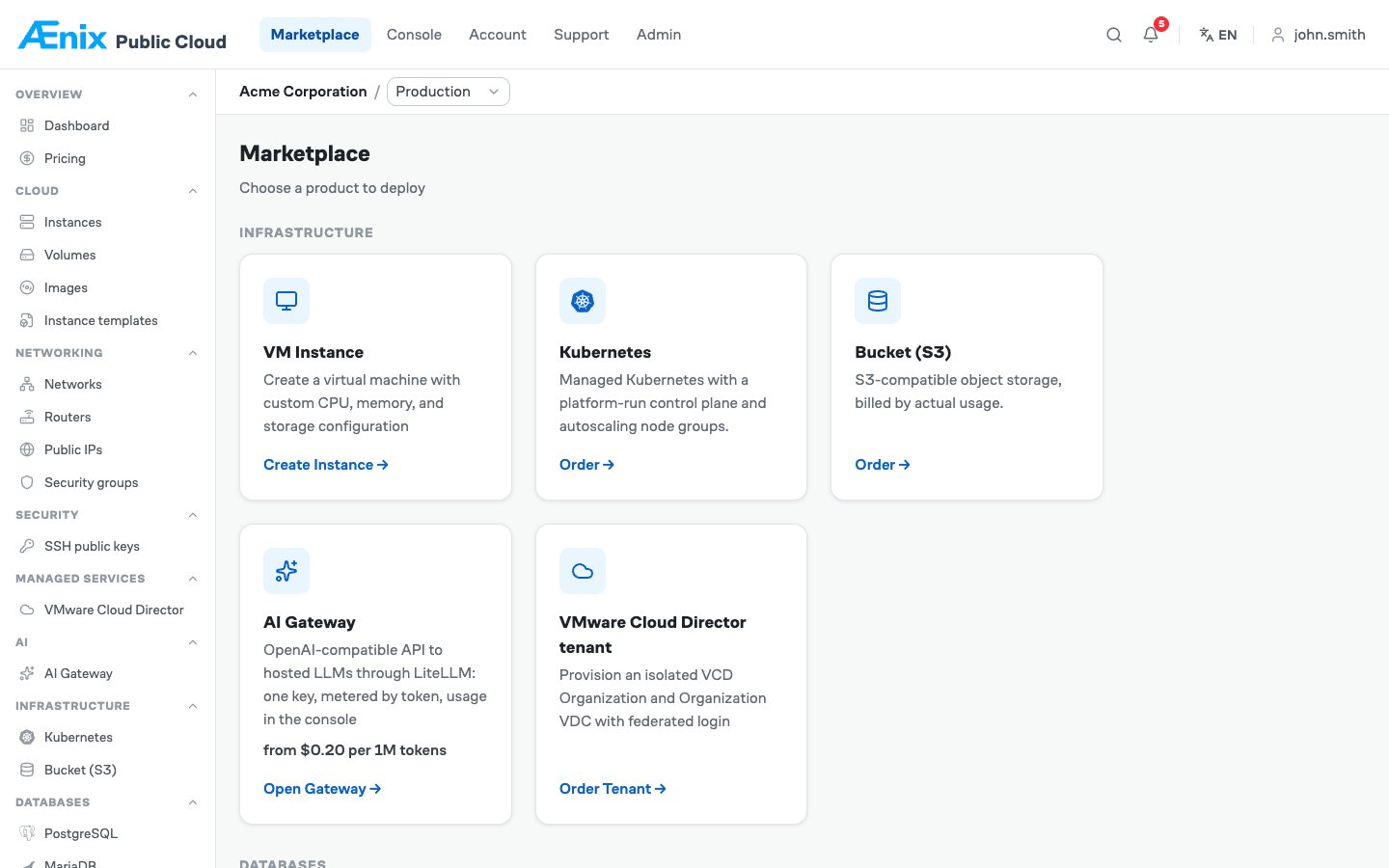
The live demo runs in your browser on demo data: the customer portal (marketplace, console, account, support) and, behind the Admin switch, the operator back-office with clients, verification, invoices and resource pricing. No signup, no cluster.
One platform, two ends of the same scale
A regional hoster with forty nodes and a national operator with several data centres are in the same business: you sell capacity to someone who is not you, so you need billing, a customer-facing portal, tenant isolation you can defend under audit, and payments that reconcile. That is one product, not two. The difference is how much of it is switched on.
| Provider scale | National / operator scale | |
|---|---|---|
| Who | Hosting providers, MSPs, regional clouds, data centres | Telcos, national operators, banks running a commercial cloud, large public clouds |
| Regions | One or a few sites | Multi-region control plane; workload placement and policy across regions |
| Billing | WHMCS-integrated, Stripe and regional processors | Full billing back-end plus your own front-end, custom payment integrations |
| Existing estate | Migrate off it | Run alongside it — a single portal and API over existing estates while you migrate |
| Onboarding | Productized installer, live in weeks once hardware is ready | 3-6 month pilot, then 9-18 months to full multi-region |
| Bought as | Published price list, from $1,250 / month per 10 nodes | Multi-year programme, quoted per RFP |
The technology underneath is identical, which is the point: a provider that grows into the right-hand column does not replatform. It turns on multi-region and keeps its portal, its billing and its tenants.
What’s included
Full billing — back-end and front-end
Usage metering, invoicing, payment processing. Stripe, regional payment providers and B2B invoicing. Not API hooks you finish yourself — an actual production billing surface, with multi-currency and multi-jurisdiction support at operator scale, and pre-paid balance, post-paid invoicing, channel-partner billing and reseller margin handling.
WHMCS integration
A production-ready module with billing templates for the panel you already run. Two integration modes: WHMCS as the customer-facing front, or Cozystack Dashboard as the front with WHMCS as the billing back-end. Full usage data tracked and stored behind a documented API. More on the WHMCS integration →
Hosting panel and customer portal
An admin back-office for the operator, plus a customer-facing console (Cozystack Dashboard with your branding; white-labeling is an open-source Cozystack feature, and support for configuring it is included from the Standard tier) with self-service registration, profiles, team management and support ticketing.
Service-creation wizards
Guided flows for VMs, Kubernetes clusters, managed databases (PostgreSQL, MariaDB, Valkey, Kafka, ClickHouse, RabbitMQ, NATS), S3-compatible object storage and GPU workloads. No YAML required from end customers.
Tenant lock and suspension
Tenant lifecycle controls built in — automatic suspension of overdue accounts, resource blocking, lock for security review. No engineering ticket to suspend a non-paying tenant.
Multi-hypervisor control plane
Orchestrates native KubeVirt VMs and runs alongside existing VMware, OpenStack, OpenNebula and OpenShift infrastructure during migration. Storage-class compatibility with shared SAN, S3-compatible and on-premise block storage; network integration with existing fabrics over BGP, OVN and Cilium.
Multi-region
Native multi-region orchestration: workload placement, identity, network and storage policy enforced across regions. A tenant can live in one region or span several.
Service catalogue beyond VMs
Managed PostgreSQL (CloudNativePG), MariaDB, Valkey, Kafka, ClickHouse, RabbitMQ, NATS, MongoDB, OpenSearch and Qdrant; S3 storage (SeaweedFS); HTTP cache; VPN service; GPU workloads.
Migration tooling and expertise
Built-in VM migration tooling and runbooks for moving off VMware, OpenStack, Virtuozzo and OpenNebula. Migration is guided by Ænix on the Plus tier and managed by Ænix on Enterprise; on the other tiers it is quoted as a service. Migration guides →
What the subscription includes
A subscription is a support tier plus the proprietary Ænix commercial modules (billing system and WHMCS integration), priced per 10 physical nodes per month: Basic $1,250, Standard $3,000, Plus $5,500 on annual billing, Enterprise custom. A team running Cozystack itself buys the same subscription as enterprise support for self-run Cozystack and can simply leave the commercial modules unused. Platform installation is included from Standard, 24×7 support from Plus. If the subscription ends, the open-source Cozystack platform keeps running on your hardware; the commercial modules and Ænix support stop. Full tier comparison →
Why providers choose this over OpenStack
| Dimension | OpenStack | Ænix Public Cloud Platform |
|---|---|---|
| Time to production | 6+ months typical | Weeks |
| Per-node operations effort | About twice Cozystack’s when self-managed (TCO model) | The baseline in the same model |
| Service catalogue | DIY beyond core compute / storage / network | Built-in: Kubernetes, databases, S3, GPU, cache, VPN |
| Customer-facing portal | DIY | Cozystack Dashboard with your branding |
| Billing | DIY integration | WHMCS-native, Stripe and regional providers |
| Multi-tenancy | Project model — limited | Tenants with quotas, RBAC and observability per tenant |
| Migration from VMware | Heavy lift | Built-in migration tooling plus Ænix delivery |
| Vendor support | Community plus add-ons | Ænix support tiers from $1,250 per 10 nodes per month |
| Upgrade cadence | Manual | GitOps-managed platform releases |
And versus the VPS control panels
Most small and mid-size providers are not running OpenStack at all. They run Virtualizor, SolusVM, Proxmox with a billing bolt-on, or a panel written in-house. Those tools do one job well: sell and provision VPS.
| Dimension | Virtualizor / SolusVM class | Ænix Public Cloud Platform |
|---|---|---|
| Product catalogue | VPS, and variations on VPS | VMs plus managed Kubernetes, PostgreSQL, MariaDB, ClickHouse, Kafka, RabbitMQ, Valkey, S3, GPU |
| Where the margin is | Reselling capacity, competing on price per vCPU | Managed services on the same hardware, priced per service |
| Tenancy model | An account owning VMs | Tenants with quotas, RBAC, network isolation, per-tenant observability and billing |
| Kubernetes for customers | Not offered, or a separate product to operate | Native, with a managed control plane per tenant |
| Upgrades | Panel upgrade and hypervisor upgrade, both manual | One GitOps-managed platform version |
| Lock-in | Proprietary panel, per-VM licence | Apache 2.0 core; you can drop the commercial layer and stay on plain Cozystack |
The honest read: if VPS resale is your whole business and the margin satisfies you, a panel is cheaper and simpler — keep it. This platform pays for itself when you want to sell managed services, databases, Kubernetes and GPU without building each one yourself.
Combine it with the other platforms
The three Ænix platforms are the same engine with different surfaces switched on, so they compose rather than compete. Nothing here is a separate installation.
- AI Platform — multi-tenant GPU scheduling, fractional GPU sharing, model serving, vector databases. Providers sell this as GPU-as-a-Service on the hardware they already have.
- Private Cloud Platform — DORA- and NIS2-aligned architecture, encryption and audit logging designed for your regulator. Relevant when you are a regulated entity yourself, or when you run internal workloads next to the ones you sell.
A telco selling a sovereign cloud product while running its own regulated internal estate takes both, on one platform, under one operations team.
Who buys it
| Buyer | Typical engagement |
|---|---|
| Hosting provider, MSP, regional cloud | Productized installer, live in weeks once hardware is ready, from the price list |
| Data centre adding cloud services | Migration from VMware or Virtuozzo, then service catalogue expansion |
| Large public-cloud operator | New cloud product launch or multi-region scale-up |
| Large telco or national operator | Customer-facing sovereign cloud product, often regional plus edge |
Production customers
Providers running Ænix Public Cloud Platform include GoHost.kz, HDReady, Beby Cloud, HiKube, UseTech, Cloupard, Cloudsy, delivering multi-tenant cloud products across the EU, DACH, Central Asia and other regions.
One commercial public cloud built on this platform is written up in detail: a Swiss provider running three data centres with synchronous cross-DC replication and GPU in production.
Engagement structure
- Discovery call (30 minutes, free) — confirm fit
- Platform Readiness Assessment (14 or 28 days, fixed price) — current-state and target architecture, migration roadmap, risk register
- Pilot (3-6 months, operator scale) — one region, one tenant cohort, one product line
- Build — live in weeks at provider scale once the hardware is ready, via the productized installer; 9-18 months to full multi-region production for operator-scale programmes
- Managed operations (optional) — Ænix runs the control plane under SLA
Platform Readiness Assessment →
How to start
Tell us your scale, your current stack and what you sell today — we reply by email and set up a focused call with an Ænix engineer to confirm fit. Or book a 30-minute call in the calendar right away.
Form not loading? Email [email protected].
Prefer to start with numbers? Model your margins in the hosting-provider unit economics calculator. The recorded webinar Add Kubernetes, databases and GPU to your price list walks through the catalogue, billing and migration path.