
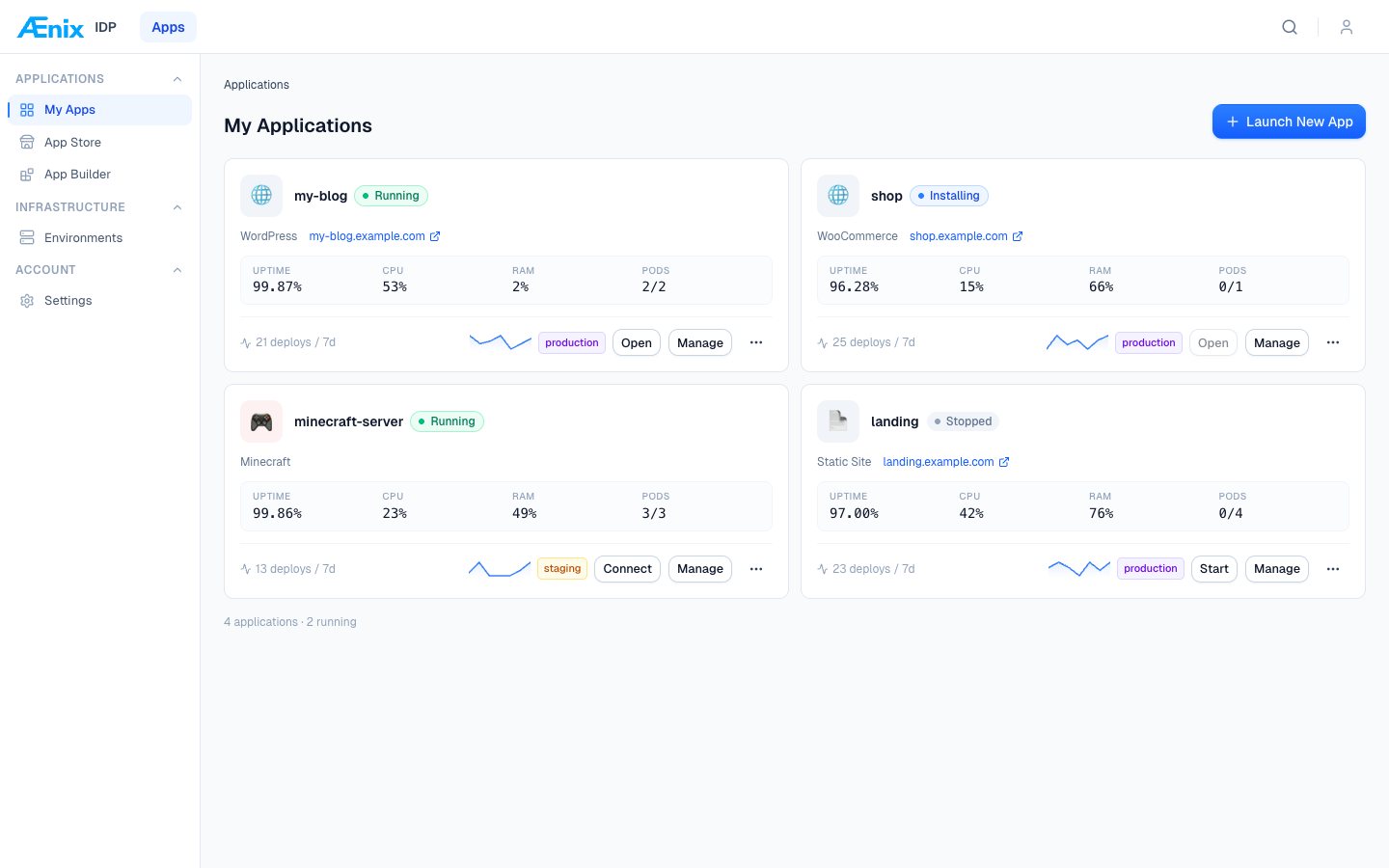
A private cloud platform is the software that turns hardware you own into self-service cloud — compute, storage, networking, multi-tenancy, managed data services and a provisioning surface, under your own governance. This page explains what the category has to provide, and how the open-source Kubernetes-native option compares with VMware Cloud Foundation, OpenStack and OpenShift Virtualization.
The open-source reference implementation here is Cozystack — a CNCF Sandbox project under Apache 2.0, created by Ænix and co-maintained with maintainers from other companies; nine production deployments are written up as case studies.
Buying rather than learning? The supported commercial version for a regulated estate is Ænix Private Cloud Platform — architecture, build, support and pricing are on the product page. Heads of infrastructure can start with the infrastructure guide.
Who runs a private cloud platform
- Service providers — operating multi-tenant cloud products for enterprise customers
- Banks and insurers — regulated workloads under DORA / sectoral compliance
- Telecom operators — sovereign-cloud product launches
- AI / GPU operators — sustained-utilization GPU workloads where hyperscaler economics don’t fit
- Public-sector and quasi-public — sovereignty-mandated infrastructure under procurement rules
- Enterprise platform teams — internal developer platforms with multi-BU isolation
What a private cloud platform has to provide
1. Compute — VMs and containers on one platform KubeVirt for VMs (KVM-based with live migration, snapshots, templates) plus Kubernetes containers, side by side. No separate VM platform; no separate container platform.
2. Storage — replicated block + S3 object storage LINSTOR (DRBD) for replicated block storage at scale; SeaweedFS for S3-compatible object storage used by applications and backups.
3. Networking — eBPF-native Cilium as the CNI: L4/L7 policies, observability, MetalLB integration, BGP fabric support. NSX-equivalent functionality without NSX licensing.
4. Multi-tenant control plane Tenant CRD model with nested tenants, per-tenant quotas, RBAC, audit. Suitable for service-provider model (multi-customer) or enterprise multi-BU.
5. Managed data services PostgreSQL (CloudNativePG), MariaDB, MongoDB, ClickHouse, Valkey, OpenSearch, Kafka, NATS, RabbitMQ and Qdrant — provisioned as first-class platform services, not bolted-on Helm charts.
6. GPUs NVIDIA data-centre GPUs through the NVIDIA GPU Operator: whole-GPU passthrough to VMs, NVIDIA vGPU for VMs (requires your NVIDIA vGPU licence), whole GPUs to pods via the device plugin, MIG partitions on MIG-capable cards, and time-sliced sharing for pods via HAMi.
7. Observability VictoriaMetrics + VictoriaLogs included — low-overhead, sovereignty-friendly. Optional Grafana on top.
8. Backup and DR Velero + S3 + per-database PITR for managed services. Backups should go to object storage outside the cluster they protect. There is no automated cross-site VM failover; multi-site designs are engineering work. Within a site, VMs move by live migration when a node is drained for maintenance. After an unplanned node loss they restart on healthy nodes once the failed node is fenced, a single operator action or an external fencing mechanism, because Cozystack ships no automatic fencing; worker nodes of tenant Kubernetes clusters are replaced automatically.
9. Self-service portal and billing Cozystack Dashboard for service provisioning. Operators that bill tenants add the WHMCS integration, a proprietary Ænix module that is not part of open-source Cozystack.
How the options compare
| VMware (VCF) | OpenStack | OpenShift Virtualization | Cozystack | |
|---|---|---|---|---|
| Licence | Subscription only | Apache 2.0 | Red Hat commercial | Apache 2.0 |
| Compute | vSphere + ESXi | Nova + KVM | KubeVirt | KubeVirt |
| Multi-tenancy | vCloud Director | Keystone projects | Namespaces | Tenant CRD (Kubernetes-native) |
| Managed databases | Limited | DBaaS optional | Available | First-class |
| Self-service portal | vCD | Horizon | Console | Cozystack Dashboard |
| Operational footprint | Heavy (VCF) | Heavy (OpenStack) | Medium (OpenShift) | Light (Kubernetes-native, single platform) |
| Vendor relationship | Closed source US vendor | Foundation, vendor distros | Red Hat | Open source, no vendor lock-in |
| Best for | Existing VMware | Large telco / OpenStack-fluent teams | Existing Red Hat customers | Service providers, regulated multi-tenant, sovereign cloud |
How to start
Two paths:
- Self-deploy — Cozystack is open source. Architecture, install and operations documentation: cozystack.io. Community support in #cozystack on Kubernetes Slack and on Telegram.
- Buy the supported product — Ænix Private Cloud Platform adds an architecture built to support DORA and NIS2 work, multi-DC designs and runbooks, opt-in volume encryption with key handling designed with you, audit logging with configurable retention, SLA-backed support and developer self-service. Delivery runs through private cloud consulting.
For sovereignty / DORA / repatriation / AI-specific motivations, the relevant solution pages:
Companies running platforms built with Ænix






Hosting providers running Ænix Public Cloud Platform in production
Hosting providers running Ænix Public Cloud Platform in production. Regulated, telecom and GPU deployments are written up in anonymised form on the case studies page.
"Running Nuvolos on sovereign bare metal meant we needed hyperscaler-grade multi-tenancy without the hyperscaler. Cozystack delivered exactly that — isolated tenants, shared GPUs, KubeVirt for legacy workloads — and it's why we can promise our customers infrastructure control, not just a workspace."
 Alexandru PopescuCEO, Nuvolos



What it costs
Cozystack itself is open source under Apache 2.0 and free to run: no per-CPU, per-VM or per-core meter. The real cost of a private cloud platform is hardware plus the platform team that operates it — which is what an assessment sizes.
Ænix sells two things on top: subscription support for organisations running Cozystack themselves, from $1,250 per 10 nodes per month on the published price list, and Ænix Private Cloud Platform as a programme for regulated estates, quoted per RFP. Both are on the pricing page.
Get started
Or:
- Ænix Private Cloud Platform — the supported product for regulated estates
- cozystack.io — install and documentation
- Private cloud consulting — engineering services
- Platform Readiness Assessment — assessment methodology
- Private cloud providers comparison — full guide
Ænix created Cozystack (CNCF Sandbox project, CNCF Certified Kubernetes distribution, OpenSSF Best Practices) and co-maintains it. Ænix sells three platforms on that engine — Public Cloud Platform, Private Cloud Platform and AI Platform.